

 Nihonga
 104.0 x 34.0 cm
スピーディーな制作と多彩な仕上げオプションが魅力の、ミュージアムクオリティなジークレー・キャンバスプリント。 ( 手描きの複製画を注文する デジタル画像販売へ切り替え)
作品のオリジナル比率に合わせた、当店の規定サイズからお選びください。

特定のフレームやスペースに合わせて、ご自身でサイズを指定することも可能です。選択されたサイズが元の画像の比率と一致しない場合、作品をトリミングするか、鏡面反射または単色での塗りつぶしによって画像を拡張いたします。制作を開始する前に、ご確認用のデジタルモックアップをお送りいたします。
画面上のプレビューには、実際のトリミングや拡張は反映されませんのでご注意ください。最終的な構図を正確に確認できるのは、モックアップのみとなります。
カスタムサイズも承っておりますが、元の比率を維持するためには、あらかじめ用意されたリストからサイズを選択することをお勧めいたします。

Sparrow Hovering
複製画サイズ一覧

In the heart of Kyoto’s vibrant textile district, a legacy was born that would forever alter the trajectory of Japanese painting. Takeuchi Tsunekichi, known to the world by his artistic name Takeuchi Seihō, emerged from the Meiji era not merely as a painter, but as a bridge between two worlds. His journey began amidst the rhythmic looms and intricate patterns of his family’s restaurant and textile connections, an upbringing that instilled in him a profound sensitivity to texture, color, and form. As he transitioned from a student of Chinese literature and temple arts to a dedicated pupil of the renowned Kōno Bairei, Seihō began to master the Shijō school's essence—a style defined by its delicate realism and an almost spiritual connection to the natural world.
The evolution of Seihō’s artistry is a testament to his courage in the face of cultural transformation. While many of his contemporaries clung strictly to the traditions of the past, Seihō looked toward the horizon. His pivotal journey to Paris during the 1900 Exposition Universelle served as a transformative encounter with the avant-garde. Immersed in the atmospheric light of Impressionism and the dreamlike depths of Symbolism, he returned to Japan with a vision that was uniquely his own. He did not abandon the traditional Nihonga techniques; instead, he breathed new life into them by synthesizing the meticulous brushwork of Japanese masters with the luminous, spatial depth found in the works of Western legends like Turner and Corot.
The true brilliance of Seihō lies in his ability to capture the ephemeral soul of nature through a sophisticated technical duality. His work often oscillates between the minimalist tranquility of sumi-e ink wash and a robust, textured realism. In masterpieces such as "Sparrow Hovering," one can witness the breathtaking simplicity of Japanese aesthetics, where every stroke of ink conveys a sense of weightless motion and profound stillness. Conversely, his larger landscapes and seascapes demonstrate a mastery of light and atmosphere that feels remarkably modern, utilizing subtle gradations to evoke the salt spray of a "Seascape" or the shifting mists of a mountain morning.
His subject matter—ranging from the intimate details of small animals to the sweeping grandeur of the Japanese landscape—serves as a canvas for his exploration of life's fleeting moments. Through his brush, the following elements often converge:
Takeuchi Seihō’s impact on the art world extends far beyond the borders of Japan. By successfully navigating the tension between the preservation of heritage and the necessity of innovation, he provided a blueprint for modern Japanese art. He proved that tradition is not a static relic to be guarded, but a living, breathing entity capable of absorbing new influences without losing its fundamental identity. His life, spanning the transformative Meiji and early Shōwa periods, mirrors the very evolution of Japan itself—a nation moving from isolation into a complex, interconnected global stage.
Today, his works remain cherished symbols of cultural synthesis. To view a Seihō painting is to experience a moment of profound equilibrium: the stillness of ancient Kyoto meeting the dynamic energy of a modernizing world. He remains a titan of Nihonga, an artist whose name continues to evoke the delicate balance of light, line, and the eternal beauty of the natural world.

1864 - 1942 , Japan
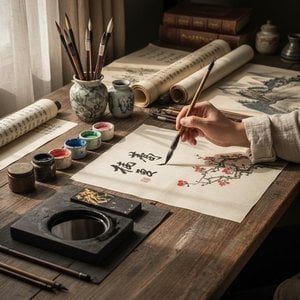
Embark on a sophisticated exploration of ink wash painting and Sumi-e. Uncover the profound historical lineages, Zen philosophies, and technical mastery behind this timeless medium in our authoritative guide for fine art enthusiasts.

Explore the profound beauty of Japanese Ukiyo-e art. Discover the legacy of Hokusai and the Utagawa school through an expert exploration of Edo-period aesthetics, seasonal motifs, and the enduring global influence of Japan's 'Floating World' on fine art history.

Embark on a journey through the ephemeral beauty of Ukiyo-e. Explore the profound mastery of Japanese woodblock prints, from Hokusai to the masters of the Edo period. Discover museum-quality reproductions and bespoke commissions curated for the discerning global collector.

Explore the ephemeral beauty of Japanese Ukiyo-e art. From the dynamic warriors of Kuniyoshi to serene landscapes, discover the profound history, masterful techniques, and global influence of these iconic woodblock prints in our deep cultural retrospective.

 設置イメージを確認
 送る
送る シェア
シェア
 詳細情報
詳細情報 ガイドを表示

 画像をダウンロード
 似ている作品
 X線調査
X線調査 スライドショー
 統計情報
統計情報 続きを読む
続きを読む






































 ガラスオプションは、110cm未満のサイズでのみご利用いただけます。


