
当社のアーティストが、お客様のご希望のサイズと額縁に合わせて、キャンバスに手描きで制作する油彩画です。 ( プリント版に切り替え デジタル画像販売へ切り替え)





























作品のオリジナル比率に合わせた、当店の規定サイズからお選びください。

特定のフレームやスペースに合わせて、ご希望のサイズをご入力いただけます。選択されたサイズが元の画像の比率と異なる場合、アートワークをトリミングするか、手描きで要素を追加して絵画を拡張いたします。デジタルモックアップ を制作し、制作開始前にご確認(承認)をいただきます。
画面上のプレビューは、実際のトリミングや拡張を正確に反映しているものではありません。最終的な構図は、モックアップによってのみ正確にご確認いただけます。
カスタムサイズもご利用いただけますが、元の比率を維持するためには、あらかじめ用意されたリストからサイズを選択することをお勧めいたします。

Untitled
複製画のサイズ

Stela Barbieri is far more than a singular painter; she is a weaver of stories, an educator, and a multidisciplinary force whose work exists at the intersection of visual art, literature, and sound. Born in Arara-quara, Brazil, in 1965, her creative essence is deeply rooted in the concept of the "living atelier." Her professional journey is not a linear path but rather a spiral, where her experiences as an author, composer, and curator feed into her visual practice. This interconnectedness allows her to approach the canvas not merely as a surface for pigment, but as a space for pedagogical invention and poetic reflection. Through her leadership of Bináh Espaço de Artes, she has cultivated an environment where art is not just observed but lived, much like the cherished memories of her childhood spent in the vibrant, storytelling atmosphere of her family's gardens.
The evolution of Barbieri’s work is marked by a profound commitment to the transformative power of creativity. Her artistic practice has expanded across various media, from the delicate precision of gouache and collage to large-scale installations and musical compositions. In her visual works, one often finds a dialogue between the ephemeral and the permanent, utilizing textures that invite tactile contemplation. Her history as an educator—having served as the educational director at the Instituto Tomie Ohtake and an educational curator for the São Paulo Biennial Foundation—deeply informs her aesthetic. She views art as a tool for discovery, a sentiment reflected in her numerous exhibitions that often invite public participation, blurring the boundaries between the creator and the observer.
To engage with Barbieri’s oeuvre is to enter a world where different forms of expression coalesce into a singular atmospheric experience. Her work as an author of over thirty books for children and young adults provides a literary foundation that mirrors the narrative depth found in her visual art. There is a rhythmic quality to her compositions, a cadence that suggests the influence of her musical endeavors, such as her recent musical album, Canoa. This auditory dimension complements her visual language, creating a sensory landscape where light, color, and sound perform a delicate dance.
Her technical mastery is particularly evident in her ability to manipulate medium and material to evoke specific emotional states:
The historical significance of Stela Barbieri lies in her ability to bridge the gap between high art and community engagement. Her career has been defined by a refusal to isolate art within the sterile confines of a gallery; instead, she brings it into the realms of education, literature, and daily life. By serving on prestigious boards such as the Pinacoteca do Estado de São Paulo and the Calouste Gulbenkian Foundation, she has helped shape the institutional landscape of contemporary art in Brazil while maintaining a grassroots connection to the act of storytelling.
Ultimately, Barbieri’s work serves as an invitation to a state of constant becoming. Whether through the quiet resonance of a landscape or the complex layers of a multimedia installation, her art remains a testament to the enduring power of curiosity. She reminds us that the artist is not merely a maker of objects, but a curator of experiences, a guardian of stories, and a guide through the infinite possibilities of the human imagination.

Italy

Journey through Wassily Kandinsky's 25 most iconic abstract paintings. Explore his revolutionary use of color, form & spiritual expressionism. Find museum-quality Kandinsky reproductions and elevate your home decor with WahooArt.com. Discover all masterpieces on WahooArt.com!

マーク・ロスコの傑作25選。抽象表現主義を代表する巨匠、色彩が織りなす深遠な世界を探求します。絵画の背景や技法、感動的なストーリーを紐解き、WahooArtで高品質なアートプリントをお楽しみください。リビングやオフィスにモダンアートを飾るなら!

抽象表現主義を定義する10の傑作。ポロック、ロスコら巨匠たちの情熱と色彩の世界へ。各作品に込められた物語と技法を紐解き、至高のアート体験を。WahooArt.comで、ミュージアムクオリティの複製画や洗練されたインテリアアイデアを発見してください。
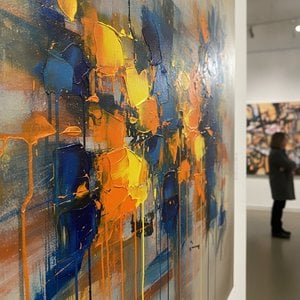
Master the high-impact world of contemporary abstraction. Discover how bold colors, textures, and modern movements like Abstract Expressionism can transform your space with premium, high-energy art curated for the design-conscious professional.

モンドリアン、マレーヴィチ…幾何学的抽象絵画を代表する傑作10選。各作品の背景や色彩構成、アーティストの情熱に迫ります。美術館品質の複製画はWahooArt.comで。オンラインでアートコレクションをご覧ください。


 プレビュー
プレビュー
 シェアする
シェアする シェアする
シェアする
 詳細を見る
詳細を見る ガイド
ガイド

 ダウンロード
 似ている作品
 X線調査
X線調査 スライドショー
 統計情報
統計情報


 詳細を見る
詳細を見る









 ガラスオプションは、110cm未満のサイズでのみご利用いただけます。


