The Luminous Geometry of Silviu Oravitzan
Born in the quiet village of Ciclova-Montană, Romania, in 1941, Silviu Oravitzan emerged as a profound and singular voice within the landscape of Romanian Neo-Orthodox art. His journey is not merely one of personal development but a spiritual odyssey that seeks to bridge the gap between the ancient traditions of the East and the avant-garde movements of the West. Growing up in the Caraș-Severin region, Oravical's early life was shaped by a deep connection to his cultural roots, yet his intellectual curiosity eventually led him far beyond the borders of his homeland. Through extensive travels across Greece, Italy, France, Germany, and Austria, he absorbed a diverse palette of European influences, which he would later distill into a highly personal language of geometric abstraction.
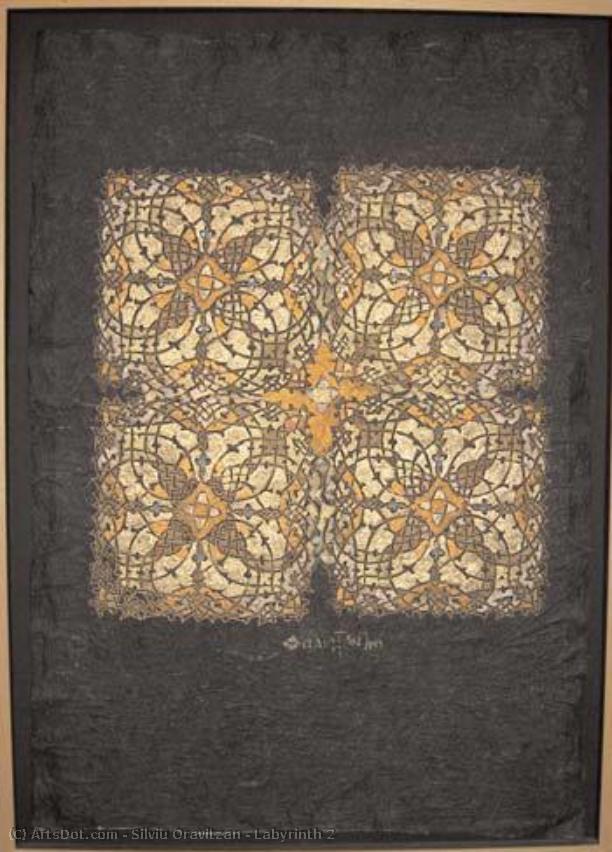
Oravitzan’s work is characterized by an intense preoccupation with what he calls the primordial light. This is not a mere fascination with luminosity in the physical sense, but a theological pursuit to capture the very essence of divine presence through pigment and form. His canvases often function as windows into a spiritual dimension, where intricate grids and rhythmic patterns serve as conduits for transcendence. By utilizing the visual vocabulary of Byzantine iconography—the structured, symbolic, and eternal—he translates the profound mysteries of Orthodox Christian spirituality into a modern, abstract dialect. In his hands, the rigid geometry of a square or a line becomes a vessel for the infinite, inviting the viewer to move past the material surface and encounter a sense of sacred stillness.
A Legacy of Artistic Integrity and Controversy
The trajectory of Oravitzan’s career was marked by both immense creative breakthroughs and significant social friction. He rose to prominence during a period of intense debate regarding the direction of Romanian art following the shifts of 1989, positioning himself as an uncompromising advocate for genuine expression against the tide of simplistic cultural interpretations. His commitment to his vision often placed him at odds with the established art circles of his time; most notably, his 1985 solo exhibition at the Dalles Hall in Bucharest became a flashpoint of controversy. The exhibition faced vehement opposition and subsequent closure, yet such setbacks only served to solidify his reputation as an artist who refused to sacrifice artistic integrity for social or political ease.
Beyond the canvas, Oravitzan’s contributions to the intellectual life of Romania were equally significant. His dedication to exploring the intersections of faith and culture led him to engage deeply with the Romanian Institute for Inter-Orthodox, Interconfessional and Interreligious Studies between 2005 and 2015. This period of scholarly and spiritual inquiry mirrored the themes found in his paintings, reinforcing the idea that his art was an extension of a much larger, lived philosophy. His life’s work remains a testament to the power of Neo-Orthodoxism—a movement that does not look backward with nostalgia, but forward, using the ancient echoes of the past to illuminate the complexities of the modern soul.
The enduring significance of Silviu Oravitzan can be summarized through several key pillars of his contribution to art history:
- Synthesis of Traditions: The seamless integration of Byzantine iconographic principles with contemporary geometric abstraction.
- Spiritual Innovation: The development of a unique aesthetic language designed to evoke the theological concept of divine light.
- Cultural Resilience: A career defined by the courage to maintain artistic autonomy amidst political and institutional pressure.
- Global Perspective: An enriched artistic vocabulary derived from a deep engagement with the diverse cultural landscapes of Europe.



 プレビュー
プレビュー
 手描きの絵画を購入
 シェアする
シェアする シェアする
シェアする
 詳細を見る
詳細を見る

 ダウンロード
 似ている作品
 X線調査
X線調査 スライドショー

 詳細を見る
詳細を見る






































 ガラスオプションは、110cm未満のサイズでのみご利用いただけます。





