A Symphony of Geometry: Exploring Piet Mondrian’s *Tableau no. 2 Composition no. V*
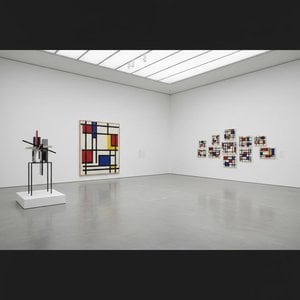
Piet Mondrian's *Tableau no. 2 Composition no. V*, a monumental work from 1914, isn’t merely a painting; it’s an architectural meditation rendered in pigment and line. This piece, currently available as a meticulously crafted hand-painted reproduction on WahooArt.com, embodies the core tenets of Neoplasticism – Mondrian's radical pursuit of universal harmony through pure abstraction. The canvas explodes with a deceptively simple palette: a vibrant yellow field punctuated by precisely delineated rectangles in shades of pink, blue, green, and red. Yet, within this apparent austerity lies an intricate dance of balance and tension, inviting the viewer into a world stripped bare of representational detail, focusing instead on fundamental geometric relationships. The scale alone – a significant investment in capturing Mondrian’s vision – speaks to the artist's ambition to create a visual language capable of expressing profound spiritual truths. It’s a piece that demands contemplation, encouraging us to consider the underlying order of the universe and our place within it.
The Genesis of Pure Abstraction
Mondrian’s journey toward *Tableau no. 2 Composition no. V* was anything but immediate. His early work, steeped in Dutch landscape traditions – reminiscent of the Hague School – demonstrated a diligent study of nature and technique. However, a persistent yearning for simplification drove him away from mere representation. He experimented with Pointillism and Fauvism, each offering a different approach to color and form, yet ultimately failing to capture his desired essence. This period reveals an artist actively searching, testing the boundaries of artistic expression. Influenced by Post-Impressionists like Paul Cézanne – whose *Three Bathers 1* is also available as a stunning reproduction on WahooArt.com – Mondrian began to deconstruct natural forms, isolating their essential shapes and colors. This process culminated in Neoplasticism, his revolutionary system of art based on the reduction of visual elements to their most fundamental components: straight lines, right angles, primary colors, and black and white. *Tableau no. 2 Composition no. V* is a prime example of this distilled aesthetic.
Brick Walls and Universal Harmony
The seemingly straightforward composition belies a complex interplay of color and form. The dominant yellow background isn’t simply a backdrop; it's an active participant in the painting’s dynamic equilibrium. The brick wall, rendered in varying shades of pink and yellow, introduces a subtle sense of depth and texture, grounding the abstract forms within a tangible space. The strategically placed blue, green, and red squares – not haphazardly applied but carefully positioned – create visual tension and movement, preventing the composition from becoming static. These rectangles aren’t merely decorative; they represent fundamental building blocks, mirroring Mondrian's belief in universal harmony through geometric relationships. The inclusion of a brick wall, a familiar element of urban life, subtly anchors the abstract forms to our everyday experience while simultaneously elevating them to a higher plane of artistic expression.
A Legacy of Influence and Modern Design
Piet Mondrian’s impact on 20th-century art and design is undeniable. His work, housed in prestigious institutions like the Museum Gemeentemuseum Netherlands – a treasure trove of Gothic and Renaissance masterpieces (also featured on WahooArt.com) – continues to inspire artists across disciplines. His exploration of pure abstraction paved the way for movements such as Constructivism and Minimalism, influencing everything from architecture to fashion. *Tableau no. 2 Composition no. V*, now available in exquisite hand-painted reproductions through WahooArt.com, offers a tangible connection to this pivotal moment in art history. Owning a reproduction allows you to bring the power of Neoplasticism into your own space, transforming your environment into a testament to Mondrian’s enduring vision. For those seeking to delve deeper into the life and work of this revolutionary artist, resources like Wikipedia.org and the MoMA's collection page (accessible via the link provided) provide invaluable insights.