A Symphony of Geometric Simplicity: Exploring Piet Mondrian’s Quadro nº 2
Piet Mondrian, a titan amongst modernist painters, didn't arrive at his groundbreaking aesthetic overnight. His artistic journey began with landscapes imbued with the spirit of the Hague School and Dutch Impressionism – canvases like *The Red Mill*, diligently capturing the nuances of natural light and form. Yet, even amidst these explorations of observation, Mondrian harbored a profound conviction: art shouldn’t merely reflect reality; it should strive to distill its essence into pure abstraction. This yearning for simplification wasn't simply stylistic preference—it represented a deeply held philosophical belief that underpinned his entire oeuvre.
- Style: Neoplasticism (De Stijl) – Mondrian’s signature style championed radical reduction, discarding representational imagery altogether in favor of geometric forms and primary colors.
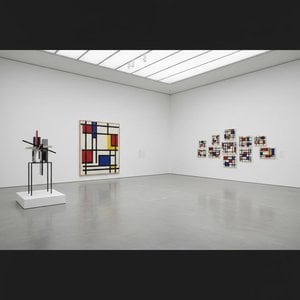
- Composition: Quadro nº 2 exemplifies this approach perfectly. It presents a square divided into four equally sized colored squares—red, blue, yellow, and black—arranged in a deliberate collage-like fashion. This seemingly austere composition belies its complexity; the careful placement of hues creates an illusion of depth and dimension.
- Technique: Mondrian employed oil paint on canvas with meticulous precision. Each square is executed with unwavering accuracy, demonstrating his dedication to geometric rigor and upholding the tenets of De Stijl’s philosophy.
Historical Context & The Birth of Geometric Abstraction
Founded in 1917 by Theo van Doesburg, Neoplasticism emerged from a fervent desire to liberate art from the constraints of illusion and subjective expression. Influenced by thinkers like Rudolf Steiner and Henri Bergson, the movement sought to align artistic principles with spiritual ideals—a quest for universal harmony rooted in mathematical precision. Mondrian’s work stands as a pivotal moment in the history of modern art, signaling a decisive break from traditional painting traditions and establishing geometric abstraction as a dominant aesthetic force. The influence of Bauhaus design principles further solidified De Stijl's impact on visual culture.
Symbolism Beyond Color: Verticality & Horizontal Lines
More than just colors—though their deliberate selection is undeniably significant—vertical and horizontal lines constitute the core symbolic language of Quadro nº 2. These lines represent fundamental forces of nature – earth and sky – mirroring Mondrian’s belief that they embody universal order and stability. The grid pattern itself symbolizes this harmonious balance, reflecting a broader philosophical preoccupation with mathematical ratios and geometric proportions. It's a visual articulation of Mondrian’s conviction that art could transcend the limitations of individual perception and communicate timeless truths.
Emotional Resonance & Artistic Legacy
Despite its apparent simplicity, Quadro nº 2 possesses an undeniable emotional resonance. The bold colors—red, blue, yellow, and black—evoke feelings of vibrancy and energy, juxtaposed against the stillness of geometric form. Viewed as a testament to Mondrian’s unwavering commitment to abstraction and universal harmony, Quadro nº 2 continues to inspire artists and designers alike. Its enduring appeal lies in its ability to convey profound ideas through elegant visual language – a timeless masterpiece that embodies the spirit of modern art's pursuit of beauty and intellectual rigor.
よくあるご質問
ピエト・モンドリアン作「Quadro nº 2」を特徴づける技法やスタイルは何ですか?
ピエト・モンドリアン作「Quadro nº 2」は、Acrylic On Canvasの技法とNeoplasticismの様式を融合させた作品です。技法(テクニック)は制作手法を、様式(ムーブメント)はその作品のスタイルを表しています。
ピエト・モンドリアン作「Quadro nº 2」の画像は自由に複製できますか?
ピエト・モンドリアン作「Quadro nº 2」 の著作権について:本作品はパブリックドメイン(著作権消滅)です。これにより、画像の複製が自由に行えるかどうかが決まります。
学生向けのピエト・モンドリアン作「Quadro nº 2」に関するファクトシートはありますか?
ピエト・モンドリアン作「Quadro nº 2」のガイドページでは、印刷して活用できる2枚構成のファクトシートを提供しています。これには、作品とその詳細情報をまとめたデータテーブル、アーティストの生涯における時代背景を示す年代チャート、同アーティストによる他の作品、測定されたカラーパレット、そしてそのままコピーして使用できる4つの形式の引用文献情報が含まれています。