
 Acrylic On CanvasWallArtNeo-Plasticism
 108.0 x 86.0 cm
迅速な制作と多彩な仕上げオプションを備えた、ミュージアムクオリティのジークレーまたはキャンバスプリント。 ( 手描きの絵画を購入 デジタル画像販売へ切り替え)





























作品のオリジナル比率に合わせた、当店の規定サイズからお選びください。

特定のフレームやスペースに合わせて、ご自身でサイズを指定することも可能です。選択されたサイズが元の画像の比率と一致しない場合、作品をトリミングするか、鏡面反射または単色での塗りつぶしによって画像を拡張いたします。制作を開始する前に、ご確認用のデジタルモックアップをお送りいたします。
画面上のプレビューには、実際のトリミングや拡張は反映されませんのでご注意ください。最終的な構図を正確に確認できるのは、モックアップのみとなります。
カスタムサイズも承っておりますが、元の比率を維持するためには、あらかじめ用意されたリストからサイズを選択することをお勧めいたします。

On the Lappenbrink
複製画のサイズ
Piet Mondrian's "On the Lappenbrink," painted in 1899, offers a poignant glimpse into the artist’s formative years and his nascent artistic explorations. Far removed from the stark geometric abstractions that would define his mature style, this work embodies a distinctly Post-Impressionist sensibility, rooted firmly in the landscapes of his Dutch homeland. The scene depicts a quiet moment along the Lappenbrink, a small stream near Winterswijk, a region largely untouched by grand artistic narratives at the time. Rather than striving for photographic realism, Mondrian captures an atmosphere—a sense of serene stillness and understated beauty – reminiscent of the Hague School painters who preceded him, alongside echoes of Dutch Impressionism’s focus on light and color. Note the careful observation of natural forms: the gently sloping bank, the reflections shimmering in the water, and the subtle variations in tone that suggest a fleeting moment captured on canvas. This early work reveals a young artist diligently studying nature, mastering technique, yet already hinting at a desire to distill its essence – a yearning that would ultimately lead him away from direct representation.
While “On the Lappenbrink” showcases Mondrian's early technical skill and his engagement with naturalistic painting, it also foreshadows a dramatic shift in his artistic trajectory. The influence of Pointillism and Fauvism is evident in the vibrant yet subdued palette – primarily reds, yellows, and blues – and the loose brushwork. However, these stylistic influences served as stepping stones toward his revolutionary concept of Neo-Plasticism. Mondrian’s increasing dissatisfaction with merely mirroring the world around him fueled a relentless pursuit of simplification. He sought to express fundamental geometric forms—straight lines, right angles, and primary colors—as the building blocks of a universal visual language, believing they could represent the underlying order of the cosmos. This painting represents an important stage in this evolution, demonstrating his initial experiments with reducing complex scenes to their essential elements.
Beyond its technical merits, “On the Lappenbrink” carries a subtle layer of symbolic meaning. The scene depicts an ordinary moment in rural life – a woman seated on the bank of a stream, seemingly lost in contemplation. Her posture and expression invite speculation: is she waiting for someone? Is she simply enjoying the tranquility of her surroundings? This ambiguity adds to the painting’s quiet power, transforming a commonplace vista into a meditation on human experience. The inclusion of several figures in the background – men walking, children playing – further enriches the scene, suggesting a community connected to its landscape. Mondrian's choice to portray this specific location—a relatively unvisited corner of the Netherlands—underscores his desire to capture authentic moments and experiences, moving beyond idealized representations of nature.
“On the Lappenbrink” is not merely a charming depiction of a Dutch landscape; it’s a crucial link in the chain that led to Mondrian's groundbreaking contributions to modern art. It represents a pivotal moment in his artistic development, demonstrating his early experimentation with abstraction and foreshadowing the principles of Neo-Plasticism. This work exemplifies his initial steps toward reducing visual complexity to its most essential elements – a journey culminating in the iconic compositions of *Composition with Red, Yellow and Blue* and other works that profoundly influenced 20th-century art and design. Today, “On the Lappenbrink” stands as a testament to Mondrian’s artistic vision—a beautiful reminder of his roots and a vital precursor to his revolutionary style.


1872 - 1944 , オランダ
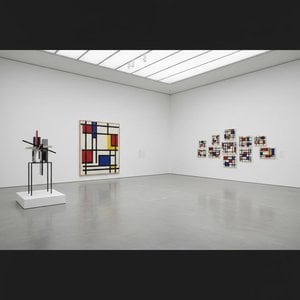
Explore the profound essence of Neoplasticism. Discover how Piet Mondrian and De Stijl masters used pure color and geometric form to redefine modern art. An essential guide for collectors seeking to understand the enduring power of abstract harmony and universal order.

Explore the profound elegance of De Stijl. Discover how Piet Mondrian and the masters of Neoplasticism utilized geometric harmony and primary colors to redefine modern abstraction. An authoritative guide for the discerning collector seeking timeless, structured beauty.


 プレビュー
プレビュー
 シェアする
シェアする シェアする
シェアする
 詳細を見る
詳細を見る ガイド
ガイド

 ダウンロード
 似ている作品
 X線調査
X線調査 スライドショー
 統計情報
統計情報 詳細を見る
詳細を見る









 ガラスオプションは、110cm未満のサイズでのみご利用いただけます。


