
迅速な制作と多彩な仕上げオプションを備えた、ミュージアムクオリティのジークレーまたはキャンバスプリント。 ( 手描きの絵画を購入 デジタル画像販売へ切り替え)





























作品のオリジナル比率に合わせた、当店の規定サイズからお選びください。

特定のフレームやスペースに合わせて、ご自身でサイズを指定することも可能です。選択されたサイズが元の画像の比率と一致しない場合、作品をトリミングするか、鏡面反射または単色での塗りつぶしによって画像を拡張いたします。制作を開始する前に、ご確認用のデジタルモックアップをお送りいたします。
画面上のプレビューには、実際のトリミングや拡張は反映されませんのでご注意ください。最終的な構図を正確に確認できるのは、モックアップのみとなります。
カスタムサイズも承っておりますが、元の比率を維持するためには、あらかじめ用意されたリストからサイズを選択することをお勧めいたします。

Composition with Double Line and Yellow, 1932
複製画のサイズ
Piet Mondrian's 1932 painting, ‘Composition with Double Line and Yellow,’ is not merely an arrangement of colors and lines; it is a visual distillation of a profound philosophical quest. Emerging from the crucible of early 20th-century artistic experimentation, this work embodies the core tenets of Neoplasticism – Mondrian’s signature style and a radical departure from representational art. The canvas presents a deceptively simple composition: a grid of black lines delineating rectangles of primary colors (primarily yellow), white, and black against a pale yellow background. Yet within this apparent austerity lies a dynamic tension, a carefully orchestrated balance that speaks to Mondrian’s ambition to express universal harmony.
To understand ‘Composition with Double Line and Yellow,’ one must trace the artist's journey. Born Pieter Cornelis Mondriaan in 1872, he initially painted traditional landscapes, influenced by the Hague School and Dutch Impressionism. However, a move to Paris in 1912 proved pivotal. Immersed in the avant-garde scene, particularly Cubism, Mondrian began deconstructing forms, gradually shedding representational elements. This process wasn’t merely stylistic; it was driven by a spiritual yearning. Inspired by Theosophy – a mystical philosophy emphasizing underlying unity – Mondrian sought to transcend the visible world and express essential truths through abstract art. The introduction of double lines in works like this one marked a subtle but significant shift, adding a sense of optical movement and depth that hadn’t been present in his earlier compositions with single black lines. This technique creates an almost vibrating energy within the confines of the geometric structure.
Mondrian believed that by reducing painting to its most fundamental elements – horizontal and vertical lines, primary colors, and neutral tones – he could achieve a pure, universal aesthetic. The horizontal and vertical lines, he argued, represented opposing forces in nature, while the primary colors symbolized essential energies. The black lines aren’t simply boundaries; they are active participants in the composition, creating a rhythmic interplay with the colored rectangles. The yellow, often featured prominently as in this work, is not merely a color but a radiant force, injecting vitality into the otherwise austere arrangement. This isn't about depicting reality, but *creating* a new reality – one based on order, clarity, and spiritual resonance. The precise placement of each element wasn’t arbitrary; Mondrian meticulously adjusted proportions and relationships to achieve an equilibrium that he believed reflected cosmic harmony.
‘Composition with Double Line and Yellow’ is more than a historical artifact; it continues to resonate deeply with contemporary audiences. Its influence extends far beyond the realm of painting, permeating architecture, design, and fashion. The clean lines, geometric forms, and limited color palette have become synonymous with modernism itself. The work invites contemplation – a moment to pause and appreciate the power of simplicity, the beauty of balance, and the enduring human quest for meaning in an increasingly complex world. Owning a reproduction of this iconic piece isn’t just acquiring a beautiful artwork; it's embracing a legacy of artistic innovation and philosophical inquiry.


1872 - 1944 , オランダ

Explore the profound evolution of Neo-Abstract art. Discover how bold geometric forms, vibrant chromatic depth, and tactile textures redefine modern expression for the discerning collector seeking sophisticated, high-impact masterpieces for contemporary interiors.
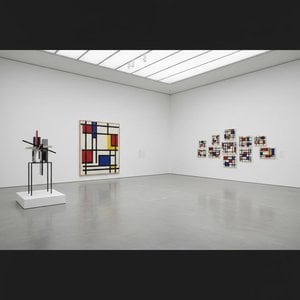
Explore the profound essence of Neoplasticism. Discover how Piet Mondrian and De Stijl masters used pure color and geometric form to redefine modern art. An essential guide for collectors seeking to understand the enduring power of abstract harmony and universal order.

Explore the profound spiritual depth of geometric abstraction. From Malevich's Suprematism to modern masters, our expert guide reveals how pure form and color command presence in fine art collections.


 プレビュー
プレビュー
 シェアする
シェアする シェアする
シェアする
 詳細を見る
詳細を見る ガイド
ガイド

 ダウンロード
 似ている作品
 X線調査
X線調査 スライドショー
 統計情報
統計情報


 詳細を見る
詳細を見る









 ガラスオプションは、110cm未満のサイズでのみご利用いただけます。


