
x


迅速な制作と多彩な仕上げオプションを備えた、ミュージアムクオリティのジークレーまたはキャンバスプリント。 ( 手描きの絵画を購入 画像を購入)





























作品のオリジナル比率に合わせた、当店の規定サイズからお選びください。

特定のフレームやスペースに合わせて、ご自身でサイズを指定することも可能です。選択されたサイズが元の画像の比率と一致しない場合、作品をトリミングするか、鏡面反射または単色での塗りつぶしによって画像を拡張いたします。制作を開始する前に、ご確認用のデジタルモックアップをお送りいたします。
画面上のプレビューには、実際のトリミングや拡張は反映されませんのでご注意ください。最終的な構図を正確に確認できるのは、モックアップのみとなります。
カスタムサイズも承っておりますが、元の比率を維持するためには、あらかじめ用意されたリストからサイズを選択することをお勧めいたします。

Composition No. 8
複製画のサイズ
In the pantheon of twentieth-century modernism, few works possess the magnetic clarity and structural authority of Piet Mondrian’s Composition No. 8. Created in 1921, this masterpiece serves as a profound manifesto of Neoplasticism, a movement that sought to strip away the distractions of the physical world to reveal the underlying mathematical harmonies of existence. At first glance, the viewer is met with an arresting arrangement of thick, black orthogonal lines that intersect to form a rhythmic grid of rectangular and square zones. Yet, beneath this seemingly austere surface lies a vibrant dialogue between color and void. The canvas becomes a stage where primary hues—the bold red, the sunny yellow, and the deep blue—dance against a stark white background, creating a visual tension that is both dynamic and incredibly stable.
To gaze upon this work is to witness the deliberate rejection of the organic in favor of the universal. Mondrian, moving away from his early Dutch landscape roots, utilized these elemental components to express a sense of cosmic order. The black lines do not merely divide the space; they act as structural anchors, providing a skeletal strength that prevents the bright color blocks from overwhelming the composition. For the discerning collector or interior designer, this piece offers more than just aesthetic appeal; it provides a focal point of unwavering balance. It is an artwork that demands presence, bringing a sense of sophisticated, rational calm to any modern architectural space.
The technical execution of Composition No. 8 reflects Mondrian’s unwavering dedication to precision and purity. Eschewing the textured impasto or visible brushwork common in Impressionism, Mondrian approached this canvas with a desire for flatness and clarity. Each line was meticulously measured and aligned to ensure that no single element dominated the others disproportionately, achieving what he termed a "dynamic equilibrium." The application of color is remarkably unmodulated; there is no shading, no gradient, and no illusion of depth. This deliberate lack of dimension forces the eye to remain on the surface of the painting, emphasizing the two-dimensional reality of the canvas itself.
This technique creates a fascinating paradox: while the painting is strictly flat, it feels incredibly alive. The way the primary colors are strategically placed—never touching the edges in a predictable pattern—creates a sense of movement, as if the shapes are floating within a structured vacuum. For those looking to integrate such a piece into a curated collection, its power lies in this very tension between rigidity and motion. It is a sophisticated interplay of weight and lightness that resonates deeply with the principles of contemporary minimalism and high-end geometric design.
Beyond its formal elegance, Composition No. 8 is steeped in profound symbolic intent. Mondrian believed that by reducing art to its most basic elements—the straight line and the primary color—he could tap into a spiritual truth that transcends individual experience. The use of red, yellow, and blue was not merely a stylistic choice but a way to represent the fundamental forces of nature in their most distilled form. In an era of rapid industrialization and global upheaval, Mondrian’s work offered a vision of a new, utopian order—a world governed by logic, clarity, and balance.
For the art lover, this painting offers an emotional journey from chaos to order. It invites contemplation on how much can be achieved through simplicity and how much beauty can be found in restraint. Whether displayed as a centerpiece in a minimalist loft or as a sophisticated accent in a professional gallery setting, Composition No. 8 continues to inspire awe. It remains a timeless testament to the idea that true complexity is often found within the most fundamental truths, making it an enduring icon for anyone who appreciates the intersection of art, mathematics, and soul.

1872 - 1944 , オランダ

Explore the profound elegance of De Stijl. Discover how Piet Mondrian and the masters of Neoplasticism utilized geometric harmony and primary colors to redefine modern abstraction. An authoritative guide for the discerning collector seeking timeless, structured beauty.
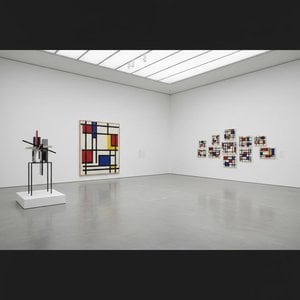
Explore the profound essence of Neoplasticism. Discover how Piet Mondrian and De Stijl masters used pure color and geometric form to redefine modern art. An essential guide for collectors seeking to understand the enduring power of abstract harmony and universal order.

Explore the profound spiritual depth of geometric abstraction. From Malevich's Suprematism to modern masters, our expert guide reveals how pure form and color command presence in fine art collections.


最新の美術ニュース、限定オファー、そしてインテリアのアイデアをいち早くお届けします。
お客様のプロジェクトについてお聞かせください。当社の美術専門家が、お客様に合わせた3つのパーソナライズされた芸術提案をご提供いたします。
あなたにぴったりの3作品を無料で厳選いたします


 プレビュー
プレビュー
 シェアする
シェアする シェアする
シェアする
 詳細を見る
詳細を見る

 ダウンロード
 似ている作品
 X線調査
X線調査 スライドショー

 詳細を見る
詳細を見る









 ガラスオプションは、110cm未満のサイズでのみご利用いただけます。


