

当社のアーティストが、お客様のご希望のサイズと額縁に合わせて、キャンバスに手描きで制作する油彩画です。 ( プリント版に切り替え デジタル画像販売へ切り替え)





























作品のオリジナル比率に合わせた、当店の規定サイズからお選びください。

フレームや壁のスペースに合わせて、ご希望の幅と高さを入力してください。本作品は手描きのため、異なる比率のサイズをご希望の場合、絵画の周囲を少し広げて描くか、あるいは端を少しカットして調整することが可能です。お客様のご要望に合わせます。制作を開始する前に、仕上がりを確認するためのデジタルモックアップをお送りいたします。このページに表示されている画像は完成品の実物ではなく、あくまでモックアップによるイメージです。
Composition 1 A
複製画サイズ一覧
Piet Mondrian's Composition 1 A is not merely a painting; it is a visual manifesto, a distillation of artistic principles that would come to define an era. Emerging from the tumultuous currents of early 20th-century art, this work embodies the core tenets of Neoplasticism – a style Mondrian believed could express universal harmony through pure abstraction. To gaze upon its stark arrangement of black lines and rectangular planes is to encounter a world stripped bare of representational clutter, leaving only the essential elements of form and color. The painting’s power resides not in what it depicts, but in how it is depicted: a rigorous exploration of balance, tension, and the fundamental building blocks of visual experience.
Mondrian's path to this radical simplicity was far from direct. Born Pieter Cornelis Mondriaan in Amersfoort, Netherlands, he initially trained as a teacher while simultaneously pursuing his artistic passions. His early works reveal a fascination with naturalistic landscapes, echoing the traditions of the Hague School and Dutch Impressionism. However, a restless spirit drove him to experiment – Pointillism, Fauvism – always searching for an authentic visual language. The pivotal moment arrived with his move to Paris in 1912, where exposure to Cubism ignited a transformative process. He began deconstructing forms, dismantling traditional perspective, and gradually reducing his palette. This wasn’t merely stylistic experimentation; it was a philosophical quest. Mondrian sought to transcend the subjective and represent an underlying reality – a spiritual order accessible through pure abstraction.
Composition 1 A is deeply rooted in the principles of De Stijl (The Style), a Dutch artistic movement co-founded by Mondrian and Theo van Doesburg. This group envisioned art as a vehicle for social and spiritual renewal, believing that abstract forms could embody universal values. The painting’s limited palette – primarily black, white, and shades of gray – wasn't arbitrary. It represented a deliberate rejection of emotional expression in favor of clarity and objectivity. The bold, straight black lines aren’t simply outlines; they are dynamic forces creating structure and defining space. The asymmetrical arrangement of the rectangles introduces a subtle tension, preventing the composition from becoming static or predictable. This careful balance between order and dynamism is crucial to the work's enduring appeal. It evokes a sense of calm rationality, yet simultaneously engages the eye with its intricate interplay of shapes.
The impact of Composition 1 A extends far beyond the realm of painting. Mondrian’s Neoplasticism profoundly influenced graphic design, architecture, and fashion throughout the 20th century and continues to inspire contemporary artists today. His emphasis on geometric forms and primary colors became synonymous with modernism itself. The work invites contemplation – a quiet meditation on form, color, and the search for universal harmony. Owning a reproduction of this iconic piece is not simply acquiring an artwork; it’s embracing a legacy of artistic innovation and a vision of a more ordered, balanced world.
ピエト・モンドリアン作「Composition 1 A」のパステルカラーなパレットは、その思索的なな情緒的トーンと見事に調和しています。色彩は、作品が感情を伝えるための重要な要素の一つです。
ピエト・モンドリアン作「Composition 1 A」は近代時代の作品です。この時代背景が、本作の歴史的な文脈を形作っています。
ピエト・モンドリアン作「Composition 1 A」の複製画をプレビューするには、作品のプレビューページを開いてください。

1872 - 1944 , オランダ
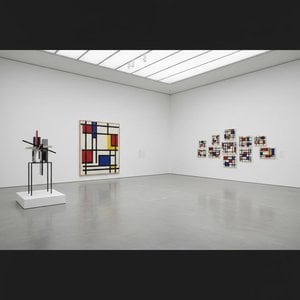
Explore the profound essence of Neoplasticism. Discover how Piet Mondrian and De Stijl masters used pure color and geometric form to redefine modern art. An essential guide for collectors seeking to understand the enduring power of abstract harmony and universal order.

Explore the profound elegance of De Stijl. Discover how Piet Mondrian and the masters of Neoplasticism utilized geometric harmony and primary colors to redefine modern abstraction. An authoritative guide for the discerning collector seeking timeless, structured beauty.

 設置イメージを確認
 送る
送る シェア
シェア
 詳細情報
詳細情報 ガイドを表示

 画像をダウンロード
 似ている作品
 X線調査
X線調査 スライドショー
 統計情報
統計情報

 続きを読む
続きを読む









 ガラスオプションは、110cm未満のサイズでのみご利用いただけます。


