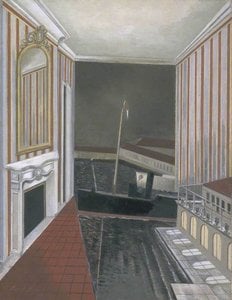
WatercolorWallArtExpressionism
 1918Modern
 25.0 x 36.0 cm
 Imperial War Museum
迅速な制作と多彩な仕上げオプションを備えた、ミュージアムクオリティのジークレーまたはキャンバスプリント。 ( 手描きの絵画を購入 デジタル画像販売へ切り替え)





























作品のオリジナル比率に合わせた、当店の規定サイズからお選びください。

特定のフレームやスペースに合わせて、ご自身でサイズを指定することも可能です。選択されたサイズが元の画像の比率と一致しない場合、作品をトリミングするか、鏡面反射または単色での塗りつぶしによって画像を拡張いたします。制作を開始する前に、ご確認用のデジタルモックアップをお送りいたします。
画面上のプレビューには、実際のトリミングや拡張は反映されませんのでご注意ください。最終的な構図を正確に確認できるのは、モックアップのみとなります。
カスタムサイズも承っておりますが、元の比率を維持するためには、あらかじめ用意されたリストからサイズを選択することをお勧めいたします。

Sunrise, Inverness Copse
複製画のサイズ
In the hauntingly beautiful watercolor "Sunrise, Inverness Copse," painted in 1918, Paul Nash invites us into a landscape that is simultaneously devastating and transcendent. Created during the height of World War I, this masterpiece serves as a profound meditation on the scars left by conflict upon the natural world. The scene captures the Western Front near Ypres, Belgium, not through the lens of traditional combat, but through the quiet, eerie aftermath of destruction. As the sun begins to crest over the horizon, it illuminates a skeletal forest of shattered trees, their broken trunks silhouetted against a bruised and atmospheric sky. It is a work that captures a singular, breathless moment where the dawn of hope meets the heavy reality of loss.
Nash’s technical mastery is evident in his delicate yet impactful use of watercolor on paper. Eschewing the rigid lines of traditional realism, he employed a layered washing technique to achieve subtle gradations of tone and texture. This method allows for an ethereal quality to permeate the piece; the sky feels heavy with moisture and memory, while the earth appears saturated with the mud and ochre hues characteristic of the battlefield. The artist’s use of geometric shapes and fractured compositions mirrors the psychological trauma of the era, creating a visual language that speaks to the splintered psyche of a generation. For the discerning collector, this technique offers a depth of texture that makes a high-quality reproduction feel remarkably alive and atmospheric.
Beyond its striking visual impact, "Sunrise, Inverness Copse" is rich with complex symbolism that resonates deeply with the human experience. The towering, broken trees stand as poignant metaphors for strength and endurance; though they have been violently uprooted and broken by the machinery of war, they remain stubbornly anchored to the earth, clinging to life amidst the wreckage. Nash further weaves a narrative of interconnectedness through the inclusion of a still lake, which acts as a mirror reflecting the sky, bridging the gap between the celestial and the terrestrial. Even the sparse presence of birds scattered across the canvas suggests a fragile, persistent beauty that refuses to be extinguished by darkness.
For interior designers and art enthusiasts alike, this painting offers a unique emotional resonance. It is not merely a depiction of war, but an exploration of resilience. The interplay between the somber browns of the devastated earth and the luminous light of the rising sun provides a sophisticated palette that can anchor a room with both gravity and grace. Whether placed in a quiet study or as a focal point in a contemporary living space, Nash’s work invites contemplation, offering a sense of peace found within the struggle. It is an exquisite choice for those seeking art that possesses both historical weight and a timeless, poetic soul.


1889 - 1946 , イギリス

ポール・セザンヌの至高の25選。ポスト印象派を代表する画家、セザンヌの傑作と革新的な技法を紐解きます。WahooArtで高品質な複製画やインテリアアートを見つけ、芸術の世界をご自宅に。今すぐコレクションをご覧ください。

Explore the captivating world of watercolor painting! Discover its rich history, essential techniques, influential artists & collecting tips. A comprehensive guide for art enthusiasts from WahooArt.
Explore the evocative landscapes & poignant war art of Paul Nash (1889-1946), a key figure in British Modernism. Discover his unique style and lasting impact on art history with WahooArt.

パウル・クレーの傑作25選🎨 色彩と象徴に満ちた抽象絵画の世界を旅。ドイツ表現主義からバウハウスまで、クレーの革新的な技法と感動的な作品群をWahooArtで。高品質な美術品複製やインテリアアートも豊富です。オンラインストアで全コレクションをご覧ください。
Journey through 10 legendary watercolor masterpieces by Sargent, Turner & Homer! Explore iconic landscapes, portraits & floral art that redefined history. Find museum-quality reproductions and curated decor ideas at WahooArt.com.


 プレビュー
プレビュー
 シェアする
シェアする シェアする
シェアする
 詳細を見る
詳細を見る ガイド
ガイド

 ダウンロード
 似ている作品
 X線調査
X線調査 スライドショー
 統計情報
統計情報 詳細を見る
詳細を見る









 ガラスオプションは、110cm未満のサイズでのみご利用いただけます。