A Fragment of Imagination: Exploring Paul Klee’s “Actor”
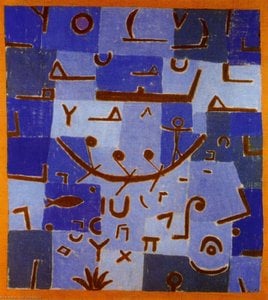
Paul Klee's "Actor" stands as a testament to the artist’s singular vision—a deceptively simple composition brimming with layered meanings and executed in his characteristic blend of geometric abstraction and tonal color harmonies. Painted circa 1937, this monochrome canvas embodies Klee’s fascination with musical form and his belief that painting could achieve similar expressive power. The artwork depicts a solitary figure positioned centrally against a backdrop of muted grey tones, punctuated by subtle variations in shade—a deliberate choice reflecting Klee's meticulous attention to color theory and its ability to convey emotion.
- Subject Matter: The central figure is stylized, almost childlike, conveying an aura of vulnerability and contemplation. Its posture suggests stillness, yet hints at movement—perhaps a gesture or a subtle shift in balance—creating a dynamic tension within the frame.
- Style & Technique: Klee’s style aligns firmly with Surrealism, albeit filtered through his own rigorously controlled aesthetic sensibilities. He employs a technique of hatching and crosshatching to build up tonal gradations, achieving remarkable depth and luminosity despite the absence of color. This method prioritizes texture and visual rhythm, mirroring the principles of musical orchestration.
The painting’s historical context is inextricably linked to the turbulent years preceding World War II—a period marked by anxieties about societal upheaval and a profound engagement with philosophical ideas concerning human existence. Klee was deeply influenced by Jungian psychology, particularly concepts of archetypes and collective unconsciousness, which informed his artistic explorations. The figure's ambiguous expression invites viewers to contemplate themes of identity, performance, and the masks we wear in social interactions—concepts central to Jung’s theories.
Symbolism:
- The grey background symbolizes neutrality and introspection, representing a space devoid of external distractions. It allows for contemplation of inner states and invites viewers to consider the complexities of human experience.
- The stylized figure itself can be interpreted as an emblem of humanity—a representation of both vulnerability and resilience—suggesting that despite facing challenges, individuals retain an inherent capacity for creativity and self-expression.
Ultimately, “Actor” resonates with viewers on an emotional level through its understated beauty and profound psychological depth. Klee’s masterful manipulation of tonal color and textural technique transcends mere visual representation, conveying a sense of quiet contemplation and hinting at the hidden dramas unfolding beneath the surface—a timeless reminder of art's ability to illuminate the human condition.
- Recommended Reproduction Size: For optimal impact within interior spaces, consider reproductions ranging from 36” x 48” to 50” x 70”.
- Material Considerations: High-quality Giclée prints on archival canvas offer exceptional color fidelity and longevity—preserving Klee’s artistic vision for generations to come.
よくあるご質問
パウル・クレー作「Actor」は、どのような情緒や感情を表現していますか?
パウル・クレー作「Actor」は、全体的なDramaticなムードの中に、Dramaticな感情を伝えています。
パウル・クレー作「Actor」の色使いは、どのような感情を呼び起こしますか?
パウル・クレー作「Actor」のEarthyなパレットは、そのDramaticな情緒的トーンと見事に調和しています。色彩は、作品が感情を伝えるための重要な要素の一つです。
パウル・クレー作「Actor」には何が描かれており、どのような情緒が漂っていますか?
パウル・クレー作「Actor」は、mask, warrior, sword, costume, black white, geometric form, symbolism, theaterを描き出し、Dramaticな情緒を湛えています。主題と雰囲気が相まって、作品の物語を形作っています。