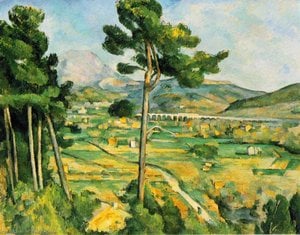
A Pioneer's Embrace of Nature: Exploring Cézanne’s “Large Pine”
Paul Cézanne, a name synonymous with artistic innovation and the genesis of modern art, wasn’t merely depicting a tree; he was wrestling with fundamental questions about perception and representation. His "Large Pine," painted in 1905, stands as a testament to this intellectual fervor—a deceptively simple landscape brimming with complex considerations that continue to fascinate scholars and inspire artists today. Initially dismissed by critics who favored Impressionistic fleetingness, Cézanne stubbornly pursued his vision of solidity and form, ultimately reshaping the artistic landscape forever.
- Subject Matter: The painting focuses on a solitary pine tree against a muted backdrop of earthy tones—primarily ochre and reddish hues—characteristic of Cézanne’s Provençal homeland. It's not an idealized depiction; rather, it presents a rugged, weathered specimen of nature, capturing its essence with remarkable accuracy.
- Style: Cézanne firmly rejected Impressionism’s emphasis on optical illusion, opting instead for Post-Impressionism—a movement that prioritized expressive color and formal experimentation over faithful observation. This stylistic choice distinguishes “Large Pine” from its contemporaries, signaling a decisive break from artistic conventions of the time.
- Technique: Cézanne employed a groundbreaking technique known as "alla prima," meaning "at first sight." He applied paint directly onto the canvas without underpainting or sketching beforehand, resulting in textured brushstrokes that convey palpable energy and dynamism. These strokes aren’t blended smoothly; they retain their individual marks, creating a visual richness that defies conventional painting methods.
Historical Context: Cézanne's Quest for Geometric Harmony
Cézanne’s artistic journey coincided with a period of profound intellectual upheaval—the burgeoning influence of Nietzsche and Bergson challenged traditional philosophical assumptions about time, causality, and subjectivity. Cézanne internalized these ideas, believing that art should strive to capture the underlying structure of reality—a concept radically different from Impressionism's preoccupation with capturing momentary sensations. He sought to distill nature into its fundamental geometric forms—cylinders, cones, and planes—reflecting a desire for intellectual rigor alongside artistic expression. This pursuit aligns powerfully with the broader philosophical currents shaping European thought at the turn of the century.
Symbolic Resonance: Beyond Representation – An Exploration of Form
While seemingly straightforward in its depiction, “Large Pine” carries significant symbolic weight. The pine tree itself is a venerable emblem of resilience and immortality—a symbol frequently invoked in religious iconography representing eternal life and spiritual fortitude. Cézanne’s deliberate simplification of the tree's form isn’t merely stylistic; it represents an attempt to transcend mere visual representation, delving into the underlying essence of existence. By reducing complex organic contours to geometric primitives, Cézanne invites viewers to contemplate not just what they see but also what lies beneath—a profound statement about art’s capacity to communicate deeper truths.
Emotional Impact: Capturing Stillness Amidst Movement
Despite the energetic brushstrokes that characterize the painting's surface, “Large Pine” exudes a remarkable sense of tranquility and contemplation. Cézanne skillfully conveys this stillness through careful compositional choices—the tree’s placement against the muted earth tones creates a harmonious balance that draws the eye inward. The painting speaks to our innate desire for connection with nature—a yearning for beauty and permanence amidst the uncertainties of life. It's a piece that lingers in the mind long after viewing, prompting reflection on themes of solitude, perseverance, and the enduring power of artistic vision.



 プレビュー
プレビュー
 手描きの絵画を購入
 シェアする
シェアする シェアする
シェアする
 詳細を見る
詳細を見る

 ダウンロード
 似ている作品
 X線調査
X線調査 スライドショー

 詳細を見る
詳細を見る






































 ガラスオプションは、110cm未満のサイズでのみご利用いただけます。