Oil On CanvasWallArtPost-Impressionism
 189919th Century
 61.0 x 81.0 cm
スピーディーな制作と多彩な仕上げオプションが魅力の、ミュージアムクオリティなジークレー・キャンバスプリント。 ( 手描きの複製画を注文する デジタル画像販売へ切り替え)





























作品のオリジナル比率に合わせた、当店の規定サイズからお選びください。

額縁や壁のスペースに合わせて、ご希望の幅と高さを入力してください。プリントはカットすることは可能ですが、元の画像より大きくすることはできないため、異なる比率のサイズを選択された場合は、画像の一部が欠けることになります。印刷を開始する前に、内容を確認していただくためのデジタルモックアップをお送りいたします。このページに表示されている画像は、実際のカット後の状態を示すものではありません。実際の仕上がりはモックアップにてご確認ください。
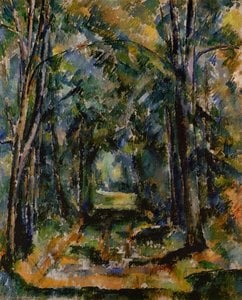
In the Forest
複製画サイズ一覧
Paul Cézanne's "In the Forest," painted in 1899, isn’t merely a landscape; it’s an immersive experience, a deliberate attempt to capture the essence of nature rather than its literal representation. This pivotal work stands as a cornerstone of Post-Impressionism, a movement that arose as a reaction against the fleeting impressions favored by earlier Impressionists and sought instead to explore the underlying structure and emotional resonance of the natural world. Cézanne’s approach wasn't about replicating what the eye sees; it was about distilling the *feeling* of being within a forest – its stillness, its depth, and its vibrant energy – onto canvas.
The painting itself measures 61 x 81 cm and is executed in oil on canvas. Immediately striking are the bold, almost sculptural forms of the trees dominating the composition. Cézanne employs a technique that anticipates Cubism; he breaks down objects into their fundamental geometric shapes – cylinders, cones, and planes – and rearranges them to create an illusion of depth and volume. The orange leaves, particularly prominent in the foreground, aren’t rendered with delicate brushstrokes but rather as blocks of color, contributing significantly to the painting's dynamic and somewhat unsettling atmosphere. The rocks scattered throughout the scene add further textural complexity, grounding the composition while simultaneously hinting at the vastness of the forest.
Cézanne’s style represents a significant departure from the Impressionist preoccupation with capturing momentary effects of light. While Impressionists sought to depict the *impression* of light and color, Cézanne was interested in exploring the underlying structure of objects and their relationship to space. He famously stated, “I do not paint what I see, but what I feel.” This sentiment encapsulates his core artistic philosophy – he aimed to convey a sense of solidity and permanence, as if the trees themselves were imbued with an inner strength.
The influence of Japanese prints is evident in Cézanne’s flattened perspective and simplified forms. He admired the way Japanese artists rendered objects without relying on traditional linear perspective, creating a sense of depth through color and composition. Furthermore, his exploration of color – particularly the juxtaposition of warm oranges and greens – reflects the work of Paul Gauguin, another key figure in Post-Impressionism, who sought to express emotion through vibrant hues. However, Cézanne’s use of color is far more restrained and deliberate than Gauguin's, serving primarily to define form and create a sense of harmony within the composition.
“In the Forest” can be interpreted as a symbolic meditation on humanity’s relationship with nature. The dense foliage creates a feeling of enclosure, suggesting both protection and isolation. The vibrant colors evoke a sense of vitality and energy, while the muted tones in the background create a backdrop of tranquility. The painting isn't simply a depiction of a forest; it’s an evocation of the profound emotional experience of being immersed within one – a feeling of awe, wonder, and perhaps even a touch of melancholy.
Cézanne’s work profoundly influenced subsequent generations of artists, including Pablo Picasso and Henri Matisse. His emphasis on form, color, and subjective expression paved the way for movements like Cubism and Fauvism. His legacy continues to inspire artists today who seek to capture the essence of nature in a bold and innovative manner. For those seeking to bring this remarkable artwork into their homes, WahooArt offers meticulously crafted oil painting reproductions that faithfully recreate Cézanne’s vision with exceptional detail and vibrancy.
Cézanne’s journey from Impressionism to Post-Impressionism is a fascinating one, marked by a constant experimentation with form and color. His exploration of the “promontory” – a technique of depicting objects as viewed through a gap or opening – exemplifies his desire to break free from traditional perspective and create a more dynamic and expressive representation of space.
To further appreciate Cézanne’s contribution, consider examining works by Claude Monet, whose Impressionistic landscapes provide a valuable contrast to Cézanne's more structured approach. Alternatively, explore Henri Matisse’s Fauvist paintings for an example of how color was used to express emotion and create a sense of immediacy. Understanding these related movements provides a richer context for appreciating the unique qualities of “In the Forest.”
For those interested in delving deeper into Cézanne's life and work, we encourage you to visit Paul Cezanne’s "In the Forest" on WahooArt.com or explore our comprehensive collection of Cézanne reproductions at [WahooArt URL].
Additionally, you can learn more about Post-Impressionism through Post-Impressionism Art Movement on WahooArt.com and gain insights into Symbolist painting at Symbolist Painting.
セザンヌ作「In the Forest」のガイドページでは、印刷して活用できる2枚構成のファクトシートを提供しています。これには、作品とその詳細情報をまとめたデータテーブル、アーティストの生涯における時代背景を示す年代チャート、同アーティストによる他の作品、測定されたカラーパレット、そしてそのままコピーして使用できる4つの形式の引用文献情報が含まれています。
セザンヌ作「In the Forest」はパブリックドメイン(著作権消滅)です。著作権の保護期間は、1906年に亡くなった作家の没年から起算されます。
セザンヌ作「In the Forest」は、forest, trees, orange leaves, landscape, cezanne, composition, depth, textureを描き出し、Calmな情緒を湛えています。主題と雰囲気が相まって、作品の物語を形作っています。

1839 - 1906 , フランス

Unveil the profound revolution of Post-Impressionism. Explore how masters like Van Gogh and Cézanne utilized bold colors and emotional depth to transcend mere representation, laying the foundation for modern art. A sophisticated journey through history's most emotive brushstrokes.

Explore the transformative era of Post-Impressionism. Discover how masters like Cézanne and Matisse revolutionized color and form, moving beyond Impressionism to shape modern art history through structural innovation and expressive emotion.

Explore the profound legacy of Paul Cézanne. Discover how his mastery of geometric forms and vibrant color bridged Impressionism and Cubism, offering timeless inspiration for fine art collectors and enthusiasts seeking to understand the foundations of modern art.

Explore the structural genius of Paul Cézanne. Discover how his mastery of geometric form and color bridged Impressionism and Cubism in this definitive guide for art enthusiasts and collectors.

印象派と後期印象派の決定的な違いを、光と色彩、そして感情の変遷から紐解くマスタークラス。モネやルノワールが捉えた「一瞬の光」から、ゴッホらが追求した「内なる情熱」まで、美術史の革命を専門家が解説します。WahooArtでは、巨匠たちの息吹を感じる高品質な手描き油彩複製画をご提供。あなたの空間に、美術館級のエレガンスと本物の芸術体験をお届けします。

 設置イメージを確認
 送る
送る シェア
シェア
 詳細情報
詳細情報 ガイドを表示

 画像をダウンロード
 似ている作品
 X線調査
X線調査 スライドショー
 統計情報
統計情報 続きを読む
続きを読む









 ガラスオプションは、110cm未満のサイズでのみご利用いただけます。