作品詳細説明
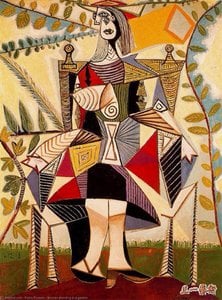
A Fragmented Portrait: Picasso’s Exploration of Form in 1927
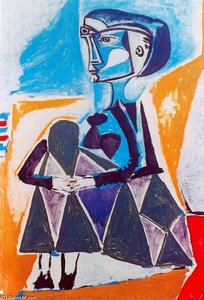
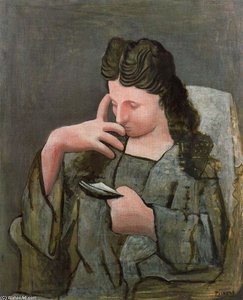
This captivating artwork, created by Pablo Picasso in 1927, presents a striking example of his enduring contribution to the Cubist movement. Measuring 56 x 34 cm, this portrait isn't concerned with realistic representation; instead, it’s a bold investigation into the very *idea* of portraying a woman – dissecting and reconstructing her form through geometric abstraction.
Deconstructing Reality: Style & Technique
The artwork is immediately recognizable as Cubist in style, echoing the revolutionary approach Picasso pioneered alongside Georges Braque. The subject’s face and shoulders are broken down into fragmented planes and angles – a deliberate departure from traditional portraiture. Notice how strong vertical lines bisect the composition, creating a dynamic tension between figure and ground. Geometric shapes—circles, rectangles, and triangles—are not merely *used* to depict features; they *become* the features themselves. Picasso employs a muted palette of browns, beiges, and subtle grays, enhancing the artwork’s introspective mood. The application of paint appears layered, building form through texture and tone, while bold outlines define each fragmented shape. This isn't about capturing likeness, but rather analyzing and representing multiple viewpoints simultaneously on a single canvas – a core tenet of Cubism.
Picasso in 1927: A Moment in Artistic Revolution
By 1927, Picasso was already a celebrated figure, having fundamentally altered the course of modern art. He had moved beyond the early constraints of purely analytical Cubism and was exploring more expressive and sculptural forms. While this piece doesn’t exhibit the full-blown Surrealist tendencies that would emerge later in his career, it demonstrates a continued commitment to challenging artistic conventions. The late 1920s saw Picasso engaging with classical themes alongside his abstract explorations, but works like this demonstrate his unwavering dedication to deconstruction and reassembly of form. Consider comparing this work to “Table in a Cafe (Bottle of Pernod)” or “Woman with guitar” from the same period to see how he was simultaneously exploring different facets of Cubism.
Symbolism & Interpretation
The fragmentation inherent in this portrait can be interpreted on multiple levels. It could symbolize the complexities of human perception – how we rarely grasp a complete, unified image of another person. Alternatively, it reflects Picasso’s broader artistic project: to dismantle traditional modes of representation and rebuild them according to new principles. The lack of conventional depth and flattened perspective further emphasize this rejection of illusionistic space. The artwork invites viewers to actively participate in reconstructing the subject, filling in the gaps and creating their own interpretation.
Emotional Resonance & Interior Impact
Despite its intellectual rigor, this portrait possesses a quiet emotional power. The muted color palette and fragmented form evoke a sense of introspection and melancholy. It’s not a celebratory or idealized depiction; rather, it feels like an intimate exploration of the human condition. In an interior design context, this artwork would serve as a compelling focal point, adding sophistication and intellectual depth to any space. Its neutral tones make it surprisingly versatile, complementing both modern and traditional settings. A high-quality reproduction captures not only the visual elements but also the spirit of Picasso’s revolutionary vision – a testament to his enduring legacy.



 プレビュー
プレビュー
 手描きの絵画を購入
 シェアする
シェアする シェアする
シェアする
 詳細を見る
詳細を見る

 ダウンロード
 似ている作品
 X線調査
X線調査 スライドショー


 詳細を見る
詳細を見る






































 ガラスオプションは、110cm未満のサイズでのみご利用いただけます。