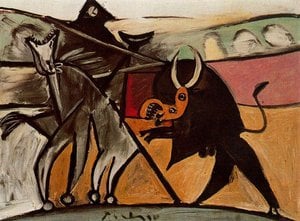
A Window Into Primitive Wonder: The Vibrant Soul of Picasso’s Spring
In the vast, revolutionary tapestry of Pablo Picasso’s career, few works capture the uninhibited joy of existence quite like "Spring," painted in 1956. During this prolific later period, Picasso moved away from the fractured complexities of Cubism to embrace a style deeply rooted in naivety and primitivism. This painting is not merely a pastoral depiction of a rural landscape; it is a deliberate invocation of a world untouched by academic rigor or modern cynicism. Through a masterful distillation of complex emotions into strikingly simple forms, Picasso invites the viewer into an idyllic realm where nature and humanity exist in a state of pure, rhythmic harmony.
The composition serves as a captivating dialogue between the organic and the human. At the heart of this sun-drenched scene, a goat stands nestled against the lush foliage of a tree, its head dipped into the leaves as if partaking in the very essence of life itself. This central figure acts as a powerful symbol of innocence and vitality. Nearby, a human figure rests upon the ground, suggesting a moment of profound contemplation or peaceful repose. The way Picasso balances these elements—the reaching branches, the grazing animal, and the resting person—creates a sense of compositional grace that guides the eye in a gentle, wandering dance across the canvas.
Technique and the Language of Color
To behold "Spring" is to experience a riot of sensory delight. Picasso utilizes a palette that pulses with feverish energy, dominated by vibrant yellows, deep blues, and verdant greens. His technique in this era favored a certain flattening of perspective, a hallmark of the naive art movement, which rejects the illusion of three-dimensional depth in favor of emotional immediacy. By stripping away the shadows of traditional realism, he allows color to become the primary narrator of the story. The brushstrokes, while bold, possess a rhythmic quality that mirrors the seasonal renewal the title suggests.
For the discerning collector or interior designer, this piece offers an unparalleled opportunity to introduce a sense of movement and light into a space. The painting’s ability to command attention through its chromatic intensity makes it a magnificent centerpiece for a room seeking a touch of warmth and historical prestige. It is a work that does not merely decorate a wall; it breathes life into an environment, offering a perennial sense of renewal regardless of the season outside.
A Legacy of Emotional Resonance
Beyond its aesthetic brilliance, "Spring" carries a profound emotional weight. While the surface presents a lively and engaging outdoor setting—complete with secondary figures and charming details like a distant bird or a simple chair—there is an underlying depth to Picasso’s vision. Art historians often note that even in his most exuberant works, traces of memory and the enduring power of human connection remain woven into the fabric of the paint. The painting acts as a sanctuary, a place where the viewer can escape the frantic pace of modernity to reconnect with a primal, elemental joy.
Owning a high-quality reproduction of this masterpiece allows one to possess a fragment of art history’s most transformative mind. It is an invitation to contemplate the beauty of simplicity and the resilience of the human spirit. Whether placed in a contemporary gallery setting or a classic study, "Spring" remains a timeless testament to Picasso's ability to reinvent the world through the lens of wonder.



 プレビュー
プレビュー
 プリントを購入
 シェアする
シェアする シェアする
シェアする
 詳細を見る
詳細を見る

 ダウンロード
 似ている作品
 X線調査
X線調査 スライドショー


 詳細を見る
詳細を見る






































 ガラスオプションは、110cm未満のサイズでのみご利用いただけます。