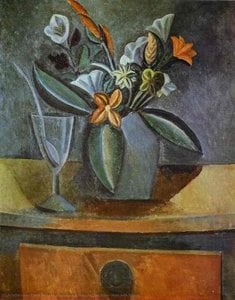
キャンバスにアクリル絵具ウォールアートNaive Art
 1954Modern
 31.0 x 12.0 cm
当社のアーティストが、お客様のご希望のサイズと額縁に合わせて、キャンバスに手描きで制作する油彩画です。 ( Switch to Print Switch to Digital Image)





























作品のオリジナル比率に合わせた、当店の規定サイズからお選びください。

特定のフレームやスペースに合わせて、ご希望のサイズをご入力いただけます。選択されたサイズが元の画像の比率と異なる場合、アートワークをトリミングするか、手描きで要素を追加して絵画を拡張いたします。デジタルモックアップ を制作し、制作開始前にご確認(承認)をいただきます。
画面上のプレビューは、実際のトリミングや拡張を正確に反映しているものではありません。最終的な構図は、モックアップによってのみ正確にご確認いただけます。
カスタムサイズもご利用いただけますが、元の比率を維持するためには、あらかじめ用意されたリストからサイズを選択することをお勧めいたします。

Jug with handle
複製画のサイズ
Pablo Picasso, a titan of 20th-century art, possessed an almost boundless capacity for reinvention. Yet, within his revolutionary explorations of Cubism and Surrealism, he periodically returned to simpler, more direct forms – a strategy that reveals a fascinating depth to his artistic process. “Jug with Handle,” painted in 1954 at the twilight of his career, offers a compelling example of this tendency, presenting a deceptively straightforward depiction of a ceramic vessel while simultaneously embodying the spirit of naive art and hinting at Picasso’s enduring fascination with form and perspective.
This unassuming work, measuring just 31 x 12 cm, immediately draws attention to its unusual color scheme: a harmonious blend of greens and whites that feels both fresh and timeless. The handle itself is rendered in a contrasting material – an element that subtly disrupts the viewer’s expectation of a unified form. This deliberate discordance is characteristic of Picasso's approach during this period, suggesting a playful engagement with visual paradox and challenging conventional notions of representation. It’s not merely a depiction of a jug; it’s an exploration of how we perceive objects and their relationships within space.
“Jug with Handle” is firmly rooted in the style of naive art, a movement that Picasso frequently embraced as a source of inspiration. Naive art, created by self-taught artists lacking formal training, is distinguished by its directness, bold colors, and simplified forms. Unlike academic realism, it prioritizes emotional expression and personal perspective over technical precision. Picasso’s engagement with this style wasn't simply mimicry; he used naive techniques to unlock new ways of seeing and representing the world – a deliberate contrast to his highly intellectual Cubist explorations. The painting’s flattened planes, lack of shading, and slightly distorted proportions are hallmarks of this approach, creating an immediate sense of innocence and spontaneity.
The influence of primitivism is also evident. Picasso was deeply interested in non-Western art forms, particularly African masks and sculptures, which he saw as embodying a raw, unmediated connection to the human experience. The stylized features and geometric shapes within “Jug with Handle” echo this fascination, suggesting a dialogue between Western artistic traditions and the visual language of other cultures.
Beyond its stylistic influences, "Jug with Handle" speaks to Picasso’s broader concerns about time and memory. The painting feels simultaneously ancient and modern – a testament to the artist's ability to synthesize disparate elements into a cohesive whole. The simple form of the jug evokes a sense of timelessness, while the vibrant colors and unconventional handling suggest a contemporary sensibility. It’s as if Picasso is inviting us to contemplate the enduring nature of everyday objects and their capacity to hold within them echoes of the past.
Considered alongside other works from this period, such as “Portrait of Sylvette David” and “Pigeon,” "Jug with Handle" reveals a consistent thread: Picasso’s persistent exploration of simplified forms and bold colors. These pieces, along with his charcoal drawing “Untitled (41),” demonstrate his versatility and his willingness to experiment with different mediums and techniques while maintaining a core aesthetic sensibility. The reproduction offered by WahooArt allows you to experience the immediacy and emotional resonance of this remarkable work firsthand.
For those seeking to delve deeper into Picasso’s artistic journey, we encourage you to explore our collection of high-quality reproductions, including “Portrait of Sylvette David,” “Pigeon,” and “Untitled (41).” You can also discover more about the Naive Art Movement on The Naïve Art Movement at WahooArt.

1881 - 1973 , スペイン

Unveil the radical revolution of Cubism. Explore how masters like Picasso and Braque redefined modern art through fragmented forms and geometric abstraction, offering profound insights for discerning collectors of fine art history and masterpieces.

Explore the profound elegance of ceramic art. From master glazes to sculptural forms, our expert guide offers discerning collectors deep insights into the mastery, texture, and timeless value of fine ceramics for sophisticated collections and luxury interiors.

Embark on a journey through the revolutionary world of Cubism. Discover how masters like Picasso redefined perspective through Analytical and Synthetic techniques in this expert-led guide for art enthusiasts and collectors.

Explore the profound evolution of Cubism through an expert analysis of Pablo Picasso's revolutionary works. From Analytical to Synthetic Cubism, discover the techniques that redefined modern art and learn how to curate these iconic masterpieces for your private collection.

 プレビュー
プレビュー
 シェアする
シェアする シェアする
シェアする
 詳細を見る
詳細を見る

 ダウンロード
 似ている作品
 X線調査
X線調査 スライドショー
 Stats
Stats 詳細を見る
詳細を見る









 ガラスオプションは、110cm未満のサイズでのみご利用いただけます。