
オンラインプレビューをはるかに凌ぐ、高解像度で鮮明なデジタル画像をご購入いただけます。
各ファイルは、社内の専門家が高度なツールと熟練した手作業によるレタッチを用いて、細心の注意を払って準備されています。すべての画像において、卓越した鮮明度、正確な色彩再現性、そして繊細なディテールを保証いたします。
最終ファイルは、プロフェッショナルな編集・印刷環境ですぐにご利用いただけるよう最適化された状態で、72時間以内にメールにてお届けいたします。これは、一流のデザインスタジオ、出版社、ギャラリーから信頼されているものと同等の品質です。
個人での鑑賞、印刷、クリエイティブなプロジェクト用に、高解像度ファイルをダウンロードできます。 ( プリント版に切り替え 手描きの絵画を購入)
WahooArt.com を選ぶことは、単に画像を手に入れることではありません。それは、プロの手によって精密に仕上げられ、満足保証が付いた高品質なデジタルアートワークを受け取ることを意味します。ご注文いただいた際に自動的に付随する内容は、以下の通りです:

ご注文から72時間以内に、高解像度のデジタル画像ファイルがメールでお手元に届きます。すぐにそのままご利用いただけます。

お客様の作品は、高度なAIツールと専門家による手作業の編集を組み合わせてプロフェッショナルに最適化されており、細部のディテール、鮮明さ、そして正確な色再現性を最大限に引き出しています。

ファイルを誤って削除したり、紛失してしまったりしましたか?ご安心ください。いつでも無料で再送いたします。

関税や手数料、配送料を気にすることなく、お気に入りのアートワークをすぐにお楽しみいただけます。デジタルダウンロードは常に免税です。

プロ仕様のツールとカラーマネジメント技術を用いることで、デジタル画像が元の色を最大限に忠実に再現することを保証いたします。

ご購入いただいたデジタル画像にご満足いただけない場合は、100日以内であれば、理由を問わず修正または100%の返金対応をさせていただきます。

ご満足いただけない場合は、デジタルファイルを受け取ってから100日以内であれば、理由を問わず全額返金いたします。

3枚購入で10%OFF - 5枚購入で15%OFF - 10枚以上購入で20%OFF。クリエイティブなプロジェクト、ギャラリー、エージェンシーに最適です。
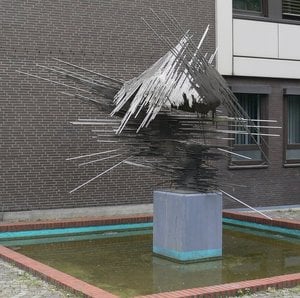
“Plastik, (2)” is a striking metal sculpture by German artist Norbert Kricke, created in 1980. The artwork presents itself as an abstract representation of a tree, constructed from interconnected metal pipes. These pipes are meticulously arranged to mimic the branching structure of a natural tree, with the metallic material forming what appears to be leaves. The sculpture is situated within an urban environment, evidenced by buildings visible in the background. Two benches provide a human element and suggest a space for contemplation or interaction with the artwork. Three potted plants further soften the industrial aesthetic, introducing organic forms into the composition.
Kricke’s “Plastik, (2)” exemplifies both Minimalism and elements of L'Art Informel. The sculpture’s geometric construction and use of industrial materials are hallmarks of the Minimalist movement, which sought to reduce art to its essential forms and eliminate representational imagery. However, the organic, flowing quality of the branches and the overall sense of dynamic growth suggest an influence from L'Art Informel, a post-World War II European artistic movement characterized by spontaneous, gestural abstraction. Kricke’s technique involves skillful welding and assembly of metal pipes to create this complex yet seemingly effortless structure. The choice of metal lends a sense of permanence and industrial strength while the flowing lines introduce an element of fragility.
This work was created during a period of significant artistic experimentation in post-war Europe. Kricke was associated with the ZERO group, an international collective of artists who rejected traditional notions of art and embraced industrial materials and technological processes. ZERO aimed to create art that reflected the era's focus on science, technology, and space exploration. “Plastik, (2)” aligns with this ethos through its use of metal—a material synonymous with industry—and its abstract form, which moves away from representational depictions of nature. The sculpture also reflects a broader trend in post-war art towards abstraction as artists sought new ways to express emotions and ideas beyond traditional figurative forms.
While abstract, “Plastik, (2)” evokes powerful symbolic associations. The tree form, even rendered in metal, suggests growth, resilience, and connection to nature—themes that resonate deeply with human experience. The sculpture’s presence within an urban setting creates a compelling juxtaposition of the natural and the man-made, prompting reflection on humanity's relationship with its environment. The work inspires a sense of calm contemplation; the flowing lines and balanced composition create a visually harmonious effect. It is both imposing in scale and delicate in execution, inviting viewers to appreciate the beauty of industrial materials transformed into an evocative artistic statement.

Norbert Kricke (1922-1984) wasn’t merely a sculptor; he was an architect of perception, a pioneer who wrestled with the very essence of space and movement. Born in Düsseldorf during a period of profound societal upheaval following World War II, Kricke’s artistic journey was deeply intertwined with the post-war desire to rebuild—not just physical structures, but also the foundations of human experience. His work, often characterized by its stark minimalism and evocative use of wire, steel, and concrete, represents a pivotal moment in the evolution of abstract sculpture, bridging the gap between the formal rigor of the Constructivists and the expressive freedom of L’Art Informel.
Kricke's early artistic training under Richard Scheibe and Hans Uhlmann at the Hochschule für Bildende Künste in Berlin provided him with a crucial grounding in traditional sculptural techniques. However, he quickly moved beyond mere representation, seeking to capture something far more elusive: the dynamic quality of space itself. This shift was profoundly influenced by his exposure to the theories of John Anthony Thwaites, particularly their exploration of “Forms of Water,” which posited that space and time were inextricably linked—a concept Kricke sought to embody in his sculptures.
Kricke’s breakthrough came with the development of what he termed *Raumplastiken* – ‘spatial sculptures.’ These weren't static objects; they were investigations into the very fabric of space, utilizing wire as a primary medium. Unlike earlier sculptors who focused on mass and volume, Kricke concentrated on line—the fundamental element that defines form and creates the illusion of depth. He meticulously crafted these lines, often employing complex geometric patterns, to suggest movement and dynamism within a confined space. This approach was revolutionary, challenging conventional notions of sculpture as a three-dimensional object and instead presenting it as an active participant in shaping our perception.
Early examples like *Raumplastik Gelb* (1951) demonstrate this shift powerfully. The work’s seemingly simple arrangement of wire immediately draws the eye, inviting viewers to trace the lines and contemplate their relationship to the surrounding space. This focus on line continued to evolve throughout his career, culminating in works that appeared almost fluid, capturing the essence of movement without depicting it literally.
Kricke’s work resonated deeply with the burgeoning L’Art Informel movement, a post-war European artistic current characterized by its rejection of formal constraints and embrace of spontaneous expression. However, Kricke distinguished himself within this group through his rigorous intellectual approach and his systematic exploration of spatial relationships. He also maintained close ties with ZERO, a German collective that similarly challenged traditional sculptural conventions, and the Nouveau Réalisme movement in France, demonstrating a broad awareness of international artistic trends.
His collaboration with Yves Klein on exploring the properties of light and space further solidified his position as a key figure in the avant-garde. The influence of Walter Gropius is also notable, particularly in Kricke’s design for water configurations for the new university complex in Baghdad – a project that underscored his belief in the interconnectedness of art, science, and human experience.
Throughout his career, Kricke created numerous significant works, including the iconic *Water Forest* sculpture outside the Gelsenkirchen Opera House (1957), a testament to his fascination with flowing water and its transformative power. His wire sculptures for Münster Theatre (1955/56) and fountains for the University of Baghdad showcased his versatility and technical skill. Perhaps most notably, Kricke served as director of the Düsseldorf Art Academy from 1972 until his death in 1984, shaping a generation of artists.
Kricke’s legacy extends far beyond his individual creations. He fundamentally altered our understanding of sculpture, demonstrating that form and space are not mutually exclusive but rather inextricably linked. His pioneering use of wire as a medium—a material often associated with industry and construction—transformed it into a tool for exploring the most profound questions about human perception and the nature of reality. His work continues to inspire artists today, reminding us of the power of art to challenge conventions and expand our horizons.
1922 - 1984


 プレビュー
プレビュー
 シェアする
シェアする シェアする
シェアする
 詳細を見る
詳細を見る

 ダウンロード
 似ている作品
 X線調査
X線調査 スライドショー
 統計情報
統計情報
 詳細を見る
詳細を見る


