当社のアーティストが、お客様のご希望のサイズと額縁に合わせて、キャンバスに手描きで制作する油彩画です。 ( プリント版に切り替え デジタル画像販売へ切り替え)





























作品のオリジナル比率に合わせた、当店の規定サイズからお選びください。

特定のフレームやスペースに合わせて、ご希望のサイズをご入力いただけます。選択されたサイズが元の画像の比率と異なる場合、アートワークをトリミングするか、手描きで要素を追加して絵画を拡張いたします。デジタルモックアップ を制作し、制作開始前にご確認(承認)をいただきます。
画面上のプレビューは、実際のトリミングや拡張を正確に反映しているものではありません。最終的な構図は、モックアップによってのみ正確にご確認いただけます。
カスタムサイズもご利用いただけますが、元の比率を維持するためには、あらかじめ用意されたリストからサイズを選択することをお勧めいたします。

Laurentian Library
複製画のサイズ
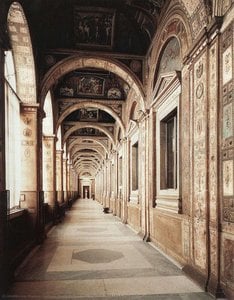
The Laurentian Library, a name that whispers of scholarly pursuit and artistic brilliance, stands as one of the most captivating architectural achievements of the High Renaissance. Designed by none other than Michelangelo Buonarroti, this extraordinary space within the Biblioteca Medicea-Laurenziana in Florence isn’t merely a repository for ancient texts; it's a meticulously crafted dialogue between classical ideals and innovative design, a testament to the genius of its creator and a poignant reflection on the era that birthed it. Commissioned by Pope Clement VII in 1530, the library was intended as a magnificent center for humanist learning, housing a vast collection amassed by the Medici family – a legacy of intellectual curiosity and artistic patronage that shaped the very fabric of Florence.
Michelangelo’s vision transcended the conventional design of libraries. He didn't simply build walls to hold books; he sculpted space itself. The long, narrow reading room, punctuated by a series of graceful arches, creates an atmosphere of profound concentration and quiet contemplation. These arches aren’t merely structural elements; they are carefully orchestrated visual cues, guiding the eye along a rhythmic path, fostering a sense of harmony and order that reflects the Renaissance fascination with proportion and balance. The building's layout is a masterful exercise in spatial composition, designed to inspire both intellectual rigor and aesthetic appreciation.
The Laurentian Library is replete with architectural details that showcase Michelangelo’s unparalleled skill and his deep understanding of classical principles. The most immediately striking element is undoubtedly the Vestibule, a dramatic entrance space designed to impress and orient visitors. Here, a majestic staircase, sculpted by Michelangelo himself, dominates the scene. This isn't just a means of ascending; it’s a work of art in its own right – an intricate dance of marble curves and elegant proportions that embodies the dynamism and expressive power characteristic of Mannerist style. The staircase serves as a powerful visual metaphor: a journey through knowledge, a climb towards enlightenment.
Beyond the Vestibule lies the main reading room, a space bathed in natural light filtering through tall windows. Rows of meticulously crafted wooden desks and benches provide a comfortable setting for scholars to immerse themselves in their studies. The high ceiling and expansive windows create an illusion of boundless space, while the ornate decorations – intricate carvings and sculptures adorning the walls and ceilings – add a layer of visual richness and symbolic depth. These details aren’t mere ornamentation; they are integral to the library's overall atmosphere, reinforcing its status as a sacred space dedicated to learning and scholarship.
The Laurentian Library is more than just a beautiful building; it’s a powerful symbol of the Renaissance spirit – a celebration of human potential, a revival of classical ideals, and an embrace of innovation. Michelangelo's design reflects his profound understanding of both ancient Greek and Roman architecture, as well as his own unique artistic vision. The library’s layout, with its emphasis on proportion, harmony, and spatial dynamism, embodies the Renaissance fascination with order and beauty. It also represents a departure from traditional architectural conventions, foreshadowing the emergence of Mannerism – a style characterized by its expressive intensity, complex forms, and subtle distortions.
The library’s significance extends beyond its aesthetic qualities. It served as a vital center for humanist learning, preserving and disseminating knowledge during a period of profound intellectual and cultural transformation. The collection housed within the Laurentian Library – including ancient manuscripts, early printed books, and rare documents – represents a priceless legacy of human achievement. Today, it continues to inspire awe and admiration from visitors around the world, serving as a tangible reminder of Florence’s enduring contribution to art, architecture, and scholarship. WahooArt offers exquisite hand-painted reproductions that capture the essence of this remarkable space, allowing you to bring its beauty into your own home or office.


1475 - 1564 , イタリア

Explore the profound genius of Leonardo, Michelangelo, and Raphael. An authoritative deep dive into the High Renaissance masters, analyzing their unique techniques, humanistic vision, and enduring influence on the world of fine art collecting.

Elevate your home with exquisite, hand-painted Renaissance reproductions by Da Vinci and Michelangelo. WahooArt offers museum-quality oil paintings, bespoke commissions, and expert art consultation for the discerning collector. Experience timeless luxury with our 100% satisfaction guarantee.

Embark on a sophisticated journey through the Sistine Chapel. Discover the profound artistry of Michelangelo’s frescoes, from the iconic ceiling to the altar wall, through an expert exploration of Renaissance mastery and theological depth.


 プレビュー
プレビュー
 シェアする
シェアする シェアする
シェアする
 詳細を見る
詳細を見る

 ダウンロード
 似ている作品
 X線調査
X線調査 スライドショー
 統計情報
統計情報


 詳細を見る
詳細を見る









 ガラスオプションは、110cm未満のサイズでのみご利用いただけます。