A Sanctuary of Knowledge: Exploring Max Ernst’s Interior
This captivating painting by
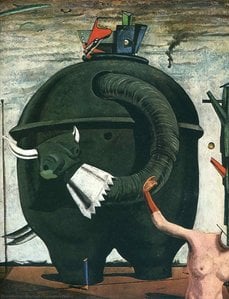
Max Ernst, tentatively titled *untitled (7458)*, offers a glimpse into an intimate and intellectually stimulating interior. The focal point is undoubtedly the imposing bookcase, densely populated with volumes that suggest a life devoted to learning and contemplation. While the date and size remain unknown, the work’s stylistic elements firmly place it within Ernst's broader artistic explorations of the mid-20th century.
Style & Technique: Surrealism Meets Domesticity
Though seemingly straightforward in its depiction of a room, *untitled (7458)* subtly embodies the principles of
Surrealism. Ernst, a pivotal figure in both Dada and Surrealist movements, often infused everyday objects and scenes with an unsettling or dreamlike quality. Here, that manifests not through overt distortion, but through the sheer weight of knowledge represented by the books – a silent, imposing presence. The painting’s technique appears to favor careful observation and rendering, yet there's a deliberate ambiguity in the light and shadow, creating a sense of quiet mystery. It diverges from his more experimental techniques like frottage or collage, suggesting a period where he explored representational forms with a surrealist sensibility.
Symbolism & Interpretation
- The Bookcase: The dominant element symbolizes the accumulation of knowledge, memory, and perhaps even the weight of history. Its size suggests an all-encompassing pursuit of understanding.
- The Chair: Positioned invitingly near the bookcase, the chair represents contemplation, rest, and the active engagement with ideas. It’s a space for the mind to wander within the world contained by the books.
- Arrangement & Order: The seemingly organized arrangement of the books hints at a desire for control and understanding in the face of vast knowledge. However, their varied positions also suggest the chaotic nature of thought itself.
Historical Context & Artistic Evolution
Ernst’s career was marked by constant reinvention. Emerging from the nihilistic fervor of Dada after World War I, he embraced Surrealism as a means to explore the subconscious and challenge conventional artistic norms. While *untitled (7458)* doesn't exhibit the overt shock tactics of some of his earlier works, it reflects his ongoing fascination with psychological themes and the power of imagery. The painting likely dates from a period where Ernst was moving between more abstract explorations and a return to figuration, seeking new ways to express his inner world.
Emotional Impact & Interior Design
The overall atmosphere is one of quietude and intellectual curiosity. It evokes feelings of comfort, solitude, and the joy of learning. The painting’s muted tones and subtle details create a calming effect, making it an ideal piece for a study, library, or any space designed to foster contemplation. For interior designers, *untitled (7458)* offers a sophisticated touch of artistic depth, blending seamlessly with classic or contemporary décor. A high-quality reproduction would bring a sense of timeless elegance and intellectual weight to any room, serving as a constant reminder of the power of knowledge and imagination.