A Journey into the Subconscious: Decoding Max Ernst’s ‘untitled (6475)’
Max Ernst's *untitled (6475)* is not merely a painting; it’s an invitation to traverse the labyrinthine corridors of the subconscious. Created sometime during his prolific career, this work stands as a quintessential example of Surrealism’s power – a movement dedicated to liberating art from the constraints of reason and embracing the illogical beauty of dreams. The canvas presents a fragmented scene, immediately drawing the viewer into its enigmatic world where familiar forms dissolve and reality itself seems to bend to the dictates of an inner landscape.
Worlds Adrift: Composition and Subject Matter
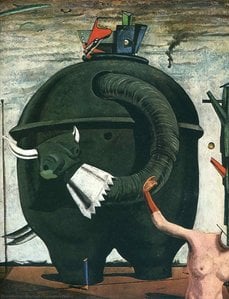
The composition is strikingly unconventional, defying any straightforward interpretation. Two figures, their heads dramatically elongated, occupy a small boat adrift on what appears to be an expansive plane of green – a surface that tantalizingly resists categorization as either land or water. Above them, the sky hosts an improbable spectacle: a sailboat and fish float amongst the clouds, disrupting our expectations of natural order. Scattered throughout this dreamscape are further enigmatic elements—a woman in a pink dress, a dog, a bag, and other symbolic objects – each contributing to the painting’s unsettling yet compelling narrative. The arrangement feels deliberately illogical, mirroring the unpredictable nature of dreams where disparate memories and desires collide. It's as if Ernst has captured a fleeting moment from a half-remembered reverie, presenting it with an arresting clarity that is both captivating and disquieting.
Cubist Roots and Surrealist Visions: Technique and Style
Ernst masterfully blends influences from Cubism and Surrealism in this piece. The angular lines, disjointed forms, and abstracted shapes echo the Cubist principles of fragmentation and multiple perspectives. However, unlike the analytical approach of early Cubism, which sought to dissect reality into its component parts, Ernst employs these techniques to evoke an emotional response rather than a purely intellectual one. The visible brushstrokes and somewhat rough texture, achieved with oil paint on canvas, add depth and physicality to the dreamscape, grounding the ethereal imagery in a tangible reality. The diffuse lighting, lacking strong shadows, further enhances the sense of ambiguity and unreality, creating an atmosphere that is both haunting and beautiful. This isn’t simply a depiction of a scene; it's an evocation of a feeling—a sense of disorientation, isolation, and perhaps even longing.
A Pioneer of the Avant-Garde: Historical Context and Interpretation
Max Ernst (1891-1976) was a pivotal figure in 20th-century art. Initially associated with Dadaism – a movement born out of disillusionment with the horrors of World War I – he quickly became a leading light of Surrealism, pushing the boundaries of artistic expression and challenging conventional notions of reality. His artistic journey was marked by experimentation and innovation; he pioneered techniques like *frottage* (rubbing textures onto paper) and collage, constantly seeking new ways to unlock the power of the subconscious mind. The symbolism within *untitled (6475)* is deliberately open-ended, inviting viewers to project their own interpretations onto the canvas. The elongated heads of the figures could represent alienation or a sense of being stretched and distorted by modern life. The boat adrift on an undefined surface might symbolize isolation or a journey into the unknown. The seemingly random juxtaposition of objects encourages us to create our own narratives, tapping into our personal associations and subconscious thoughts. Ultimately, *untitled (6475)* is not about finding definitive answers; it’s about embracing the mystery and allowing ourselves to be swept away by the currents of the imagination.
Emotional Resonance and Aesthetic Appeal
This painting evokes a sense of unease, disorientation, and wonder. It's a work that stays with you long after you've looked away, prompting contemplation about the nature of reality, identity, and the power of the subconscious. Its unique aesthetic – a blend of abstraction, surreal imagery, and expressive brushwork – makes it a compelling addition to any art collection or interior space. The dreamlike quality lends itself particularly well to spaces seeking an atmosphere of intrigue and intellectual stimulation, offering a constant source of visual fascination and emotional resonance.



 プレビュー
プレビュー
 プリントを購入
 シェアする
シェアする シェアする
シェアする
 詳細を見る
詳細を見る

 ダウンロード
 似ている作品
 X線調査
X線調査 スライドショー

 詳細を見る
詳細を見る






































 ガラスオプションは、110cm未満のサイズでのみご利用いただけます。