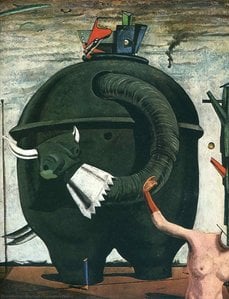
Unveiling the Enigma: Max Ernst’s “Untitled (2964)”
Max Ernst's "Untitled (2964)" is not merely a depiction of a desert scene; it’s an immersion into the subconscious, a meticulously crafted exploration of the surreal that defines much of the artist’s oeuvre. This enigmatic work, painted by the German master in what remains unknown date, presents a group of figures adrift within a stark, almost desolate landscape – a tableau ripe with psychological and philosophical implications. The painting immediately draws the viewer into a realm where reality bends to the will of the imagination, inviting contemplation on themes of isolation, observation, and the unsettling nature of human interaction.
A Surrealist Genesis: Ernst’s Intellectual Framework
Born in Brühl, Germany, in 1891, Max Ernst was a profoundly unconventional artist. His artistic trajectory wasn't forged through traditional academic routes but rather through a relentless pursuit of knowledge across diverse fields – philosophy, art history, psychology, and psychiatry – all nurtured under the influence of his teacher father, who instilled both sensitivity and rebellion. This intellectual grounding is palpable in "Untitled (2964)," where the arrangement of figures, the barren landscape, and the implied narrative resonate with Ernst’s fascination with the unconscious mind and his desire to challenge conventional perceptions. His early exposure to Dadaism and its rejection of established norms further fueled this exploration of the irrational and dreamlike.
Decoding the Desert Landscape
The scene itself is a masterclass in surrealist composition. The figures, scattered across the foreground and receding into the distance, create a sense of unease and disorientation. Their interactions – or lack thereof – are ambiguous, prompting questions about their motivations and relationships. The vast, empty desert, devoid of any recognizable vegetation or water source, amplifies this feeling of isolation and vulnerability. This desolate setting isn’t simply a backdrop; it's an active participant in the painting’s unsettling atmosphere, mirroring perhaps the inner landscapes of the figures themselves. Ernst frequently employed techniques like frottage – rubbing pencil over textured surfaces to create unexpected images – which likely informed the organic, almost dreamlike quality of this composition.
Symbolism and Emotional Resonance
"Untitled (2964)" is rich in symbolic potential. The items carried by some of the figures—a handbag and a bowl—suggest a fleeting connection to domesticity or perhaps a futile attempt to impose order on the chaotic scene. The large tree trunk, dominating the composition, could represent both life and decay, memory and oblivion. The overall effect is profoundly evocative, stirring feelings of melancholy, mystery, and a subtle sense of dread. It’s a painting that lingers in the mind long after viewing, prompting viewers to confront their own anxieties about existence and perception. This piece exemplifies Ernst's ability to tap into primal emotions through carefully constructed imagery.



 プレビュー
プレビュー
 手描きの絵画を購入
 シェアする
シェアする シェアする
シェアする
 詳細を見る
詳細を見る

 ダウンロード
 似ている作品
 X線調査
X線調査 スライドショー

 詳細を見る
詳細を見る






































 ガラスオプションは、110cm未満のサイズでのみご利用いただけます。