

このページに掲載されている作品は著作権法によって保護されており、当社の許可なく同一の複製物を制作または販売することは法律で禁じられています。この保護は、以下のような国際条約に基づき執行されます。 ベルヌ条約 および、以下の条項に定められたものを含む各国の法律により、 米国著作権法 第17編。
この手法は、著作権で保護された作品の複製や複写を伴わないため、著作権法に完全に準拠しています。これは単なる模倣ではなく、創造的な再解釈です。元の作品からインスピレーションを受けつつも、それとは異なる、全く新しい絵画を生み出すものです。
スピーディーな制作と多彩な仕上げオプションが魅力の、ミュージアムクオリティなジークレー・キャンバスプリント。 ( 手描き複製画を注文する デジタル画像販売へ切り替え)
作品のオリジナル比率に合わせた、当店の規定サイズからお選びください。

額縁や壁のスペースに合わせて、ご希望の幅と高さを入力してください。プリントはカットすることは可能ですが、元の画像より大きくすることはできないため、異なる比率のサイズを選択された場合は、画像の一部が欠けることになります。印刷を開始する前に、内容を確認していただくためのデジタルモックアップをお送りいたします。このページに表示されている画像は、実際のカット後の状態を示すものではありません。実際の仕上がりはモックアップにてご確認ください。
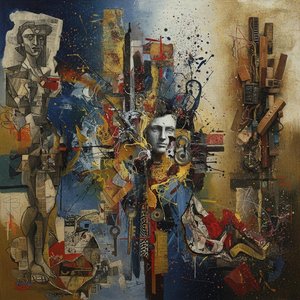
Untitled
複製画サイズ一覧
In the heart of Leipzig, a city where the echoes of classical tradition meet the pulse of contemporary experimentation, the work of Matthias Weischer emerges as a profound meditation on space, memory, and the boundaries of perception. Born in 1973 in Elte, North Rhine-Westphalia, Weischer has become a pivotal figure within the New Leipzig School, a movement celebrated for its ability to bridge the gap between rigorous academic training and the fluid, often surrealist explorations of modern life. His journey through the prestigious Hochschule für Grafik und Buchkunst (HGB) in Leipzig, where he studied under Professor Sighard Gille, provided him with a formidable technical foundation—a mastery of form and color that would later serve as the scaffolding for his more complex, layered compositions.
Weischer’s early career was marked by a fascination with the theatricality of the interior. During the late 1990s and early 2000s, his canvases often presented deserted, stage-like settings that felt both intimate and hauntingly vacant. These works utilized furniture, everyday objects, and large-scale ornaments that subtly referenced the aesthetics of the 1950s and 1960s. Through a collage-like approach, he constructed environments that functioned as much like puzzles as they did landscapes, establishing an ambiguous relationship between the viewer and the depicted space. This period was characterized by a tension between the figurative and the abstract, where the solidity of an object would often dissolve into a pattern or a void, challenging the eye to find a stable point of reference.
A transformative moment in Weischer’s evolution occurred during his residency in Rome in 2007. This period of intense study led him away from the structured, man-made interiors toward the organic complexities of nature and landscape. The heavy, staged atmospheres of his earlier work began to give way to a lighter, more delicate exploration of botanical specimens and natural vistas. His palette shifted toward softer, more ethereal tones, and he began to experiment extensively with paper and various printing techniques. This transition did not represent a departure from his interest in complexity but rather a redirection of it; instead of finding mystery in the arrangement of furniture, he sought it within the intricate textures of flora and the subtle gradients of light.
In this later phase, Weischer’s work often oscillates between the tangible and the illusory. His process remains deeply rooted in meticulous observation, yet there is a palpable sense of the dreamlike. He possesses a unique ability to manipulate color and texture so that a landscape might appear as a flat pattern or, conversely, that a simple floral arrangement might possess a sculptural depth. This duality creates a mesmerizing visual experience, where the viewer is caught in a perpetual state of discovery, peeling back layers of pigment to reveal hidden depths of meaning and form.
The significance of Matthias Weischer lies in his ability to maintain the relevance of painting in an era dominated by digital fragmentation. While some contemporary interpretations suggest a fusion of classical technique with modern computational vision, his true strength remains his capacity to evoke emotion through the physical manipulation of medium. His work has been showcased on the world's most prestigious stages, from the Venice Biennale to major institutions such as the Museum of Contemporary Art in Los Angeles and the Cleveland Museum of Art.
Today, Weischer continues to push the boundaries of his practice, occasionally venturing into three-dimensional sculptural arrangements that extend his exploration of space beyond the two-dimensional plane. His contribution to the contemporary art canon is defined by several key achievements:
Through his evocative use of light and shadow, Weischer invites us into a world where the boundaries between reality and imagination are perpetually blurred, leaving us to wonder what lies beneath the surface of the seen.

1973 - , Germany

Immerse yourself in the profound emotion of Abstract Expressionism. Explore our curated guide to the top 25 Mark Rothko masterpieces, from iconic color field paintings to museum-quality reproductions for your decor. Discover all masterpieces on WahooArt.com.

Explore the profound world of Art Brut and Outsider Art. From Jean Dubuffet’s raw textures to the psychological depth of primitive forms, discover how this untamed movement redefines modern collecting through an art-historical lens.
Journey through history with 10 iconic mixed media masterpieces that redefined modern art. Explore the stories, textures, and techniques behind these legendary works. Find museum-quality reproductions and curated decor inspiration at WahooArt.com. Discover all masterpieces online.
 設置イメージを表示

 シェアする
 シェアする
 詳細を見る
 ガイドを表示


 ダウンロード
 似ている作品
 X線調査
 スライドショーを表示
 Q&A

 統計情報
 詳細を表示






































 ガラスオプションは、110cm未満のサイズでのみご利用いただけます。


