
x


 Oil On CanvasWallArtBaroque
 118.0 x 153.0 cm
 Szépművészeti Múzeum




























作品のオリジナル比率に合わせた、当店の規定サイズからお選びください。

特定のフレームやスペースに合わせて、ご希望のサイズをご入力いただけます。選択されたサイズが元の画像の比率と異なる場合、アートワークをトリミングするか、手描きで要素を追加して絵画を拡張いたします。デジタルモックアップ を制作し、制作開始前にご確認(承認)をいただきます。
画面上のプレビューは、実際のトリミングや拡張を正確に反映しているものではありません。最終的な構図は、モックアップによってのみ正確にご確認いただけます。
カスタムサイズもご利用いただけますが、元の比率を維持するためには、あらかじめ用意されたリストからサイズを選択することをお勧めいたします。

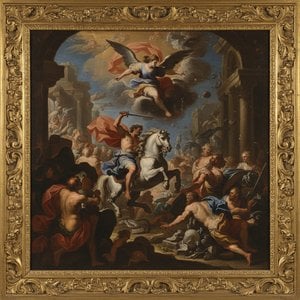
Jupiter and Mnemosyne
複製画のサイズ
To gaze upon Marco Liberi's depiction of Jupiter and Mnemosyne is to step directly into the luminous drama of classical mythology. This magnificent oil on canvas, steeped in the grandeur of the 17th century, does more than merely hang on a wall; it invites the viewer into an ethereal moment where divine power meets eternal memory. The composition itself is breathtakingly dramatic, capturing the instant Jupiter descends upon Mnemosyne. Liberi masterfully frames this encounter, presenting a scene rich with narrative tension and profound symbolic weight.
At the heart of the painting lies the potent symbolism drawn from Greek lore. Mnemosyne, the goddess personifying memory itself, reclines upon a richly patterned couch, embodying tranquility amidst the divine storm. Above her descends Jupiter, represented by the formidable form of an eagle—a creature symbolizing his immense power and celestial reach. Their union is not merely physical; it is the mythological genesis of the Muses, suggesting that true inspiration and art are born from powerful connections between intellect and memory. Liberi’s genius shines through in how he handles the interplay between these elements: the delicate pallor of Mnemosyne contrasts sharply with the dark, muscular presence of the eagle, creating a visual dialogue that speaks volumes about creation itself.
Technically speaking, this work is a superb testament to the height of Venetian Baroque painting. Liberi’s handling of oil on canvas allows for an astonishing depth and luminosity. Observe how the artist uses light not just to illuminate, but to sculpt. The play of light across Mnemosyne's nude form accentuates her graceful contours, while the brushwork detailing the eagle's feathers suggests both immense power and delicate texture. This attention to plasticity—the way forms appear three-dimensional—is characteristic of the period, giving the entire scene a palpable sense of weight and reality, despite its mythological subject matter.
Originally conceived, perhaps as an overdoor decoration in a Venetian palace, this piece carries an inherent architectural grandeur. For the modern collector or designer, reproducing this artwork offers an unparalleled opportunity to infuse a space with historical resonance and artistic drama. Imagine its presence anchoring a grand hall or a library—a focal point that whispers tales of antiquity and divine inspiration. The rich color palette, combined with the dramatic composition, ensures that it functions as both a breathtaking piece of art and a sophisticated statement of taste.

In the golden age of the Venetian Baroque, few artists captured the ethereal intersection of divine myth and human emotion as poignantly as Marco Liberi. Born around 1640 in the vibrant maritime republic of Venice, Liberi emerged from a lineage of artistic excellence. As the son of the esteemed painter Pietro Liberi, his very foundation was steeped in the traditions of classical observation and the expressive, color-driven language of the Venetian school. His early years were spent under his father's watchful eye, absorbing not just the technical rigors of oil painting, but a profound reverence for the humanist ideals and ancient narratives that would later define his mature style. While much of his early training took place in Padua, it was within the atmospheric splendor of Venice that his talent truly blossomed, allowing him to become a master of the mythological cabinet painting.
The artistry of Liberi is characterized by a breathtaking symphony of light and shadow, a technique that breathes life into the static canvas. He was a practitioner of sfumato, employing subtle gradations of tone to dissolve harsh outlines, thereby creating an atmospheric depth that feels almost otherworldly. To gaze upon his work is to witness a masterclass in Venetian Baroque execution; he utilized light not merely as a tool for visibility, but as a sculptural element to define form and evoke mood. His palette was famously luminous, capable of transitioning from the soft, pearlescent skin tones of a goddess to the dark, muscular textures of a celestial predator with seamless grace. This mastery of chiaroscuro allowed him to imbue his mythological scenes with a sense of dramatic tension and palpable movement.
Liberi’s repertoire was primarily dedicated to the grand narratives of Greek and Roman antiquity, a genre that offered endless opportunities for allegorical expression. His works often functioned as more than mere illustrations of myth; they were complex meditations on power, memory, and the divine. One of his most captivating achievements can be seen in his depiction of Jupiter and Mnemosyne. In this profound composition, the artist captures the precise moment of a divine encounter, where the king of the gods descends upon the personification of memory. Through the clever use of symbolism—such as the formidable eagle representing Jupiter’s celestial reach contrasting with the tranquil, reclining figure of Mnemosyne—Liberi suggests that all true art and inspiration are born from the union of intellect and remembrance.
This ability to weave complex layers of meaning into his compositions elevated his status among the Venetian elite. His paintings were often designed for intimate settings, such as private collections or scholarly studies, where viewers could linger over the intricate details of his brushwork. Whether portraying Jupiter and Asteria or other allegorical subjects, Liberi maintained a consistent focus on the following elements:
Though the biographical details of Marco Liberi’s later years remain somewhat veiled by the passage of time, his impact on the Venetian landscape is undeniable. He stood as a bridge between the rigorous traditions of his father's generation and the increasingly dramatic, emotive flourishes of the late Baroque period. His career, which saw him active in both Padua and Venice until his death around 1691, contributed significantly to the flourishing of mythological painting in Italy. By refining the techniques of light and color inherited from the Venetian masters, he helped ensure that the era's fascination with classical antiquity remained visually spectacular and intellectually stimulating.
Today, Liberi is remembered not just as a follower of his father’s style, but as an artist who possessed a unique, luminous voice. His legacy lives on in the way his canvases continue to invite viewers into a world where the boundaries between the mortal and the divine are blurred by a masterful stroke of a brush. In the grand tapestry of art history, Marco Liberi remains a vital thread, representing the pinnacle of Venetian mythological storytelling.

1644 - 1691 , Italy

Embark on a sophisticated journey through the eternal allure of mythological art. Discover how master painters breathe life into ancient legends, from Greek deities to Baroque masterpieces, and learn to curate these timeless narratives within your own exquisite art collection.
Explore the breathtaking power of Baroque art. Delve into the dramatic interplay of light, shadow, and motion through the works of masters like Caravaggio. Discover how the era's intense emotional realism continues to inspire collectors and connoisseurs of classical grandeur.

Master the nuances of Giclée printing with our expert guide. Discover how pigment-based inks and museum-grade substrates create fade-resistant, high-fidelity art reproductions designed for discerning collectors seeking unparalleled quality and longevity.

Explore the profound elegance of Baroque Classicism. Discover how masters fused dramatic chiaroscuro with structured order to redefine art history through light, shadow, and emotional grandeur.


最新の美術ニュース、限定オファー、そしてインテリアのアイデアをいち早くお届けします。
お客様のプロジェクトについてお聞かせください。当社の美術専門家が、お客様に合わせた3つのパーソナライズされた芸術提案をご提供いたします。
あなたにぴったりの3作品を無料で厳選いたします


 プレビュー
プレビュー
 プリントを購入
 シェアする
シェアする シェアする
シェアする
 詳細を見る
詳細を見る

 ダウンロード
 似ている作品
 X線調査
X線調査 スライドショー
 詳細を見る
詳細を見る









 ガラスオプションは、110cm未満のサイズでのみご利用いただけます。


