
 PrintWallArtDadaism
 1968Late Medieval
 34.0 x 23.0 cm
当社のアーティストが、お客様のご希望のサイズと額縁に合わせて、キャンバスに手描きで制作する油彩画です。 ( プリント版に切り替え デジタル画像販売へ切り替え)





























作品のオリジナル比率に合わせた、当店の規定サイズからお選びください。

特定のフレームやスペースに合わせて、ご希望のサイズをご入力いただけます。選択されたサイズが元の画像の比率と異なる場合、アートワークをトリミングするか、手描きで要素を追加して絵画を拡張いたします。デジタルモックアップ を制作し、制作開始前にご確認(承認)をいただきます。
画面上のプレビューは、実際のトリミングや拡張を正確に反映しているものではありません。最終的な構図は、モックアップによってのみ正確にご確認いただけます。
カスタムサイズもご利用いただけますが、元の比率を維持するためには、あらかじめ用意されたリストからサイズを選択することをお勧めいたします。

Selected Details after Cranach
複製画のサイズ
Marcel Duchamp’s “Selected Details after Cranach and Relâche,” created in 1968, isn't a painting in the traditional sense; it’s an etching and aquatint—a subtle yet profound meditation on representation, appropriation, and the very nature of art itself. This deceptively simple work, measuring just 34 x 23 centimeters, invites prolonged contemplation, revealing layers of intellectual engagement that echo Duchamp's revolutionary spirit and his deep respect for the German Renaissance master Lucas Cranach the Elder.
The image depicts two nude figures—a man and a woman—standing in a stark, almost clinical arrangement. They are rendered with an astonishing economy of line; the forms emerge not through detailed shading or vibrant color, but through precise, unwavering black ink on pristine white paper. This minimalist approach immediately establishes a sense of detachment, pulling the viewer away from the immediate sensuality of the subject matter and into a realm of conceptual inquiry. The figures are positioned side-by-side, their gazes averted, creating an atmosphere of quiet contemplation—or perhaps, unsettling ambiguity. The composition is remarkably centered, emphasizing the duality presented before us.
Duchamp’s choice to work in etching and aquatint speaks volumes about his artistic intentions. Etching involves using acid to create lines on a metal plate, while aquatint employs dust to produce tonal variations. This combination allows for both sharp detail and subtle gradations of gray—essential elements in conveying the figures' forms with such understated elegance. Crucially, Duchamp’s process deliberately departs from traditional representation. He doesn’t attempt to faithfully reproduce Cranach’s style; instead, he uses the etching technique as a vehicle for exploring his own ideas about perception and the illusion of reality.
The reference to Lucas Cranach is deliberate and complex. Cranach was a prolific painter of mythological and allegorical scenes, often depicting nude figures in dynamic poses. Duchamp’s work isn't a direct copy but rather an “after” – a selection of details, a distillation of Cranach’s approach. He seems to be interrogating the very act of representation, questioning how we perceive and interpret images, particularly those rooted in classical tradition.
Beyond its formal qualities, “Selected Details after Cranach and Relâche” is laden with symbolic weight. The nude figures themselves are open to interpretation—they could represent lovers, companions, or simply two individuals engaged in a silent exchange. The averted gazes suggest a lack of connection, perhaps reflecting the inherent limitations of representation itself. Duchamp’s inclusion of “Relâche,” a term he used to describe his approach to art as a kind of ‘release,’ hints at a desire to dismantle traditional notions of artistic value and challenge viewers to actively participate in the creation of meaning.
The work's starkness—the black ink against white paper—evokes a sense of vulnerability, stripping away any superficial ornamentation. It’s a deliberate act of reduction, forcing us to confront the essential elements of the image and consider what remains when everything else is removed. The reference to “Cranach” adds another layer of complexity, suggesting a dialogue between past and present, tradition and innovation.
“Selected Details after Cranach and Relâche” stands as a pivotal work in Duchamp’s oeuvre and a cornerstone of conceptual art. It exemplifies his relentless questioning of artistic conventions and his willingness to challenge the very definition of what constitutes “art.” The piece's enduring appeal lies not only in its formal beauty but also in its profound intellectual depth—a testament to Duchamp’s genius as both an artist and a thinker. Reproductions, like this one, offer a chance to engage with this complex and rewarding work, inviting us to contemplate the relationship between image, representation, and our own perceptions of reality.


1887 - 1968 , フランス

Explore the profound elegance of minimalist art. Discover how the precision of a single line transforms simple geometry into timeless masterpieces for the discerning collector seeking sophistication and depth in fine art acquisitions.

Explore the radical world of Dadaism with our expert-led deep dive. From Duchamp's readymades to the aesthetics of chaos, uncover how this anti-art movement redefined modern creativity and paved the way for Surrealism. A must-read for art students and history enthusiasts alike.
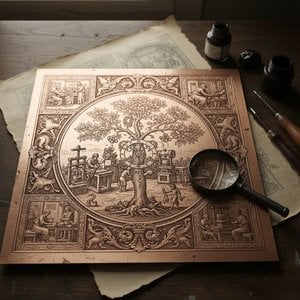
Explore the intricate world of etching and intaglio printmaking. Discover how masters use acid and metal to create profound textures and lines, from Romanticism to modern era, through an expert lens of art history and technical mastery.


 プレビュー
プレビュー
 シェアする
シェアする シェアする
シェアする
 詳細を見る
詳細を見る ガイド
ガイド

 ダウンロード
 似ている作品
 X線調査
X線調査 スライドショー
 統計情報
統計情報 詳細を見る
詳細を見る









 ガラスオプションは、110cm未満のサイズでのみご利用いただけます。


