作品詳細説明
A Dreamscape of Rural Life: Analyzing Marc Chagall’s “Village”
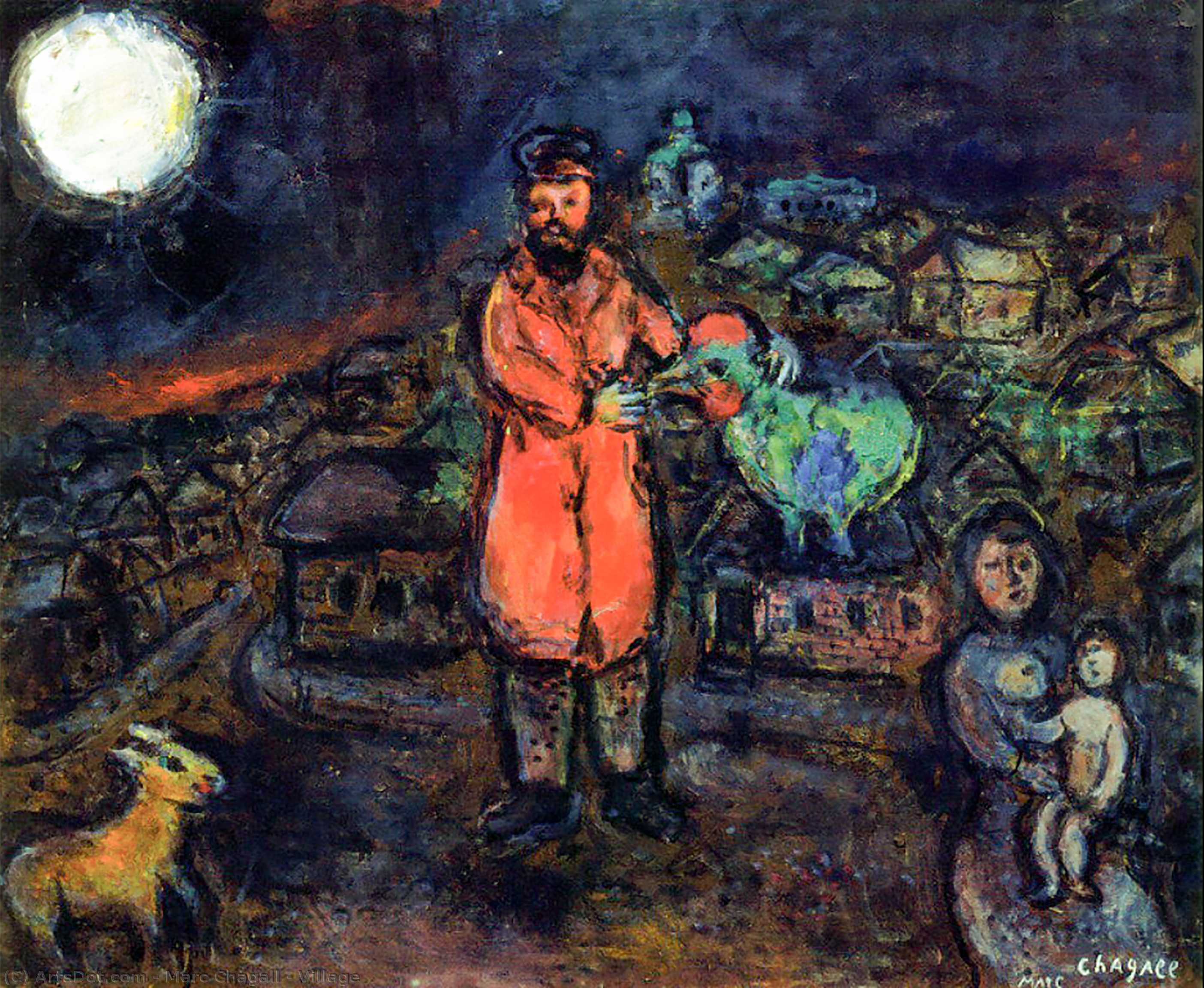
Marc Chagall's "Village," painted in 1975, stands as a quintessential example of Naïve Art—a style that prioritizes raw emotion and imaginative storytelling over meticulous realism. Created during his prolific period in Saint-Paul-de-Vence, France, this oil painting on wood embodies Chagall’s signature blend of Cubist influences with the expressive freedom characteristic of Primitivism. Measuring 73 x 92 cm, it captures a serene nighttime scene depicting a man holding a sheep in his arms amidst a quaint village nestled beneath a luminous moon.
The Essence of Naïve Art: Simplicity and Symbolism
Naïve Art emerged in the early 20th century as a reaction against academic conventions, championed by artists like Niko Pirosmani—a Georgian painter who eschewed formal training for an intuitive approach to artmaking. Chagall’s “Village” exemplifies this aesthetic perfectly; its bold colors – predominantly reds, blues, and yellows – are juxtaposed with simplified forms that convey profound meaning beyond mere visual representation. The artist deliberately avoids perspective and anatomical accuracy, opting instead for a dreamlike quality that invites contemplation and emotional resonance.
A Detailed Examination of Composition and Technique
The painting’s composition is carefully balanced, guiding the viewer's eye across the canvas. A man dominates the foreground, cradling a sheep—a recurring motif in Chagall’s oeuvre symbolizing innocence and vulnerability. Scattered figures populate the hillside landscape, illuminated by the moon’s ethereal glow, adding to the narrative richness of the scene. Two prominent birds – one positioned near the top left corner and another towards the bottom right – serve as visual anchors and contribute to the painting's symbolic depth, representing freedom and aspiration. Chagall employs loose brushstrokes and vibrant pigments—a hallmark of his technique—to achieve an impressionistic effect that captures the atmosphere of rural tranquility.
Chagall’s Artistic Legacy: Modernism Meets Folklore
Marc Chagall (1887-1985) was profoundly influenced by movements like Cubism and Surrealism, alongside Naïve Art. However, he skillfully integrated these influences into his own distinctive style—characterized by fantastical imagery rooted in Jewish folklore and biblical narratives. “Village” exemplifies this fusion, demonstrating Chagall’s ability to transcend stylistic boundaries while conveying universal themes of peace, harmony, and the beauty of nature. His work continues to inspire artists and collectors alike, cementing his place as one of the most celebrated painters of the 20th century.
Beyond Reproduction: Exploring Chagall's Artistic Universe
For those seeking a deeper understanding of Chagall’s artistic vision, exploring works like “Russian Village” (73 x 92 cm), "The Return of the Prodigal Son" (80 x 59 cm) and “Circus in the Village” (Naive Art / Primitivism, Gouache) offers invaluable insight into his stylistic evolution and thematic preoccupations. Consider commissioning a high-quality reproduction from WahooArt.com to bring Chagall’s evocative imagery into your home or workspace—a testament to the enduring power of art and its ability to transport us beyond the everyday.



 プレビュー
プレビュー
 手描きの絵画を購入
 シェアする
シェアする シェアする
シェアする
 詳細を見る
詳細を見る

 ダウンロード
 似ている作品
 X線調査
X線調査 スライドショー


 詳細を見る
詳細を見る






































 ガラスオプションは、110cm未満のサイズでのみご利用いただけます。