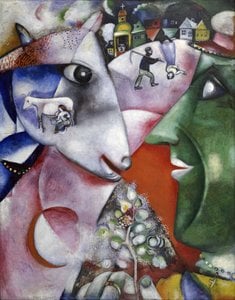
A Dreamscape of Parisian Light: Unveiling Chagall’s “View over Notre-Dame”
Marc Chagall's "View over Notre-Dame," painted in 1980, isn’t merely a depiction of a Parisian landmark; it’s an immersion into the artist’s intensely personal and profoundly symbolic world. Born Moishe Shagal in 1887 in Liozna, Belarus, Chagall cultivated a unique artistic language rooted in his Jewish heritage, folklore, and a lifelong fascination with dreams and memory. This particular work, created during a period of considerable reflection and experimentation, embodies the culmination of these influences, offering a glimpse into the artist’s inner landscape as much as it presents a view of the city.
The painting immediately captivates with its vibrant palette – a symphony of rose pinks, blues, greens, and yellows that evoke both the warmth of a summer evening and the ethereal quality of a dream. The composition is dynamic yet strangely serene; a reclining nude figure dominates the lower portion of the canvas, her back turned to the viewer, creating an immediate sense of intimacy and mystery. Above her floats a luminous, almost angelic figure, holding a bouquet – a potent symbol of offering, blessing, and perhaps even remembrance. The presence of three birds, strategically placed throughout the scene, adds another layer of symbolic richness, often associated with freedom, spirituality, and messengers from beyond.
Naïve Art and the Language of Emotion
“View over Notre-Dame” firmly places Chagall within the realm of Naïve Art (or Primitivism), a style characterized by its directness, lack of academic training, and emphasis on emotional expression. Unlike traditional representational art, Chagall eschews meticulous detail in favor of bold colors, simplified forms, and an intuitive approach to composition. This deliberate simplification allows the painting’s emotional core – a sense of longing, tranquility, and perhaps even melancholy – to resonate powerfully with the viewer. The lack of precise perspective and realistic rendering contributes to the dreamlike atmosphere, inviting us to interpret the scene through our own emotions and experiences.
The choice of Notre-Dame as the focal point is significant. While the cathedral itself is relegated to the background, it’s not absent; rather, it exists as a silent witness to the unfolding drama below. The painting isn't about a literal representation of Paris but about capturing a feeling—a memory, an aspiration, or perhaps even a meditation on faith and mortality. This aligns with Chagall’s broader artistic project: to translate his inner world onto canvas, using visual metaphors to communicate profound spiritual and emotional truths.
A Window into Chagall's World
Considering the painting’s creation in 1980, a period marked by both personal reflection and renewed engagement with his art, it offers a poignant glimpse into Chagall’s evolving vision. His earlier works were deeply influenced by Jewish folklore and biblical narratives; however, as he aged, his style became increasingly abstract and expressive, prioritizing emotional impact over precise representation. “View over Notre-Dame” represents a delicate balance between these influences – retaining elements of his signature symbolism while embracing a more fluid and evocative approach to composition. The painting’s enduring appeal lies in its ability to transport the viewer to Chagall's world—a realm where dreams, memory, and faith converge in a dazzling display of color and emotion.
This reproduction captures the essence of this remarkable artwork, allowing you to experience the magic of Chagall’s vision firsthand. It is more than just a beautiful image; it's an invitation to contemplate the mysteries of life, love, and the enduring power of art.



 手描きの絵画を購入
 シェアする
シェアする シェアする
シェアする
 詳細を見る
詳細を見る

 ダウンロード
 似ている作品
 スライドショー


 詳細を見る
詳細を見る






































 ガラスオプションは、110cm未満のサイズでのみご利用いただけます。