作品解説
A Window Into Dreams: Exploring Marc Chagall’s “Sobakevich at Table”
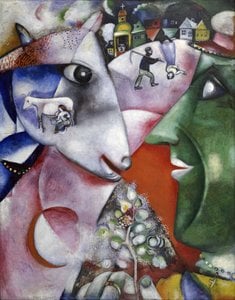
Marc Chagall's "Sobakevich at Table," created around 1923 in Paris, France, stands as a testament to the artist’s unwavering commitment to capturing the essence of memory and imagination—a cornerstone of his celebrated Naïve Art style. This etching, part of the “Dead Souls” series, transcends mere depiction; it's an invitation into Chagall’s deeply personal visual lexicon, where recognizable forms intertwine with fantastical elements to convey profound emotional resonance.
The Style of Primitivism: Simplicity as Revelation
Chagall’s artistic vision firmly resides within the realm of Primitivism or Naïve Art, a movement that deliberately eschews academic conventions in favor of direct observation and unfiltered emotion. Unlike polished realism, “Sobakevich at Table” prioritizes clarity and immediacy—a stylistic choice that powerfully amplifies its impact. The artist employs bold lines and flattened perspectives, reminiscent of folk art traditions, to create an image brimming with vitality and imbued with a childlike wonder. This deliberate simplification isn’t merely aesthetic; it serves as a conduit for conveying universal themes of solitude, contemplation, and the enduring power of human connection.
Technique and Material: Etching's Delicate Dance
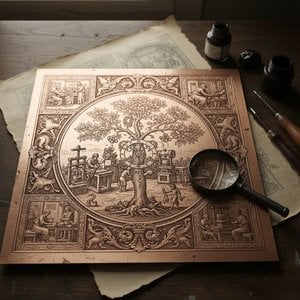
The etching process itself contributes significantly to the artwork’s distinctive character. Chagall utilized drypoint technique—a method involving scratching lines into a copper plate—resulting in rich tonal variations and textural nuances that would have been unattainable with conventional engraving. These subtle marks, visible upon completion of the print, capture the artist's meticulous attention to detail while simultaneously reinforcing the overall impression of spontaneity. The resulting image possesses an ethereal quality, mirroring the dreamlike atmosphere characteristic of Chagall’s oeuvre.
Historical Context: Vitebsk and the Spirit of Its Time
“Sobakevich at Table” emerged during a period marked by considerable artistic experimentation and intellectual ferment—the aftermath of World War I and the burgeoning avant-garde movement in Europe. Chagall's formative years were spent in Vitebsk, Belarus, a city steeped in Jewish cultural heritage and grappling with the complexities of Russian Orthodox influence. This dual identity profoundly shaped his artistic sensibility, informing his recurring motifs of biblical figures, rural landscapes, and stylized representations of human experience. The etching reflects the broader anxieties and aspirations of its time—a yearning for authenticity amidst rapid societal change.
Symbolism: Food as Remembrance
Beyond its stylistic considerations, “Sobakevich at Table” is laden with symbolic significance. The central figure’s preoccupation with his meal serves as a poignant reminder of cherished memories and sensory experiences—themes frequently explored by Chagall throughout his career. The food itself – depicted with careful attention to detail – symbolizes nourishment not only for the body but also for the soul, representing sustenance for the mind and spirit. Furthermore, the table acts as a focal point, anchoring the composition and emphasizing the importance of ritual and tradition within Jewish culture.
Emotional Resonance: Quiet Contemplation
Ultimately, “Sobakevich at Table” succeeds in conveying a profound sense of emotional stillness—a contemplative gaze directed inward rather than outward. The artist’s masterful use of color (though rendered in monochrome) evokes a palpable atmosphere of serenity and introspection. It invites viewers to pause and consider the simple joys of existence, mirroring Chagall's own belief that art should illuminate the deepest recesses of human consciousness. This etching remains an enduring emblem of Chagall’s artistic legacy—a captivating glimpse into his inner world and a timeless celebration of imagination as a pathway to understanding.



 プレビュー
プレビュー
 プリントを購入
 シェアする
シェアする シェアする
シェアする
 詳細を見る
詳細を見る

 ダウンロード
 似ている作品
 X線調査
X線調査 スライドショー

 詳細を見る
詳細を見る






































 ガラスオプションは、110cm未満のサイズでのみご利用いただけます。