作品詳細説明
A Symphony of Dreams: Exploring Marc Chagall’s “Creation”
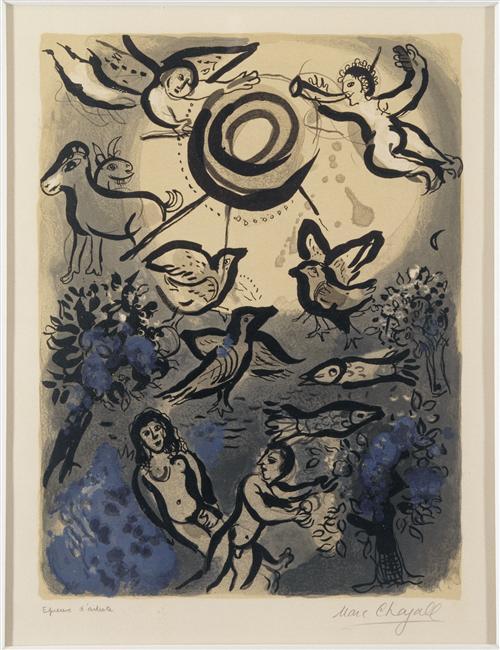
The painting "Creation" by Marc Chagall, completed in 1960, isn't merely a depiction of animals; it’s an embodiment of the artist’s lifelong preoccupation with mythic narratives and deeply felt emotion. Born Moishe Shagal in Liozna, Belarus, Chagall’s formative years were steeped in Jewish folklore and Orthodox tradition—influences that permeate every brushstroke of his oeuvre, particularly evident in this monumental lithograph. The scene unfolds as a vibrant tapestry woven from fantastical imagery, transporting the viewer into a realm where earthly concerns dissolve amidst an exuberant celebration of life's primal forces.
Lithography: A Technique Rooted in Tradition
Chagall’s masterful use of lithography—a printing process dating back centuries—contributes significantly to the artwork’s distinctive aesthetic. Unlike oil paints, which offer rich textures and blending capabilities, lithography relies on transferring ink from a stone matrix onto paper through pressure. This method lends itself beautifully to capturing intricate detail and achieving astonishing tonal range, allowing Chagall to convey an unparalleled sense of luminosity and depth. The subtle variations in color and shading create an ethereal quality that underscores the painting’s dreamlike atmosphere.
Symbolism Within Surreal Landscapes
The composition is brimming with symbolic resonance. The multitude of birds—a recurring motif throughout Chagall's work—represent freedom, aspiration, and spiritual transcendence. Their soaring flight embodies a yearning for something beyond the confines of earthly existence. Similarly, the cows symbolize fertility and abundance, anchoring the fantastical elements within a grounding connection to the natural world. The fish, positioned strategically across the canvas, evoke notions of regeneration and divine providence – mirroring Chagall’s own Jewish heritage and his belief in cyclical renewal.
Historical Context: Echoes of Vitebsk's Cultural Crossroads
“Creation” was created during a period marked by significant artistic experimentation and intellectual ferment—the aftermath of World War II and the burgeoning Surrealist movement. Chagall, deeply affected by the horrors of conflict and displacement, sought solace in his imagination, channeling his anxieties into expressions of hope and wonder. Vitebsk, where Chagall spent his childhood, served as a constant reminder of the artist’s roots—a place where Jewish tradition intersected with Russian Orthodox Christianity, shaping his artistic sensibility and informing his vision of humanity's relationship to the cosmos.
Emotional Resonance: Capturing the Essence of Memory
Ultimately, “Creation” succeeds in conveying an overwhelming sense of emotional depth. It isn’t simply a visual spectacle; it’s an invitation to contemplate profound questions about existence, faith, and beauty. Chagall’s ability to distill complex ideas into deceptively simple forms—characterized by bold colors and stylized figures—creates an artwork that lingers in the mind long after viewing. Reproductions of this masterpiece offer collectors and interior designers alike a chance to experience the transformative power of Chagall's vision – a testament to art’s capacity to transcend time and inspire contemplation.



 プレビュー
プレビュー
 手描きの絵画を購入
 シェアする
シェアする シェアする
シェアする
 詳細を見る
詳細を見る

 ダウンロード
 似ている作品
 X線調査
X線調査 スライドショー


 詳細を見る
詳細を見る






































 ガラスオプションは、110cm未満のサイズでのみご利用いただけます。