

 Abstract Expressionism
 250.0 x 260.0 cm
 Centre of Contemporary Art Znaki Czasu
このページに掲載されている作品は著作権法によって保護されており、当社の許可なく同一の複製物を制作または販売することは法律で禁じられています。この保護は、以下のような国際条約に基づき執行されます。 ベルヌ条約 および、以下の条項に定められたものを含む各国の法律により、 米国著作権法 第17編。
敬意を払った法的な代替手段として、私たちはオリジナルにインスピレーションを与えられた、カスタムの手描きアートワークを提供しています。私たちの熟練したプロのアーティストは、元の作品が持つスタイル、情緒、そして芸術的なエッセンスを注意深く研究し、独自の創作物でありながら、同じ感性を呼び起こすような、新しくユニークな作品を作り上げます。
この手法は、著作権で保護された作品の複製や複写を伴わないため、著作権法に完全に準拠しています。これは単なる模倣ではなく、創造的な再解釈です。元の作品からインスピレーションを受けつつも、それとは異なる、全く新しい絵画を生み出すものです。
当社のアーティストが、お客様のご希望のサイズと額縁に合わせて、キャンバスに手描きで制作する油彩画です。 ( プリント版に切り替え デジタル画像販売へ切り替え)





























作品のオリジナル比率に合わせた、当店の規定サイズからお選びください。

フレームや壁のスペースに合わせて、ご希望の幅と高さを入力してください。本作品は手描きのため、異なる比率のサイズをご希望の場合、絵画の周囲を少し広げて描くか、あるいは端を少しカットして調整することが可能です。お客様のご要望に合わせます。制作を開始する前に、仕上がりを確認するためのデジタルモックアップをお送りいたします。このページに表示されている画像は完成品の実物ではなく、あくまでモックアップによるイメージです。
Untitled
複製画サイズ一覧
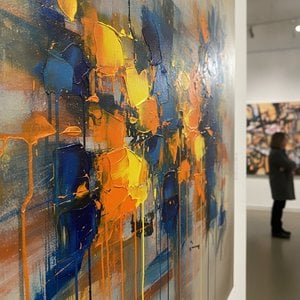
Leon Tarasewicz作「Untitled」の主要な色調はWarm Sunset Tonesです。この色調は、パレットの基調となるトーンを形作っています。
Leon Tarasewicz作「Untitled」 の輝度は Dark です。輝度とは、色がどれほど光を反射しているかを表す指標です。
Leon Tarasewicz作「Untitled」はCentre of Contemporary Art Znaki Czasu, Torun, Polandに展示されています。なお、美術館の掲載情報は複製画ではなく、原画に関するものです。

Born on March 14, 1957, in the quiet village of Waliły, Poland, Leon Tarasewicz carries within his artistic DNA the rich, complex textures of the Polish borderlands. A painter of Belarusian origin, his work is deeply rooted in the cultural intersections of a region defined by shifting boundaries and historical echoes. Growing up in a working-class family, Tarasewicz found his calling through the transformative power of color and form, eventually honing his craft at the prestigious Academy of Fine Arts in Warsaw. Under the mentorship of the influential Tadeusz Dominik, he developed a technical foundation that would later allow him to transcend traditional boundaries, moving from classical training toward a profound exploration of space and light.
The evolution of Tarasewicz’s style is a journey from the representational to the sublime. While his early academic years provided him with the tools of meticulous observation, his mature work embraces the language of abstract expressionism and color field painting. He possesses a unique ability to capture the essence of the Polish landscape—not through literal depiction, but through an emotional resonance achieved via expansive washes of pigment and rhythmic, vertical stripes. His canvases often function as panoramic experiences, where the distinction between painting and environment begins to blur. By utilizing multiple stretcher bars connected to create vast, immersive spaces, he invites the viewer to step into a world where the horizon line vanishes, replaced by a sense of infinite geological or organic growth.
To encounter a Tarasewicz painting is to engage in a sensory dialogue with nature. His palette is famously exuberant, utilizing vivid azures, deep reds, and sun-drenched yellows to evoke the vitality of forests, rivers, and skies. Yet, beneath this surface brilliance lies a deeper, more contemplative layer of symbolism. The artist’s work often references the sublimation of sensual experience into spiritual truth, a concept reminiscent of the icon traditions found in his Belarusian heritage. Even when his works appear purely abstract, they carry the weight of the landscape's history—the furrows of a field, the movement of wind through trees, and the layered memories of a borderland territory.
A defining characteristic of his practice is his deliberate avoidance of titles. By refusing to name his pieces, Tarasewicz escapes the "trap of representation," ensuring that his work cannot be confined to a single definition or historical movement. This allows for a multiplicity of interpretations, where a viewer might see a topographical map of a distant meadow one moment and a purely rhythmic exploration of color the next. His technique creates a tension between the physical texture of the paint—which hints at earth and stone—and the ethereal quality of light that seems to emanate from within the pigment itself.
Throughout his illustrious career, Leon Tarasewicz has garnered significant international acclaim, establishing himself as a pillar of contemporary Polish art. His contributions to the academic world are equally profound; as a professor of fine arts and a lecturer at the Academy of Fine Arts in Warsaw, he has shaped the perspectives of subsequent generations of artists. His professional journey is marked by prestigious accolades that reflect both his cultural impact and his technical mastery:
Beyond the gallery walls, Tarasewicz has served as a cultural ambassador, notably representing the European Year of Intercultural Dialogue. His life’s work remains a profound meditation on the beauty of the natural world and the enduring strength of cultural identity, proving that even in abstraction, the soul of a landscape can be found.

1957 - , Poland
Master the high-impact world of contemporary abstraction. Discover how bold colors, textures, and modern movements like Abstract Expressionism can transform your space with premium, high-energy art curated for the design-conscious professional.

モンドリアン、マレーヴィチ…幾何学的抽象絵画を代表する傑作10選。各作品の背景や色彩構成、アーティストの情熱に迫ります。美術館品質の複製画はWahooArt.comで。オンラインでアートコレクションをご覧ください。

抽象表現主義を定義する10の傑作。ポロック、ロスコら巨匠たちの情熱と色彩の世界へ。各作品に込められた物語と技法を紐解き、至高のアート体験を。WahooArt.comで、ミュージアムクオリティの複製画や洗練されたインテリアアイデアを発見してください。

Embark on a cultural journey through Lyrical Abstraction. Explore how masters like Kandinsky used color and motion to translate emotion into visual poetry. Discover the profound beauty of abstract expressionism and learn to curate emotional resonance in your own art collection.

Explore the profound history and emotional depth of Color Field painting. From Mark Rothko to Barnett Newman, discover how pure color redefined modern art through our expert-led guide for students and collectors alike.

 設置イメージを確認
 送る
送る シェア
シェア
 詳細情報
詳細情報 ガイドを表示

 画像をダウンロード
 似ている作品
 X線調査
X線調査 スライドショー
 統計情報
統計情報 続きを読む
続きを読む









 ガラスオプションは、110cm未満のサイズでのみご利用いただけます。


