

 PaintingWallArtMono-ha
 Contemporary
 227.0 x 181.0 cm
 福岡アジア美術館
このページに掲載されている作品は著作権法によって保護されており、当社の許可なく同一の複製物を制作または販売することは法律で禁じられています。この保護は、以下のような国際条約に基づき執行されます。 ベルヌ条約 および、以下の条項に定められたものを含む各国の法律により、 米国著作権法 第17編。
敬意を払った法的な代替手段として、私たちはオリジナルにインスピレーションを与えられた、カスタムの手描きアートワークを提供しています。私たちの熟練したプロのアーティストは、元の作品が持つスタイル、情緒、そして芸術的なエッセンスを注意深く研究し、独自の創作物でありながら、同じ感性を呼び起こすような、新しくユニークな作品を作り上げます。
この手法は、著作権で保護された作品の複製や複写を伴わないため、著作権法に完全に準拠しています。これは単なる模倣ではなく、創造的な再解釈です。元の作品からインスピレーションを受けつつも、それとは異なる、全く新しい絵画を生み出すものです。
当社のアーティストが、お客様のご希望のサイズと額縁に合わせて、キャンバスに手描きで制作する油彩画です。 ( プリント版に切り替え デジタル画像販売へ切り替え)





























作品のオリジナル比率に合わせた、当店の規定サイズからお選びください。

フレームや壁のスペースに合わせて、ご希望の幅と高さを入力してください。本作品は手描きのため、異なる比率のサイズをご希望の場合、絵画の周囲を少し広げて描くか、あるいは端を少しカットして調整することが可能です。お客様のご要望に合わせます。制作を開始する前に、仕上がりを確認するためのデジタルモックアップをお送りいたします。このページに表示されている画像は完成品の実物ではなく、あくまでモックアップによるイメージです。
From Line
複製画サイズ一覧
In the quiet intersection where Eastern philosophy meets Western minimalism, Lee Ufan’s From Line emerges as a profound meditation on existence and the passage of time. As a central figure of the Mono-ha movement, Lee does not merely paint; he orchestrates a delicate dialogue between the void and the mark. This particular work serves as a breathtaking example of his ability to transform a canvas into a living, breathing landscape of thought. The composition, characterized by its rhythmic verticality, invites the viewer into a space where the distinction between the painted stroke and the surrounding emptiness begins to dissolve, creating an atmosphere of deep contemplation.
The visual journey of From Line is one of mesmerizing movement. At first glance, the eye is drawn to the series of vertical lines that traverse the canvas, creating a sense of depth and dimension that defies the two-dimensional surface. These strokes, reminiscent of traditional Eastern brushwork, possess a weight and texture that suggest the relentless flow of a waterfall or the steady descent of rain through a misty forest. A subtle horizontal line cuts through the center, acting as a horizon of sorts, providing a structural anchor that balances the kinetic energy of the vertical elements. This careful arrangement creates a profound sense of harmony, where every interval and every void plays a vital role in the overall equilibrium of the piece.
Technically, the work is a masterclass in controlled spontaneity. Lee Ufan utilizes the relationship between color and space to evoke raw emotion, employing a palette that—while appearing simple—carries immense psychological weight. The interplay of light and shadow within the strokes suggests a physical presence, as if the paint itself is an organic material emerging from the canvas. In some iterations of this series, Lee has even paired Japanese powdered mineral pigments with Western canvas, dipping his brush in cobalt-blue paint and pulling it across the support in one continuous, decisive motion. This method ensures that each trace captures a moment of pure, unrepeatable action, making the painting a record of its own creation.
For the discerning collector or interior designer, this piece offers more than just aesthetic beauty; it provides a focal point of serenity. The way the lines move from fullness to near-invisibility allows the artwork to breathe within a room, interacting with the surrounding architecture and light. It is a work that demands a slow gaze, rewarding those who approach it with patience.
To understand From Line, one must look toward the artist's profound intellectual journey. Born in 1936, Lee’s early life was steeped in the disciplined rhythms of a traditional Confucian household, where calligraphy and inkbrush painting served as his first languages. His later immersion in Western phenomenology—engaging with thinkers like Heidegger and Merleau-Ponty—allowed him to bridge the gap between being and nothingness. This synthesis is palpable in the artwork; it is a piece that exists in the tension between the physical mark of the brush and the infinite potential of the empty space.
Owning a high-quality reproduction of such a masterpiece allows one to bring this sense of philosophical depth into a modern living space. Whether placed in a minimalist gallery-style lounge or a quiet study, From Line acts as an anchor of calm, reminding the viewer of the beauty found in simplicity and the profound resonance of a single, well-placed stroke.
Lee Ufan作「From Line」は、全体的なMinimalistなムードの中に、Tranquilな感情を伝えています。
Lee Ufan作「From Line」は、Corporate Giftへの贈り物として、特にThemeの際におすすめです。作品の複製画をプレゼントとしてお贈りいただけます。
Lee Ufan作「From Line」 の記録された数値は、明度 brilliant、輝度 Bright Balance です。

In the quiet intersection where Eastern contemplative traditions meet the rigorous inquiries of Western phenomenology, the work of Lee Ufan resides. Born in 1936 in Haman-gun, Gyeongsangnam-do, Lee’s early life was steeped in the disciplined rhythms of a traditional Confucian household. His childhood was not merely an era of growth but one of profound cultural immersion, where the delicate strokes of calligraphy and the rhythmic beauty of inkbrush painting served as his first languages. This foundational training in the classical arts provided him with a deep-seated reverence for the materiality of ink and paper, a sensitivity that would later become the heartbeat of his minimalist masterpieces.
Lee’s journey took a transformative turn in 1956 when he moved to Yokohama, Japan, seeking new intellectual horizons. While his initial studies at Seoul National University focused on painting, it was his immersion in the study of philosophy at Nihon University that would ultimately redefine his artistic trajectory. By engaging with the profound works of thinkers like Martin Heidegger and Maurice Merleau-Ponty, Lee began to develop a theoretical framework that sought to bridge the gap between being and nothingness. He did not merely wish to paint objects; he sought to explore the very essence of existence through the interaction of space, matter, and perception.
As the late 1960s approached, Lee Ufan emerged as the preeminent theorist and driving force behind the Mono-ha, or "School of Things" movement. This was not a movement defined by the creation of new forms, but rather by a radical reconsideration of what already exists. Through his seminal essays, Lee advocated for an art that emphasized the relationship between natural and man-made materials—stones, steel, glass, and wood—allowing them to exist in their raw, unadulterated state. His philosophy was a deliberate antidote to the Eurocentric dominance of the era, proposing a methodology of de-westernization that favored the experiential engagement of the viewer with the site.
Parallel to his influence in Japan, Lee’s artistic spirit breathed life into the Dansaekjo movement in South Korea. This "monotone art" emphasized the meditative process of painting, where the repetitive application of pigment became a ritualistic act of connection between the artist's hand and the canvas. His work during this period moved away from expressive abstraction toward a more restrained, rhythmic aesthetic that celebrated the subtle nuances of texture and tone. In doing so, he helped establish a uniquely Korean modernism that resonated far beyond the borders of the peninsula.
The mature works of Lee Ufan, such as his celebrated From Point and From Line series, serve as breathtaking meditations on time and decay. In these pieces, a single brushstroke begins with intense saturation and gradually fades into nothingness, tracing the inevitable passage of time and the ephemeral nature of existence. Each mark is an event; each void is a presence. The viewer is invited to witness the dialogue between the painted trace and the untouched canvas, a relationship that mirrors the profound interconnectedness of all things in the natural world.
Throughout his storied career, Lee has navigated the complexities of history—from the political turbulence of post-war Korea to his life as a cultural wanderer between Kamakura and Paris. His achievements have been recognized with the highest honors, including the Legion of Honour and the Praemium Imperiale. Today, his legacy is physically anchored in the Lee Ufan Museum on Naoshima island, a collaborative marvel designed with architect Tadao Ando. This space, where light and shadow dance across concrete walls, stands as a testament to Lee’s lifelong pursuit: an art that does not demand attention through noise, but commands reverence through its profound, resonant silence.

1936 -

Explore the profound elegance of minimalist art. Discover how the precision of a single line transforms simple geometry into timeless masterpieces for the discerning collector seeking sophistication and depth in fine art acquisitions.

Discover the profound elegance of modern & minimalist art. Our expert guide explores geometric abstraction, optical depth, and curated simplicity for the discerning collector seeking to elevate contemporary interiors with timeless, sophisticated design.

Embark on a sophisticated journey through the history of line drawing. From classical mastery to modern minimalism, explore how the power of the line shapes emotion and space in fine art. Discover expert insights for collectors and enthusiasts of graphic elegance.
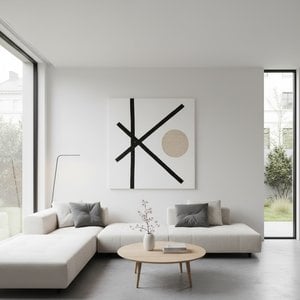
Discover how minimalist art elevates modern interiors. Explore the transformative power of geometric sculptures, tactile textures, and curated simplicity to create a luxurious, tranquil sanctuary in your home through expert design principles.

Explore the profound elegance of the Minimalist Art Movement. From geometric abstraction to the power of negative space, our expert guide offers sophisticated insights for discerning collectors seeking to curate timeless, impactful modern collections.

 設置イメージを確認
 送る
送る シェア
シェア
 詳細情報
詳細情報 ガイドを表示

 画像をダウンロード
 似ている作品
 X線調査
X線調査 スライドショー
 統計情報
統計情報 続きを読む
続きを読む









 ガラスオプションは、110cm未満のサイズでのみご利用いただけます。


