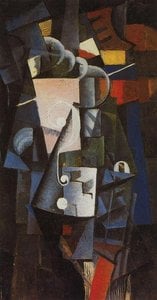
スピーディーな制作と多彩な仕上げオプションが魅力の、ミュージアムクオリティなジークレー・キャンバスプリント。 ( 手描きの複製画を注文する デジタル画像販売へ切り替え)





























作品のオリジナル比率に合わせた、当店の規定サイズからお選びください。

特定のフレームやスペースに合わせて、ご自身でサイズを指定することも可能です。選択されたサイズが元の画像の比率と一致しない場合、作品をトリミングするか、鏡面反射または単色での塗りつぶしによって画像を拡張いたします。制作を開始する前に、ご確認用のデジタルモックアップをお送りいたします。
画面上のプレビューには、実際のトリミングや拡張は反映されませんのでご注意ください。最終的な構図を正確に確認できるのは、モックアップのみとなります。
カスタムサイズも承っておりますが、元の比率を維持するためには、あらかじめ用意されたリストからサイズを選択することをお勧めいたします。

Vanily Case
複製画サイズ一覧
“Vanily Case,” a deceptively simple painting by Kazimir Malevich, offers a profound meditation on form, color, and the very nature of perception. Executed around 1917, this work represents a crucial step in Malevich’s radical journey toward pure abstraction, a movement he would later codify as Suprematism. The image itself – a commonplace scene of cups, spoons, and tables – is rendered with an almost obsessive attention to detail, yet simultaneously stripped down to its most essential elements. The black background acts not merely as a backdrop but as a contained void, intensifying the vibrancy of the red cup and silver spoon, drawing the viewer’s eye into a carefully constructed dialogue between object and space.
‘Vanily Case’ emerged during a period of intense artistic experimentation in Russia, fueled by the influence of European avant-garde movements like Cubism and Futurism. However, Malevich was seeking something beyond mere imitation; he aimed to create a completely new visual language – one that rejected representational illusion entirely. This work anticipates the core tenets of Suprematism, a movement founded by Malevich in 1915, which advocated for art based solely on geometric forms and pure color. The painting’s reductionist approach—focusing on basic shapes and colors—reflects this philosophical shift, moving away from depicting reality to expressing an inner truth.
Malevich’s technique in ‘Vanily Case’ is characterized by meticulous brushwork and a precise rendering of form. The surfaces are built up with thin layers of paint, creating subtle variations in tone and texture that enhance the objects' three-dimensional appearance. The composition itself is deceptively simple, yet carefully balanced. The placement of the cups—one on the left, another towards the top right—creates a dynamic tension within the confined space, guiding the viewer’s eye across the canvas. The use of negative space – the areas around and between the objects – is equally important, contributing to the painting's overall sense of depth and spatial awareness.
Beyond its formal qualities, ‘Vanily Case’ possesses a subtle symbolic resonance. The objects themselves—cups and spoons—represent the everyday rituals of life, yet their isolation within the black void suggests a detachment from worldly concerns. The painting evokes a sense of quiet contemplation and perhaps even melancholy, inviting viewers to reflect on the nature of existence and the search for meaning in a world increasingly dominated by abstraction. This piece is not merely a depiction of objects; it’s an exploration of perception, reality, and the potential of art to transcend the limitations of language and representation.


1878 - 1935 , ウクライナ

Journey through Wassily Kandinsky's 25 most iconic abstract paintings. Explore his revolutionary use of color, form & spiritual expressionism. Find museum-quality Kandinsky reproductions and elevate your home decor with WahooArt.com. Discover all masterpieces on WahooArt.com!
マーク・ロスコの傑作25選。抽象表現主義を代表する巨匠、色彩が織りなす深遠な世界を探求します。絵画の背景や技法、感動的なストーリーを紐解き、WahooArtで高品質なアートプリントをお楽しみください。リビングやオフィスにモダンアートを飾るなら!

カジミール・マレーヴィチの至高の25選。シュプレマティズムを代表する「ブラックスクエア」をはじめ、抽象芸術の革命的作品群を紐解きます。ロシア構成主義からミニマリズムまで、美術史に輝く傑作をWahooArt.comで。高品質なアートプリントとホームデコレーションの世界へ。今すぐコレクションをご覧ください。

モンドリアン、マレーヴィチ…幾何学的抽象絵画を代表する傑作10選。各作品の背景や色彩構成、アーティストの情熱に迫ります。美術館品質の複製画はWahooArt.comで。オンラインでアートコレクションをご覧ください。

抽象表現主義を定義する10の傑作。ポロック、ロスコら巨匠たちの情熱と色彩の世界へ。各作品に込められた物語と技法を紐解き、至高のアート体験を。WahooArt.comで、ミュージアムクオリティの複製画や洗練されたインテリアアイデアを発見してください。

 設置イメージを確認
 送る
送る シェア
シェア
 詳細情報
詳細情報 ガイドを表示

 画像をダウンロード
 似ている作品
 X線調査
X線調査 スライドショー
 統計情報
統計情報

 続きを読む
続きを読む









 ガラスオプションは、110cm未満のサイズでのみご利用いただけます。