
 Contemporary Realism
 1494
1494 82.0 x 160.0 cm
迅速な制作と多彩な仕上げオプションを備えた、ミュージアムクオリティのジークレーまたはキャンバスプリント。 ( 手描きの絵画を購入 デジタル画像販売へ切り替え)
作品のオリジナル比率に合わせた、当店の規定サイズからお選びください。

特定のフレームやスペースに合わせて、ご自身でサイズを指定することも可能です。選択されたサイズが元の画像の比率と一致しない場合、作品をトリミングするか、鏡面反射または単色での塗りつぶしによって画像を拡張いたします。制作を開始する前に、ご確認用のデジタルモックアップをお送りいたします。
画面上のプレビューには、実際のトリミングや拡張は反映されませんのでご注意ください。最終的な構図を正確に確認できるのは、モックアップのみとなります。
カスタムサイズも承っておりますが、元の比率を維持するためには、あらかじめ用意されたリストからサイズを選択することをお勧めいたします。

Jousting Armour (Stechzeug)
複製画のサイズ

In the twilight of the fifteenth century, amidst the burgeoning splendor of the Renaissance, a unique form of artistry emerged from the heat of the forge and the rhythmic strike of the hammer. Kaspar Rieder (1452-1499), born in the quiet Austrian town of Mühlau, stands as a monumental figure in this specialized tradition. While many artists of his era sought expression through pigment and canvas, Rieder mastered the language of metal, transforming cold, utilitarian steel into breathtaking works of sculptural elegance. He is most renowned for his creation of stechzeug—the elaborate, highly decorative armor specifically engineered for the high-stakes spectacle of jousting tournaments.
The life of Rieder remains partially shrouded in the mists of history, as the archival records of medieval craftsmen are often as fragmented as the eras they inhabited. However, the brilliance of his surviving work allows us to reconstruct a narrative of profound skill and cultural connection. It is widely believed by scholars that Rieder underwent his formative training within the vibrant artistic hub of Innsbruck, Austria. This apprenticeship likely exposed him to the cutting-scale metallurgical techniques of the period and the sophisticated sculptural aesthetics that defined the late Gothic and early Renaissance transition. His style suggests a deep dialogue with Flemish armorers, reflecting a broader European movement where craftsmanship transcended borders to create a unified language of prestige and power.
To understand Rieder’s contribution to art history, one must look beyond the functional necessity of protection. The stechzeug he produced was not merely a suit of defense; it was a canvas for heraldry and high fashion. Unlike standard field armor designed for the chaos of battle, jousting armor required a level of ornamentation that could withstand the scrutiny of the royal court. Rieder’s mastery lay in his ability to manipulate steel through intricate processes such as:
These techniques allowed Rieder to weave complex narratives of lineage and status directly into the armor itself. A single piece, such as the exquisitely preserved sallet housed in the Kunsthistorisches Museum in Vienna, reveals a meticulous attention to detail where subtle textures and light-reflecting surfaces converge. Through his hands, the heavy weight of steel was visually lightened by the grace of floral patterns and the prestige of noble iconography.
The historical significance of Kaspar Rieder extends far beyond the tournament grounds of the 1400s. He represents a pivotal moment in European history when the artisan rose to the level of the fine artist, blurring the lines between functional weaponry and high sculpture. His work served as a vital instrument of political communication, where a knight's very silhouette announced his wealth, his alliances, and his bravery.
Today, Rieder’s legacy is preserved not in galleries of oil paintings, but in the silent, gleaming halls of museums, where his steel masterpieces continue to command awe. He remains a testament to the ingenuity of the Renaissance spirit—a period defined by the belief that even the most rugged materials could be refined into something transcendent. His ability to marry the strength required for combat with the delicacy required for art ensures his place as one of the most significant master armorers in the annals of European history.

1452 - 1499 , Austria

Embark on a scholarly journey through the sacred beauty of High Medieval art. Discover the profound symbolism, luminous iconography, and spiritual depth of Gothic masterpieces in this expert guide for classical art enthusiasts.
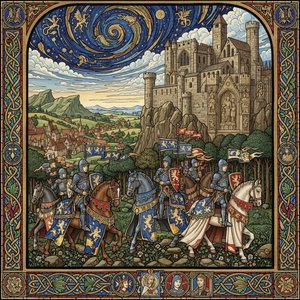
Explore the profound beauty of medieval art through the lens of history. Discover the symbolism of knights, the divine frescoes of Giotto, and how legendary masterpieces continue to inspire modern collectors and lovers of chivalric heritage.

Embark on a visual journey through Early Medieval art. Explore the profound beauty of illuminated manuscripts, sacred symbols, and golden light through an expert historical lens, celebrating the enduring legacy of medieval craftsmanship and divine artistry.

Embark on a scholarly journey through the spiritual grandeur of Late Medieval art. Discover the intricate symbolism, technical mastery, and profound religious narratives that define the Gothic era in this expert-led guide for art enthusiasts and collectors.


 プレビュー
プレビュー
 シェアする
シェアする シェアする
シェアする
 詳細を見る
詳細を見る ガイド
ガイド

 ダウンロード
 似ている作品
 X線調査
X線調査 スライドショー
 統計情報
統計情報 詳細を見る
詳細を見る






































 ガラスオプションは、110cm未満のサイズでのみご利用いただけます。


