
x


迅速な制作と多彩な仕上げオプションを備えた、ミュージアムクオリティのジークレーまたはキャンバスプリント。 ( 手描きの絵画を購入 画像を購入)
作品のオリジナル比率に合わせた、当店の規定サイズからお選びください。

特定のフレームやスペースに合わせて、ご自身でサイズを指定することも可能です。選択されたサイズが元の画像の比率と一致しない場合、作品をトリミングするか、鏡面反射または単色での塗りつぶしによって画像を拡張いたします。制作を開始する前に、ご確認用のデジタルモックアップをお送りいたします。
画面上のプレビューには、実際のトリミングや拡張は反映されませんのでご注意ください。最終的な構図を正確に確認できるのは、モックアップのみとなります。
カスタムサイズも承っておりますが、元の比率を維持するためには、あらかじめ用意されたリストからサイズを選択することをお勧めいたします。

Untitled
複製画のサイズ

Born in Zaragoza, Spain, in 1747, Joseph Beraton’s life unfolded during a pivotal period of artistic transition – the waning years of the Baroque era and the burgeoning rise of Neoclassicism. His early training under José Luzán, a prominent Aragonese painter, laid the foundation for his technical skill, yet it was his time in Madrid, studying with Francisco Bayeu and ultimately the Royal Academy of Fine Arts, that truly shaped his artistic trajectory. Beraton’s career wasn't marked by grand commissions or widespread fame during his lifetime; instead, he primarily served as a chamber painter, meticulously crafting portraits and landscapes for aristocratic patrons, a role that afforded him a degree of stability but also limited exposure to the broader art world.
Beraton’s artistic style is often described as a nuanced blend of influences. Initially rooted in the academic traditions instilled by Bayeu – characterized by precise draftsmanship, balanced compositions, and a restrained palette – his work gradually absorbed elements of Neoclassicism while retaining a distinctly Spanish sensibility. He demonstrated a remarkable ability to capture subtle nuances of expression, particularly in his portraits, imbuing his subjects with an air of dignified reserve. His landscapes, though less frequently exhibited, reveal a keen eye for detail and a sensitivity to the natural world, often depicting scenes of rural Spain bathed in soft light.
Beraton’s life as a chamber painter offered both opportunities and constraints. He worked primarily on commission, producing works tailored to the specific tastes and requirements of his patrons. This demanded versatility – he was expected to adapt his style and subject matter to suit diverse requests. His correspondence reveals a pragmatic approach to his profession, navigating the complexities of courtly life and managing his finances with careful precision. The documents unearthed by Jesús López Ortega in Badajoz provide invaluable insights into the daily routines and social interactions of an artist operating within the confines of a royal household.
The archival materials shed light on Beraton’s family life, including his marriage to Manuela Marcelina Sánchez de Ahumada and the birth of their two children. His will, meticulously detailing his assets and bequeathing them to his heirs, underscores the importance of familial stability within his world. The meticulous record-keeping reveals a man deeply invested in securing his family’s future, a testament to the social realities of 18th-century Spain.
While primarily known for his oil paintings, Beraton's contribution to the field of lithography is noteworthy. He collaborated with José de Madrazo on the ambitious “Views of the Royal Sites,” a series of over 300 prints documenting the palaces, gardens, and landscapes associated with the Spanish monarchy. This project showcased Beraton’s technical proficiency in printmaking and provided him with a wider audience for his work. The meticulous detail evident in these lithographs reflects his dedication to accuracy and his understanding of the medium's potential.
Furthermore, Beraton produced drawings for the *Retratos de los españoles ilustres* series, commissioned by the Calcografía Nacional. His skillful rendering of figures like Juan José de Austria demonstrates his ability to capture likenesses with remarkable precision and a subtle awareness of character. These engravings served as important visual representations of Spain’s elite during a period of significant political and social change.
Despite not achieving widespread fame during his lifetime, Joseph Beraton's work holds considerable historical significance. He represents a crucial link between the Baroque and Neoclassical traditions in Spanish art, embodying the stylistic shifts that characterized the late 18th century. His meticulous draftsmanship, nuanced portraits, and contributions to lithography offer valuable insights into the artistic practices of his time. The recent research conducted by Jesús López Ortega has brought renewed attention to Beraton’s oeuvre, solidifying his place as a significant, albeit often overlooked, figure in Spanish art history.
His work serves as a reminder that artistic success is not always measured by immediate recognition but can be found in the quiet dedication and skillful execution of one's craft. Beraton’s legacy lies not only in his individual paintings and prints but also in his representation of a specific social milieu – the world of a chamber painter navigating the complexities of courtly life and artistic patronage.

1747 - 1796 , Spain

Explore the profound artistry of graphite drawing. Discover professional techniques for mastering depth, texture, and detail through a lens of art history, from classical sketches to modern masterpieces. Elevate your understanding of the pencil medium with our expert guide.

Elevate your artistic practice with this expert guide to mastering the line. Discover advanced techniques in graphite, charcoal, and contour drawing designed for art students seeking technical precision and expressive depth in their fine art studies.

Discover the sophisticated mastery of graphite drawing. Explore expert techniques for achieving profound depth, intricate texture, and hyper-realistic detail through the alchemy of carbon, curated for the discerning art enthusiast and professional collector.
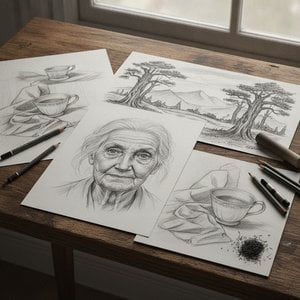
Explore the profound elegance of pencil and charcoal sketching. Discover how masters use line, shadow, and chiaroscuro to capture light and texture, bridging the gap between preparatory studies and timeless fine art masterpieces.

Explore the profound beauty of the sketch. Discover how masters use charcoal and graphite to capture raw emotion, anatomical precision, and fluid movement, bridging the gap between ephemeral marks and eternal oil masterpieces.


最新の美術ニュース、限定オファー、そしてインテリアのアイデアをいち早くお届けします。
お客様のプロジェクトについてお聞かせください。当社の美術専門家が、お客様に合わせた3つのパーソナライズされた芸術提案をご提供いたします。
あなたにぴったりの3作品を無料で厳選いたします


 プレビュー
プレビュー
 シェアする
シェアする シェアする
シェアする
 詳細を見る
詳細を見る

 ダウンロード
 似ている作品
 X線調査
X線調査 スライドショー


 詳細を見る
詳細を見る






































 ガラスオプションは、110cm未満のサイズでのみご利用いただけます。


