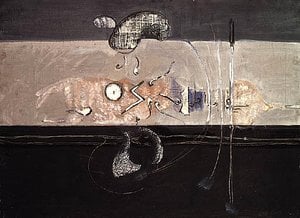
Oil On CanvasWallArtEnglish Surrealism
 1944
1944 550.0 x 370.0 cm
 British Council
このページに掲載されている作品は著作権法によって保護されており、当社の許可なく同一の複製物を制作または販売することは法律で禁じられています。この保護は、以下のような国際条約に基づき執行されます。 ベルヌ条約 および、以下の条項に定められたものを含む各国の法律により、 米国著作権法 第17編。
この手法は、著作権で保護された作品の複製や複写を伴わないため、著作権法に完全に準拠しています。これは単なる模倣ではなく、創造的な再解釈です。元の作品からインスピレーションを受けつつも、それとは異なる、全く新しい絵画を生み出すものです。
スピーディーな制作と多彩な仕上げオプションが魅力の、ミュージアムクオリティなジークレー・キャンバスプリント。 ( 手描きの複製画を注文する デジタル画像販売へ切り替え)





























作品のオリジナル比率に合わせた、当店の規定サイズからお選びください。

額縁や壁のスペースに合わせて、ご希望の幅と高さを入力してください。プリントはカットすることは可能ですが、元の画像より大きくすることはできないため、異なる比率のサイズを選択された場合は、画像の一部が欠けることになります。印刷を開始する前に、内容を確認していただくためのデジタルモックアップをお送りいたします。このページに表示されている画像は、実際のカット後の状態を示すものではありません。実際の仕上がりはモックアップにてご確認ください。
The Trial
複製画サイズ一覧
John Samuel Tunnardの記録されたテーマであるmodern fabric design, jazz player inspiration, british surrealist vision, festival britain mural, cornish landscape motifの中でも、「The Trial」はcornwall, landscape, marine life, perspective, psychological, jazz influence, symbolismに独自の焦点を当てています。
John Samuel Tunnard作「The Trial」はBritish Council, ロンドン, イギリスに展示されています。なお、美術館の掲載情報は複製画ではなく、原画に関するものです。
「The Trial」の著作権の状態について — 著作権により保護されています — は、作者の没年である1971に基づいています。

John Samuel Tunnard (1900-1971) was an English modernist painter and designer. Born in Sandwich, Kent, he initially studied design at the Royal College of Art from 1919 to 1923. This foundational training would prove crucial throughout his artistic career, influencing both his painting style and his later ventures into textile design.
During the 1920s, Tunnard worked in various textile design roles in Manchester. This period provided him with practical experience and an understanding of pattern, color, and form – elements that would later become prominent features of his paintings. In 1926, he married Mary May Robertson, a partnership that would significantly shape both their personal and professional lives.
By 1928, Tunnard began to focus seriously on painting. He taught design at the Central School of Arts and Crafts in London from 1929 onwards, further solidifying his engagement with artistic principles and pedagogy. His work during this time demonstrates a growing interest in modernist aesthetics. Tunnard’s style was notably influenced by Surrealism, although he never formally joined the movement. He participated in several surrealist exhibitions throughout the 1930s, including one at the Gordon Fraser Gallery in Cambridge.
In 1933, Tunnard and his wife moved to Cadgwith, Cornwall. There, they established a business producing printed silks, allowing them to combine their artistic talents with entrepreneurial endeavors. The Cornish landscape profoundly impacted Tunnard’s art, inspiring many of his later landscapes and providing a new source of visual motifs.
Tunnard's oeuvre encompasses both paintings – including notable landscapes and portraits – and textile designs. His painting style is characterized by its lyrical abstraction, dreamlike qualities, and vibrant color palettes. He often blended representational elements with abstract forms, creating a unique visual language that reflects his surrealist leanings.
Tunnard exhibited widely throughout his career. He showed work at the Royal Academy and with the London Group (which he joined in 1934). His participation in surrealist exhibitions further cemented his position within the British avant-garde.
John Samuel Tunnard is now considered one of the most important English modernist painters. His work represents a unique synthesis of Surrealism, abstraction, and landscape painting. Examples of his art can be found in prominent collections such as the National Galleries of Scotland. He contributed significantly to the development of modern British art, bridging the gap between traditional representation and abstract expression.

1900 - 1971 , United Kingdom
Explore the life & work of John Hoppner, a leading Georgian portraitist. Discover his vibrant style, influential patrons, and lasting impact on British art history. Expert insights for collectors.

ジョン・コンスタブルの傑作25選。英国風景画の巨匠が描く自然と光の詩の世界へ。ロマン主義を代表する絵画、デダム・ヴェールやヘイ・ウェインなど、WahooArtで高品質なアートプリントをお楽しみください。インテリアに深みと感動を。コレクションはこちら。

Explore the captivating world of John Piper, a celebrated British painter whose evocative landscapes & iconic church art captured the spirit of his time. Discover his legacy and find high-quality reproductions at WahooArt.
ジョン・シンガー・サージェントの至高の25選。肖像画、写実主義、光と影の表現が美しい作品群を紐解きます。マダムXや少女の肖像など、時代を超えて愛される名作をWahooArtで鑑賞。高品質なアート複製で、お部屋に美術館のような空間を。今すぐコレクションをご覧ください。

Explore the poignant war poetry of Wilfred Owen, a key figure in British Modernism. Discover his innovative style, themes of loss & camaraderie, and lasting impact on 20th-century literature. Analysis & historical context included.

 設置イメージを確認
 送る
送る シェア
シェア
 詳細情報
詳細情報 ガイドを表示

 画像をダウンロード
 似ている作品
 X線調査
X線調査 スライドショー
 Q&A
Q&A 統計情報
統計情報 続きを読む
続きを読む









 ガラスオプションは、110cm未満のサイズでのみご利用いただけます。