


このページに掲載されている作品は著作権法によって保護されており、当社の許可なく同一の複製物を制作または販売することは法律で禁じられています。この保護は、以下のような国際条約に基づき執行されます。 ベルヌ条約 および、以下の条項に定められたものを含む各国の法律により、 米国著作権法 第17編。
この手法は、著作権で保護された作品の複製や複写を伴わないため、著作権法に完全に準拠しています。これは単なる模倣ではなく、創造的な再解釈です。元の作品からインスピレーションを受けつつも、それとは異なる、全く新しい絵画を生み出すものです。
スピーディーな制作と多彩な仕上げオプションが魅力の、ミュージアムクオリティなジークレー・キャンバスプリント。 ( 手描き複製画を注文する デジタル画像販売へ切り替え)
作品のオリジナル比率に合わせた、当店の規定サイズからお選びください。

額縁や壁のスペースに合わせて、ご希望の幅と高さを入力してください。プリントはカットすることは可能ですが、元の画像より大きくすることはできないため、異なる比率のサイズを選択された場合は、画像の一部が欠けることになります。印刷を開始する前に、内容を確認していただくためのデジタルモックアップをお送りいたします。このページに表示されている画像は、実際のカット後の状態を示すものではありません。実際の仕上がりはモックアップにてご確認ください。
John Schanck
複製画サイズ一覧

The story of John James Masquerier is one inextricably linked to the dramatic shifts of the late eighteenth and early nineteenth centuries. Born in October 1778 in Chelsea, London, his very identity was a tapestry of cultural intersections; he was a British painter of French Huguenot descent, a heritage that placed him at the heart of the intellectual and political currents flowing between London and Paris. His childhood was marked by the vibrant, often perilous atmosphere of the French Revolution. Taken to Paris by his mother, Barbot, who had established a school in the prestigious Champs-Elysées, the young Masquerier found himself a witness to history in its most raw and violent forms. While studying painting under the esteemed François Vincent at the Tuileries Academy, he stood amidst the chaos of the massacre of the Swiss Guards in 1792. This early exposure to political upheaval did more than just shape his biography; it instilled in his art a profound sensitivity to the human condition during times of profound transition.
The volatility of the era eventually forced a retreat to England, but Masquerier carried the spirit of Paris with him. In 1792, he enrolled at the Royal Academy Schools, marking the beginning of a formal engagement with the British artistic establishment. His early talent was so striking that a self-portrait, executed when he was a mere fourteen years old, was presented to King George III—a testament to a precocious mastery of form and character that would define his professional trajectory.
Masquerier’s oeuvre is characterized by a remarkable ability to capture both the monumental and the intimate. While he is perhaps most celebrated for his portraiture, his work serves as a vital historical record of the era's most notable figures. His brush possessed a unique capacity for psychological depth, moving beyond mere likeness to reveal the inner essence of his subjects. This was particularly evident in his depictions of individuals such as Lady Hamilton, where he utilized masterful chiaroscuro to create a sense of drama and presence that commanded the viewer's attention.
Beyond the studio, Masquerier acted as an ocular chronicler of the French Revolution. Driven by an acute impulse to document the zeitgeist, he produced meticulous sketches from personal observation of pivotal, often harrowing, events. His drawings captured the trial of the King and the tragic demise of the Princesse de Lamballe, offering a visceral connection to the era's political tremors. This duality—the ability to execute refined, neoclassical portraiture while maintaining the gritty, observational eye of a war correspondent—distinguishes his contribution to the history of art.
As his career progressed, Masquerier’s reputation expanded through significant commissions and high-profile patronage. His work reached new heights of complexity with large-scale religious and historical compositions, such as The Incredulity of St. Thomas, which served as a monumental altar-piece in Westminster. Even as he navigated the complexities of the Napoleonic era, his connection to the French political landscape remained a source of artistic inspiration; he famously claimed to have produced a drawing of Napoleon Bonaparte during his time as First Consul.
The enduring significance of John James Masquerier lies in his role as a bridge between cultures and eras. He was an artist who did not merely paint the world around him but felt its pulse. Through his portraits, he immortalized the faces of the Enlightenment and the Napoleonic age, while his sketches preserved the fleeting, often terrifying moments of revolutionary change. His legacy remains a profound testament to the power of art to act as both a mirror to society and a vessel for historical memory.

1778 - 1855 , United Kingdom

Step into the haunting dreamscapes of Giorgio de Chirico. Explore 25 iconic Metaphysical and Surrealist masterpieces, from enigmatic shadows to timeless architecture. Find inspiration for museum-quality art reproductions and decor. Discover all masterpieces on WahooArt.com.
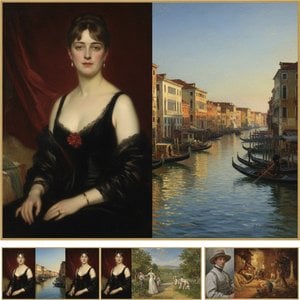
ジョン・シンガー・サージェントの至高の25選。肖像画、写実主義、光と影の表現が美しい作品群を紐解きます。マダムXや少女の肖像など、時代を超えて愛される名作をWahooArtで鑑賞。高品質なアート複製で、お部屋に美術館のような空間を。今すぐコレクションをご覧ください。

Explore the life & art of Sir James Jebusa Shannon, a leading Victorian portrait painter. Discover his elegant style, technical mastery, and lasting influence on British art. Shop high-quality reproductions at WahooArt.
 設置イメージを表示
 シェアする
シェアする シェアする
シェアする
 詳細を見る
詳細を見る ガイドを表示

 ダウンロード
 似ている作品
 X線調査
X線調査 スライドショーを表示
 Q&A
Q&A
 統計情報
統計情報
 詳細を表示
詳細を表示






































 ガラスオプションは、110cm未満のサイズでのみご利用いただけます。


