
 キャンバスにアクリル絵具ウォールアートFrederician Rococo
 1766
1766 88.0 x 187.0 cm
 Sanssouci Picture Gallery
迅速な制作と多彩な仕上げオプションを備えた、ミュージアムクオリティのジークレーまたはキャンバスプリント。 ( 手描きの絵画を購入 デジタル画像販売へ切り替え)





























作品のオリジナル比率に合わせた、当店の規定サイズからお選びください。

特定のフレームやスペースに合わせて、ご自身でサイズを指定することも可能です。選択されたサイズが元の画像の比率と一致しない場合、作品をトリミングするか、鏡面反射または単色での塗りつぶしによって画像を拡張いたします。制作を開始する前に、ご確認用のデジタルモックアップをお送りいたします。
画面上のプレビューには、実際のトリミングや拡張は反映されませんのでご注意ください。最終的な構図を正確に確認できるのは、モックアップのみとなります。
カスタムサイズも承っておりますが、元の比率を維持するためには、あらかじめ用意されたリストからサイズを選択することをお勧めいたします。

ウォンデ Tisch
複製画のサイズ

In the luminous era of the eighteenth century, few names evoke the shimmering elegance of the Frederician Rococo quite like Johann Melchior Kambly. Born in January 1718 to a distinguished patrician family in Zurich, Switzerland, Kambly was destined for a life where artistry and craftsmanship would intertwine with royal grandeur. His lineage was steeped in technical mastery; as the son of a skilled locksmith and clockmaker, the seeds of precision were sown in his earliest years. Yet, it was not merely through bloodline but through rigorous apprenticeship that he forged his identity. Under the tutelage of his uncle, the sculptor Johann Jakob Schärer in Schaffhausen, and later through studies with woodcarvers and goldsmiths, Kambly developed a polymathic command over diverse media, ranging from the delicate intricacies of bronze casting to the structural demands of architectural ornament.
The trajectory of Kambly’s career shifted dramatically when his talents caught the eye of the Prussian court. Around 1744, he was summoned to Berlin and Potsdam by Frederick the Great, a monarch whose aesthetic vision would provide the ultimate canvas for Kambly’s genius. This period marked the transition of an artisan into a pivotal figure of European decorative arts. Settling in Potsdam, Kambly did not merely participate in the era's trends; he became a primary engine of the Frederician Rococo style. His work served as a bridge between the heavy, formal traditions of the Baroque and a new, more playful sensibility characterized by asymmetrical grace, light-catching surfaces, and an almost breathless sense of movement.
Kambly’s true legacy lies in his ability to transform cold metal into fluid, organic poetry. By 1752, he had established a renowned manufactory in Potsdam dedicated to the production of bronze doré—gilded bronze. This workshop became a powerhouse of European luxury, producing works so exquisite that contemporary critics often compared them to the finest Parisian achievements. His mastery of the casting process allowed him to create intricate mounts, furniture fittings, and sculptural elements that seemed to defy the weight of their material. Whether it was the delicate floral motifs on a commode or the commanding presence of a bronze mirror frame for the Potsdam Palace, Kambondere's touch brought a sense of rhythmic vitality to the interiors of the Prussian elite.
His contributions to the architectural landscape were equally profound. As a decorative sculptor and specialist in ornamental architectural hardware, he played an essential role in the ornamentation of Sanssouci Palace and the New Palace. His hands shaped the very details that defined these spaces:
The historical significance of Johann Melchior Kambly extends far beyond the borders of Prussia. He represented a unique moment in art history where the boundaries between fine art sculpture and high-end decorative craft were beautifully blurred. Through his workshop, he helped establish a standard of excellence that influenced European interior design for decades, proving that the smallest ornamental detail could carry as much emotional weight as a monumental statue. His ability to synthesize the precision of Swiss craftsmanship with the opulent demands of the Prussian court created a visual language of power and elegance that remains etched in the halls of Potsdam today.
Though he passed away in 1783, leaving behind a trail of gilded splendor, Kambly’s influence endured. He remains a symbol of an age where art was not merely observed from a distance but lived within—a world where every surface, every hinge, and every gilded leaf was an opportunity to celebrate the sublime beauty of the Rococo spirit.

1718 - 1783 , Switzerland
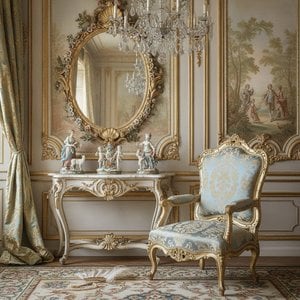
Discover the exquisite allure of Rococo art. Explore a curated guide to 18th-century French masterpieces, from Watteau to Fragonard, and learn how hand-painted oil reproductions can bring timeless elegance and luxury to your sophisticated interior design collection.

Immerse yourself in the splendor of Rococo art. Discover the era of elegance through masterworks by Watteau and Fragonard. Explore themes of romance, aristocratic leisure, and gilded ornamentation in this definitive guide to 18th-century French opulence.

Discover the sublime beauty of marble art through an expert exploration of Renaissance and Neoclassical masterpieces. From the delicate textures of Carpeaux to the grandeur of Sansovino, immerse yourself in a guide to timeless elegance and sculptural perfection.

Discover the breathtaking elegance of Rococo portraiture. Explore an expert guide to 18th-century mastery, from pastel palettes to aristocratic grandeur, and learn how to bring this era of opulence into your home through museum-quality oil reproductions.


 プレビュー
プレビュー
 シェアする
シェアする シェアする
シェアする
 詳細を見る
詳細を見る

 ダウンロード
 似ている作品
 X線調査
X線調査 スライドショー
 統計情報
統計情報 詳細を見る
詳細を見る









 ガラスオプションは、110cm未満のサイズでのみご利用いただけます。


