x


 Oil On CanvasWallArtRomanticism
 1832
1832 25.0 x 28.0 cm
 ナショナル・ギャラリー




























作品のオリジナル比率に合わせた、当店の規定サイズからお選びください。

特定のフレームやスペースに合わせて、ご希望のサイズをご入力いただけます。選択されたサイズが元の画像の比率と異なる場合、アートワークをトリミングするか、手描きで要素を追加して絵画を拡張いたします。デジタルモックアップ を制作し、制作開始前にご確認(承認)をいただきます。
画面上のプレビューは、実際のトリミングや拡張を正確に反映しているものではありません。最終的な構図は、モックアップによってのみ正確にご確認いただけます。
カスタムサイズもご利用いただけますが、元の比率を維持するためには、あらかじめ用意されたリストからサイズを選択することをお勧めいたします。

Cloud Study with Horizon
複製画のサイズ
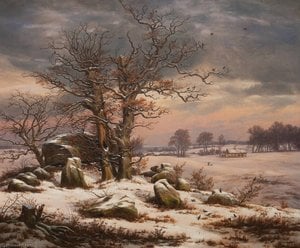
Johan Christian Dahl's "Cloud Study with Horizon," painted in 1832, isn’t merely a depiction of a landscape; it’s a profound meditation on the sublime—a concept central to the Romantic movement and deeply rooted in the Norwegian psyche. This work, rendered in oil on cardboard measuring 25 x 28 cm, transcends simple observation, inviting the viewer into a realm where nature's power and beauty converge with an almost palpable sense of melancholy and awe. Dahl, often hailed as Norway’s “father of landscape painting,” masterfully captures the dramatic interplay of light and shadow across a vast, brooding sky, establishing himself as a pivotal figure in shaping Norwegian artistic identity.
Dahl's artistic journey began humbly, working as a decorative painter in Bergen. However, his exposure to the works of Jens Juel and Christoffer Wilhelm Eckersberg ignited within him a passion for capturing the essence of nature. He sought not just to replicate what he saw, but to convey the *feeling* of being immersed in the Norwegian wilderness—a landscape imbued with both grandeur and vulnerability. This pursuit led him to meticulously study the techniques of Dutch masters like Allaert Everdingen, who had previously documented the stark beauty of the Nordic region, laying a crucial foundation for Dahl’s own style.
The painting's power resides in its masterful manipulation of light and shadow. The dark, almost bruised sky dominates the composition, punctuated by swirling clouds that seem to writhe with an inner energy. These aren’t static formations; they are dynamic entities, constantly shifting and transforming under the unseen influence of the elements. Dahl employs a technique known as *sfumato*, blurring the edges of forms and creating a hazy atmosphere—a characteristic often associated with the Venetian Renaissance masters but brilliantly adapted to evoke the ruggedness and remoteness of the Norwegian mountains. Notice how the light catches on the distant peaks, lending them an ethereal glow while simultaneously deepening the shadows that cling to the valleys below.
The horizon line itself is deliberately ambiguous, receding into a misty distance that suggests both limitlessness and profound mystery. The placement of the trees in the foreground—dark, skeletal forms reaching upwards—further emphasizes this sense of scale and isolation. They are not merely decorative elements; they serve as anchors, grounding the viewer within the scene while simultaneously drawing their gaze towards the infinite expanse above.
“Cloud Study with Horizon” is deeply intertwined with the concept of the “sublime”—a term coined by Edmund Burke to describe an aesthetic experience characterized by awe, terror, and a sense of insignificance in the face of overwhelming natural forces. Dahl’s painting doesn't offer a comforting or idyllic view of nature; instead, it confronts the viewer with its raw power and inherent unpredictability. The dark clouds, the vastness of the landscape, and the subtle hints of danger all contribute to this unsettling yet captivating effect.
The recurring motif of cloud formations in Dahl’s work—as seen also in his “Winter Landscape near Vordingborg”—represents more than just atmospheric conditions. They symbolize mortality, transience, and the cyclical nature of life and death. The shifting clouds mirror the ephemeral quality of human existence against the backdrop of an enduring natural world. This symbolic depth elevates the painting beyond a simple landscape depiction, transforming it into a profound meditation on the human condition.
Dahl’s “Cloud Study with Horizon” stands as a cornerstone of Norwegian Romanticism—a movement that sought to capture the spirit of the nation through its landscapes. His work profoundly influenced subsequent generations of Norwegian artists, establishing a distinct national style characterized by dramatic lighting, evocative color palettes, and an unwavering commitment to portraying the beauty and power of the natural world. The painting’s enduring appeal lies not only in its technical brilliance but also in its ability to evoke a powerful emotional response—a sense of wonder, melancholy, and ultimately, a deep connection to the sublime forces that shape our planet.


1788 - 1857 , ノルウェー

Embark on a visual journey through history's most iconic landscapes. Discover the mastery of Impressionism and the sublime power of nature through our expert guide to classical landscape art, curated for the discerning collector and fine art enthusiast.

Explore the profound emotional depth of Romantic landscape painting. Discover how masters captured the sublime through light, shadow, and untamed nature, and learn to bring this timeless, atmospheric beauty into your collection with museum-quality fine art reproductions.

Explore the profound emotional power of Romantic landscape art. Discover how masters like Friedrich captured the sublime through breathtaking nature, and learn to curate these evocative masterpieces for your luxury interior collection.


最新の美術ニュース、限定オファー、そしてインテリアのアイデアをいち早くお届けします。
お客様のプロジェクトについてお聞かせください。当社の美術専門家が、お客様に合わせた3つのパーソナライズされた芸術提案をご提供いたします。
あなたにぴったりの3作品を無料で厳選いたします


 プレビュー
プレビュー
 プリントを購入
 シェアする
シェアする シェアする
シェアする
 詳細を見る
詳細を見る

 ダウンロード
 似ている作品
 X線調査
X線調査 スライドショー
 詳細を見る
詳細を見る









 ガラスオプションは、110cm未満のサイズでのみご利用いただけます。