

当社のアーティストが、お客様のご希望のサイズと額縁に合わせて、キャンバスに手描きで制作する油彩画です。 ( プリント版に切り替え デジタル画像販売へ切り替え)





























作品のオリジナル比率に合わせた、当店の規定サイズからお選びください。

フレームや壁のスペースに合わせて、ご希望の幅と高さを入力してください。本作品は手描きのため、異なる比率のサイズをご希望の場合、絵画の周囲を少し広げて描くか、あるいは端を少しカットして調整することが可能です。お客様のご要望に合わせます。制作を開始する前に、仕上がりを確認するためのデジタルモックアップをお送りいたします。このページに表示されている画像は完成品の実物ではなく、あくまでモックアップによるイメージです。
Hurdy-Gurdy Player
複製画サイズ一覧
Jacques Bellange's "Hurdy-Gurdy Player," etched in the early 17th century, is more than a simple depiction of a street musician; it’s a hauntingly intimate study of human character and a masterful demonstration of Northern Mannerist aesthetics. Born in Bâse-les-Vosges around 1575, Bellange carved an extraordinary path as a printmaker, leaving behind no paintings but producing works that resonate with a profound psychological intensity rarely seen outside of the most accomplished Renaissance masters. This particular etching, rendered in stark monochrome, immediately draws the viewer into its world – a world of shadowed streets and solitary figures, reflecting the anxieties and complexities of early modern life.
Bellange's work firmly places him within the Northern Mannerist movement – a style characterized by its deliberate distortions, heightened emotions, and an intense focus on psychological realism. Unlike the idealized forms favored by earlier Renaissance artists, Bellange’s figures are rendered with a palpable sense of unease and vulnerability. The hurdy-gurdy player himself embodies this characteristic; his hunched posture and somewhat grotesque facial features suggest a character study rather than a flattering portrait – a deliberate departure from conventional artistic norms.
The monochromatic palette, achieved solely through variations in line density, further amplifies the work’s dramatic effect. The absence of color intensifies the focus on form and texture, forcing the viewer to confront the subject with unflinching honesty. This restraint is characteristic of Mannerist aesthetics, which sought to evoke a deeper emotional response than mere visual representation.
Beyond its technical brilliance and stylistic merits, “Hurdy-Gurdy Player” carries significant symbolic weight. The hurdy-gurdy itself – a medieval instrument powered by hand rotation – represents music, entertainment, and perhaps most powerfully, the wandering life. It’s a symbol of itinerant musicians who traveled from town to town, offering their services for coin. This image likely depicts a street performer from the early 17th century, a common sight in European urban centers.
Considering Bellange's origins in the Bassigny region, tragically destroyed during the siege of Lorraine in 1645, adds another layer of poignancy to the work. The image may be interpreted as a meditation on loss, displacement, and the precariousness of human existence – themes that resonate deeply within the context of Bellange’s life and times.
"Hurdy-Gurdy Player" is more than just an etching; it's a portal to a lost world—a glimpse into the artistic sensibilities of Jacques Bellange, one of Northern Mannerism’s most compelling figures. Its enduring appeal lies in its ability to evoke a powerful emotional response and to remind us of the timeless human themes that continue to resonate across centuries. WahooArt offers meticulously crafted hand-painted reproductions of this remarkable artwork, allowing you to bring its haunting beauty into your own space.
「Hurdy-Gurdy Player」は、Northern Mannerismの作品です。この様式は、その作品が属する芸術的伝統を示しています。
「Hurdy-Gurdy Player」は、Northern Mannerism様式のもと、Jacques Bellangeによって制作されました。作者と様式は、その作品が受け継ぐ伝統を定義するものです。
Jacques Bellange作「Hurdy-Gurdy Player」のデジタルイメージは、こちらのデジタル画像ページにてご購入いただけます:高解像度デジタル画像のダウンロード

Jacques Bellange remains one of the most enigmatic and captivating figures in the history of European printmaking. A master of the Northern Mannerist style, his life was lived in the twilight of the late Renaissance, a period defined by elongated forms, theatrical tension, and an almost feverish psychological intensity. Though much of his personal biography remains shrouded in the mists of the early 17th century, his artistic legacy is vibrantly clear through the intricate lines of his etchings. Born around 1575 in the Bâse-les-Vosges region of France, Bellange emerged from a landscape of shifting borders and intense religious fervor, eventually finding his creative home within the sophisticated courtly circles of Nancy.
The traces of his early life are as delicate and elusive as his etchings. While historical records regarding his family origins are sparse, scholars often point to his rapid ascent within the Duchy of Lorraine as evidence of a significant, perhaps even noble, connection. There is much speculation that he may have been the illegitimate son of a high-ranking patron, a theory supported by the prestigious title of "knight" attributed to him and his seamless integration into the court of the Dukes of Lorraine. By 1595, he was already established in La Mothe, honing a craft that would soon transform the medium of printmaking into a vehicle for profound emotional expression.
Bellange’s career reached its zenith under the patronage of Henri II and Philippe III, the Dukes of Lorraine. This period of courtly stability provided him with the luxury of time and resources, allowing him to refine a technique that was uniquely his own. Unlike many of his contemporaries who focused on the clarity of the High Renaissance, Bellange embraced the complexities of Mannerism. His work is characterized by a restless energy, where figures seem to twist and writhe with an almost supernatural grace. In the halls of Nancy, he developed a visual language that blended the sacred with the profane, creating works that were as much about the human psyche as they were about religious devotion.
His mastery of the etching needle allowed him to manipulate light and shadow with unprecedented drama. Through the meticulous use of hatching and cross-hatching, he could conjure textures ranging from the heavy folds of ancient drapery to the weathered skin of a street performer. This technical prowess is perhaps most evident in his ability to imbue even the simplest subject with a sense of profound mystery. Whether depicting a noble figure or a common musician, Bellange’s hand is unmistakable, leaving behind a trail of silvery, luminous lines that seem to vibrate with life.
The true significance of Jacques Bellange lies in his ability to capture the ephemeral. His oeuvre serves as a window into a world of intense spiritual struggle and theatrical beauty. Some of his most enduring works demonstrate this range:
Though his life was cut short in 1616, Bellange’s influence endured far beyond the borders of Lorraine. His rediscovery in the 20th century brought a renewed appreciation for the expressive potential of the etched line and the enduring power of the Mannerist aesthetic. Today, he is celebrated not merely as a court artist, but as a pioneer who pushed the boundaries of printmaking, leaving an indelible mark on the history of Western art through his hauntingly beautiful, shadow-drenched visions.

1575 - 1616 , France

Explore the dramatic evolution of Northern Mannerism. Discover how masters like Bosch and Grünewald transitioned from Renaissance harmony to profound, elegant distortion through an expert analysis of symbolism, emotional intensity, and artistic innovation.
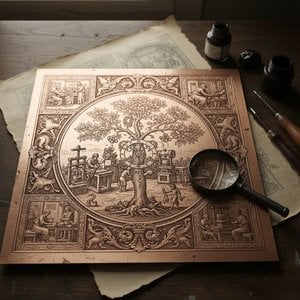
Explore the intricate world of etching and intaglio printmaking. Discover how masters use acid and metal to create profound textures and lines, from Romanticism to modern era, through an expert lens of art history and technical mastery.

 設置イメージを確認
 送る
送る シェア
シェア
 詳細情報
詳細情報 ガイドを表示

 画像をダウンロード
 似ている作品
 X線調査
X線調査 スライドショー
 統計情報
統計情報


 続きを読む
続きを読む









 ガラスオプションは、110cm未満のサイズでのみご利用いただけます。


