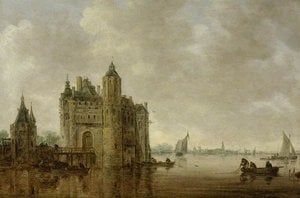
66.0 x 97.0 cm
当社のアーティストが、お客様のご希望のサイズと額縁に合わせて、キャンバスに手描きで制作する油彩画です。 ( プリント版に切り替え デジタル画像販売へ切り替え)
作品のオリジナル比率に合わせた、当店の規定サイズからお選びください。

特定のフレームやスペースに合わせて、ご希望のサイズをご入力いただけます。選択されたサイズが元の画像の比率と異なる場合、アートワークをトリミングするか、手描きで要素を追加して絵画を拡張いたします。デジタルモックアップ を制作し、制作開始前にご確認(承認)をいただきます。
画面上のプレビューは、実際のトリミングや拡張を正確に反映しているものではありません。最終的な構図は、モックアップによってのみ正確にご確認いただけます。
カスタムサイズもご利用いただけますが、元の比率を維持するためには、あらかじめ用意されたリストからサイズを選択することをお勧めいたします。

River Landscape
複製画のサイズ

In the grand, salt-sprayed tapestry of the Dutch Golden Age, certain names shine with a brilliance that obscures the subtle, masterful strokes of others. Jacobus Storck (1641–1692) is such a figure—a painter whose legacy, while occasionally overshadowed by his more famous brother Abraham, remains an essential chronicle of seventeenth-century maritime life. Born in the bustling heart of Amsterdam, Storck was immersed from birth in an environment where the rhythm of the tides and the commerce of the sea dictated the pulse of the nation. His artistic lineage was one of profound nautical significance; as the son of the accomplished marine painter Johannes Sturckenburgh, he was raised within a tradition that viewed the sea not merely as a backdrop, but as a living, breathing protagonist in the story of Dutch prosperity.
The development of Storck’s artistry was deeply rooted in this familial apprenticeship. Growing up amidst the artistic milieu of his father’s studio, he honed a remarkable ability to capture the ephemeral qualities of the maritime atmosphere. He possessed a rare sensitivity to the way light dances upon turbulent waters and how heavy, low-hanging clouds cast dramatic shadows across a harbor. His early training allowed him to master the technical complexities of marine painting—specifically the challenge of rendering movement, from the rhythmic swell of the waves to the sudden, violent spray of a breaking crest. This commitment to naturalistic observation ensured that his works were more than mere depictions; they were immersive experiences that transported the viewer to the very docks of Haarlem and Rotterdam.
Storck’s technical prowess is most evident in his sophisticated use of chiaroscuro, the dramatic interplay of light and shadow. Drawing inspiration from the monumental techniques perfected by masters like Rembrandt and Caravaggio, he utilized deep shadows to create depth and a sense of impending drama within his compositions. This was particularly effective in his depictions of harbor scenes, where the dark, weathered hulls of ships would emerge from the gloom, illuminated by sudden shafts of sunlight. His brushwork displayed an unwavering dedication to texture; one can almost feel the rough, salt-encrusted grain of a ship's wooden planks or the slick, glistening surface of a receding tide.
His oeuvre is defined by several notable achievements that showcase his versatility as a landscape and marine artist:
While biographical records regarding his personal life remain somewhat sparse, the historical significance of Jacobus Storck is undeniable. His work serves as a vital visual record of the Dutch Republic at the height of its maritime power. Through his eyes, we witness the bustling commercial vitality of the era's great ports and the technical sophistication of the vessels that drove global trade. Though some scholars have historically debated the attribution of certain works signed "ja storck"—often weighing them between Jacobus and his brother Abraham—the intrinsic quality of his hand is unmistakable.
Ultimately, Storck’s contribution to art history lies in his ability to act as a silent witness to a bygone era. He did not merely paint ships; he painted the very spirit of a nation defined by its relationship with the sea. His paintings remain enduring windows into the seventeenth century, preserving the light, the motion, and the monumental ambition of the Dutch Golden Age for all eternity.

1641 - 1692 , Netherlands


 プレビュー
プレビュー
 シェアする
シェアする シェアする
シェアする
 詳細を見る
詳細を見る ガイド
ガイド

 ダウンロード
 似ている作品
 X線調査
X線調査 スライドショー
 統計情報
統計情報 詳細を見る
詳細を見る






































 ガラスオプションは、110cm未満のサイズでのみご利用いただけます。