スピーディーな制作と多彩な仕上げオプションが魅力の、ミュージアムクオリティなジークレー・キャンバスプリント。 ( 手描き複製画を注文する デジタル画像販売へ切り替え)





























作品のオリジナル比率に合わせた、当店の規定サイズからお選びください。

額縁や壁のスペースに合わせて、ご希望の幅と高さを入力してください。プリントはカットすることは可能ですが、元の画像より大きくすることはできないため、異なる比率のサイズを選択された場合は、画像の一部が欠けることになります。印刷を開始する前に、内容を確認していただくためのデジタルモックアップをお送りいたします。このページに表示されている画像は、実際のカット後の状態を示すものではありません。実際の仕上がりはモックアップにてご確認ください。
The Third-class Carriage
複製画サイズ一覧
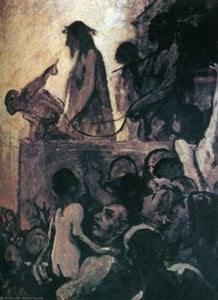
Honoré Daumier's 1865 painting, “The Third-Class Carriage,” is more than a simple depiction of a train journey; it’s a poignant snapshot of mid-19th century French society, rendered with the artist’s characteristic blend of realism and social commentary. Measuring 65 x 90 cm, this black and white composition immediately draws the viewer into the cramped confines of a third-class railway car, capturing a moment of everyday life that speaks volumes about class divisions and the burgeoning urbanization of France during the Second Empire.
Daumier’s style is immediately recognizable through his meticulous draftsmanship and a deliberate avoidance of idealized beauty. He was deeply influenced by artists like Rubens, particularly in his use of dramatic lighting (chiaroscuro) to sculpt forms and create mood. In “The Third-Class Carriage,” this influence is evident in the strong contrasts between light and shadow, which highlight the textures of the benches, luggage, and clothing. The artist’s technique relies on precise lines and detailed observation, reflecting his commitment to capturing reality with unflinching honesty. His work was often characterized by a rough, almost sketch-like quality, contributing to its raw emotional impact.
Painted in 1865, “The Third-Class Carriage” reflects the significant social and political changes occurring in France during this period. The rapid growth of Paris and other industrial centers led to a massive influx of rural populations seeking work and opportunity – often finding themselves crammed into overcrowded, poorly maintained train cars like the one depicted here. Daumier’s work aligns with the broader trend of Realist art, which sought to depict everyday life without romanticizing or idealizing it. The painting subtly critiques the social inequalities inherent in this transition, offering a glimpse into the lives of those marginalized by industrialization and urbanization.
Beyond its documentary value, “The Third-Class Carriage” possesses a powerful symbolic resonance. The presence of a woman holding a baby amidst the bustling crowd evokes themes of family, vulnerability, and the challenges faced by working-class families. The scattered luggage represents not just possessions but also dreams, aspirations, and the burdens carried on journeys – both literal and metaphorical. The overall mood is one of quiet observation, inviting viewers to contemplate the lives of these anonymous individuals and consider their place within a rapidly changing society. This artwork’s enduring appeal lies in its ability to capture a fleeting moment of human experience with remarkable sensitivity and artistic skill.
「The Third-class Carriage」の作者であるオノレ・ドーミエには、他にオノレ=ヴィクトリン・ドーミエ, Honoré-Victorin Daumierといった名称でも記録されています。
オノレ・ドーミエ作「The Third-class Carriage」の色使いは、Strong Color Unityな調和を見せています。ここでの「調和」とは、色彩同士が互いにどのように響き合っているかを表しています。
オノレ・ドーミエ作「The Third-class Carriage」には、解説資料ページをご用意しています。これは、学生や教室での学習用に設計された、印刷可能な作品解説シートです。

1808 - 1879 , フランス

Explore the exquisite world of Victorian Realism. Discover how 19th-century masters captured unparalleled detail and emotion through oil painting, and learn to curate these timeless masterpieces for your luxury interior collection.
 設置イメージを表示
 シェアする
シェアする シェアする
シェアする
 詳細を見る
詳細を見る ガイドを表示

 ダウンロード
 似ている作品
 X線調査
X線調査 スライドショーを表示
 Q&A
Q&A
 統計情報
統計情報


 詳細を表示
詳細を表示









 ガラスオプションは、110cm未満のサイズでのみご利用いただけます。