x


作品のオリジナル比率に合わせた、当店の規定サイズからお選びください。

特定のフレームやスペースに合わせて、ご希望のサイズをご入力いただけます。選択されたサイズが元の画像の比率と異なる場合、アートワークをトリミングするか、手描きで要素を追加して絵画を拡張いたします。デジタルモックアップ を制作し、制作開始前にご確認(承認)をいただきます。
画面上のプレビューは、実際のトリミングや拡張を正確に反映しているものではありません。最終的な構図は、モックアップによってのみ正確にご確認いただけます。
カスタムサイズもご利用いただけますが、元の比率を維持するためには、あらかじめ用意されたリストからサイズを選択することをお勧めいたします。

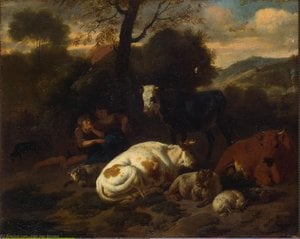
Midday Rest
複製画のサイズ

In the vast tapestry of late 19th-century art, few threads are as delicately woven as those left by Herman Hartwich. A painter who moved seamlessly between the rigorous academic traditions of Europe and the burgeoning light of the American landscape, Hartwich possessed a rare ability to capture the ephemeral. Born in 1853, his life was a journey of geographical and stylistic transitions, beginning with roots in Budapest and evolving through the prestigious studios of Munich and Paris before finding a profound spiritual home in the coastal reaches of the American Northeast. His work serves as a bridge between the structured realism of the German academies and the emotive, atmospheric freedom of Impressionism.
Hartwich’s artistic foundation was laid within the hallowed halls of the Academy of Fine Arts in Munich. It was here, between 1881 and 1885, that he encountered the transformative influence of masters such as Wilhelm Leibl. This period of intense study instilled in him a mastery of tonal painting—a technique that would become his signature. By focusing on the subtle gradations of light and shadow rather than harsh outlines, Hartwich learned to render the weight of the atmosphere itself. His time in Munich also brought him into contact with the burgeoning psychological depth found in the works of contemporaries like Edvard Munch, a connection that undoubtedly deepened the emotional resonance of his later landscapes.
The trajectory of Hartwich’s career was profoundly shaped by his engagement with the international avant-garde. His relocation to Paris in 1883 placed him at the very heart of the artistic revolution. Immersed in the vibrant, bohemian atmosphere of Montmartre, he absorbed the revolutionary principles of Claude Monet and Pierre-Auguste Renoir. From these masters, he adopted a new way of seeing: the pursuit of the fleeting moment, where color is not a static property but a living entity transformed by the sun’s movement. This Parisian era infused his German training with a luminous, Impressionistic vitality, allowing him to prioritize subjective perception over mere topographical accuracy.
As his style matured, Hartwich began to find his most enduring subject matter in the rugged, windswept beauty of Cape Cod. Returning to New York in 1894, he turned his gaze toward the American coastline, finding in its dunes and salt marshes a perfect canvas for his atmospheric experiments. His celebrated series of Cape Cod paintings, such as “Cape Cod, Sand Dune” (1894), showcases a masterful command of texture and light. In these works, the viewer can almost feel the coastal breeze and hear the rustle of the grasses. He did not merely paint the landscape; he painted the air that moved through it, using delicate, luminous brushstrokes to evoke the shimmering waters and the soft, shifting sands.
The significance of Herman Hartwich lies in his ability to synthesize disparate traditions into a singular, emotive voice. He was a painter of transitions—between Germany and America, between realism and impressionism, and between the physical world and the emotional landscape. His oeuvre remains a testament to the power of tonal painting to convey profound serenity and natural majesty. Through his meticulous rendering of light, he achieved a sense of timelessness that continues to captivate collectors and historians alike.
His contributions to the art world can be summarized through several key artistic pillars:

1853 - 1926


最新の美術ニュース、限定オファー、そしてインテリアのアイデアをいち早くお届けします。
お客様のプロジェクトについてお聞かせください。当社の美術専門家が、お客様に合わせた3つのパーソナライズされた芸術提案をご提供いたします。
あなたにぴったりの3作品を無料で厳選いたします


 プレビュー
プレビュー
 プリントを購入
 シェアする
シェアする シェアする
シェアする
 詳細を見る
詳細を見る

 ダウンロード
 似ている作品
 X線調査
X線調査 スライドショー
 詳細を見る
詳細を見る






































 ガラスオプションは、110cm未満のサイズでのみご利用いただけます。