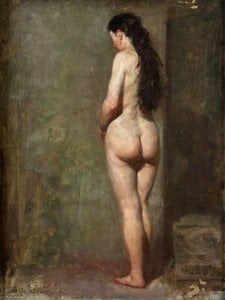
Academic Painting
 1906
1906 130.0 x 97.0 cm
オンラインプレビューをはるかに凌ぐ、高解像度で鮮明なデジタル画像をご購入いただけます。
各ファイルは、社内の専門家が高度なツールと熟練した手作業によるレタッチを駆使し、細心の注意を払って仕上げています。すべての画像において、卓越した鮮明度、正確な色彩再現性、そして繊細なディテールをお約束いたします。
最終ファイルは、プロフェッショナルな編集・印刷環境ですぐにご利用いただけるよう最適化された状態で、72時間以内にメールにてお届けいたします。これは、一流のデザインスタジオ、出版社、ギャラリーから信頼されているものと同等の品質です。
個人での鑑賞、印刷、クリエイティブなプロジェクトにご利用いただける高解像度ファイルをダウンロードできます。 ( プリント版に切り替え 手描きの複製画を注文する)
WahooArt.com を選ぶことは、単に画像を手に入れることではありません。プロの手によって精密に仕上げられ、満足保証が付いた高品質なデジタルアートワークを受け取ることを意味します。ご注文いただいた際に自動的に付随する内容は、以下の通りです:

ご注文から72時間以内に、高解像度のデジタル画像ファイルをメールでお送りいたします。お手元に届き次第、すぐにご利用いただけます。

お客様の作品は、高度なAI技術と専門家による手作業を組み合わせてプロフェッショナルに最適化されており、細部のディテール、鮮明さ、そして正確な色再現性を最大限に引き出しています。

ファイルを誤って削除したり、紛失してしまったりしましたか?ご安心ください。いつでも無料で再送いたします。

関税や手数料、配送料を気にすることなく、お気に入りのアートワークをすぐにお楽しみいただけます。デジタルダウンロードは常に免税です。

プロ仕様のツールとカラーマネジメント技術を用いることで、デジタル画像が元の色を最大限に忠実に再現することを保証いたします。

ご購入いただいたデジタル画像にご満足いただけない場合は、100日以内であれば、理由を問わず修正または100%の返金対応をさせていただきます。

ご満足いただけない場合は、デジタルファイルを受け取ってから100日以内であれば、理由を問わず全額返金いたします。

3枚購入で10%OFF、5枚購入で15%OFF、10枚以上のご購入で20%OFF。クリエイティブなプロジェクトやギャラリー、エージェンシーに最適です。

Wassily Wassilyevich Kandinsky, born December 4th (Old Style) 1866 in Moscow, Russia, and passing away on December 13th, 1944, in Neuilly-sur-Seine, France, stands as a monumental figure in the history of art. Often hailed as one of the earliest pioneers of pure abstraction, Kandinsky’s journey from a classically trained artist to a revolutionary innovator profoundly shaped the course of modern painting and continues to resonate with artists and viewers today. His life was marked by intellectual curiosity, spiritual seeking, and an unwavering commitment to exploring the expressive potential of color and form – a pursuit that ultimately led him to dismantle traditional representational art and forge a new visual language.
Kandinsky’s early years were steeped in cultural richness. Born into a family with roots tracing back to both Mongolia and Europe, he received an unusually broad education, studying law and economics alongside artistic pursuits. His travels throughout Russia, Venice, Rome, Florence, and the Caucasus instilled within him a deep appreciation for diverse cultures and aesthetics – experiences that would later inform his unique artistic vision. He began his formal art training at the Odessa Art School, followed by studies at the Moscow Imperial Academy of Arts, where he initially focused on traditional academic techniques. However, it was during this period that Kandinsky’s nascent interest in color theory and its psychological effects began to take root.
Kandinsky's artistic development wasn't a sudden shift but rather a gradual evolution. Initially influenced by the Symbolist movement, particularly the work of Edvard Munch, he experimented with expressive colors and evocative imagery in his early landscapes and portraits. His 1907 painting, *Mood*, exemplifies this period, utilizing vibrant hues to convey an emotional state rather than a literal depiction of a scene. However, it was through his encounter with Vincent van Gogh’s work that Kandinsky began to question the limitations of representational art. Van Gogh's bold brushstrokes and intense color palettes demonstrated the power of paint itself as a vehicle for expression – a concept that would become central to Kandinsky’s later artistic philosophy.
A pivotal moment in his artistic trajectory occurred during a trip to Munich in 1896, where he studied with Anton Ažbe, a pioneer of color theory and a proponent of “inner necessity” in art. This encounter introduced him to the burgeoning world of avant-garde artists and intellectuals, including Gabriele Münter, who would become his lifelong partner and collaborator. Kandinsky’s artistic explorations intensified during this period, as he experimented with various styles – from Impressionism to early Fauvism – while simultaneously developing his own distinct approach to color and form. The influence of music was also increasingly apparent in his work; he believed that art should evoke similar emotional responses as music, and sought to translate musical structures into visual forms.
In 1911, Kandinsky co-founded the *Blaue Reiter* (Blue Rider) group in Munich – a collective of artists who shared a commitment to exploring non-objective art. This movement brought together figures like Paul Klee, Franz Marc, and August Macke, fostering an environment of experimentation and intellectual exchange. The *Blaue Reiter* sought to move beyond the constraints of traditional representation, embracing color and form as independent expressive elements. Kandinsky’s 1913 painting, *Composition VII*, is a prime example of this period, showcasing his increasingly abstract approach – a swirling vortex of colors and geometric shapes that seem to vibrate with inner energy.
Crucially, Kandinsky articulated his theories about abstraction in his seminal 1911 treatise, *Concerning the Spiritual in Art*. He argued that art should transcend mere imitation of the external world and instead tap into a realm of pure feeling and spiritual experience. He believed that color and form possessed their own inherent power to evoke emotions and communicate ideas directly to the viewer – bypassing the need for recognizable objects or narratives. This philosophical framework underpinned his artistic practice, guiding him toward increasingly abstract compositions.
Following the outbreak of World War I, Kandinsky relocated to Russia in 1914, where he served as the first director of the Museums of Painterly Culture. However, the rise of the Soviet regime and its emphasis on socialist realism ultimately clashed with his artistic vision. In 1922, he returned to Germany and joined the faculty of the Bauhaus school, a revolutionary art and design institution that emphasized functionalism and experimentation. His influence at the Bauhaus was significant, particularly in his teachings on color theory.
After the Nazis closed the Bauhaus in 1933, Kandinsky moved to France, where he remained until his death in 1944. Despite facing numerous challenges throughout his life, Kandinsky continued to produce groundbreaking work, exploring new techniques and pushing the boundaries of abstraction. His later paintings, such as *Composition VIII* (1936), are characterized by their dynamic compositions and vibrant color palettes – a testament to his enduring artistic vision. Wassily Kandinsky’s legacy extends far beyond his individual works; he is widely considered one of the founding fathers of abstract art, profoundly influencing generations of artists who followed in his footsteps. His insistence on the expressive power of color and form continues to inspire artists and viewers alike, reminding us that art can transcend the limitations of representation and speak directly to the soul.

1866 - 1912 , Japan

 設置イメージを確認
 送る
送る シェア
シェア
 詳細情報
詳細情報 ガイドを表示

 画像をダウンロード
 似ている作品
 X線調査
X線調査 スライドショー
 統計情報
統計情報 続きを読む
続きを読む