


 Ink On PaperExpressionism
 1922Modern
 26.0 x 34.0 cm
 Arnold Schönberg Center




























作品のオリジナル比率に合わせた、当店の規定サイズからお選びください。

特定のフレームやスペースに合わせて、ご希望のサイズをご入力いただけます。選択されたサイズが元の画像の比率と異なる場合、アートワークをトリミングするか、手描きで要素を追加して絵画を拡張いたします。デジタルモックアップ を制作し、制作開始前にご確認(承認)をいただきます。
画面上のプレビューは、実際のトリミングや拡張を正確に反映しているものではありません。最終的な構図は、モックアップによってのみ正確にご確認いただけます。
カスタムサイズもご利用いただけますが、元の比率を維持するためには、あらかじめ用意されたリストからサイズを選択することをお勧めいたします。

Erhebt euch, Freunde, op. 2/4
複製画のサイズ
In the delicate, aged fibers of the musical score Erhebt euch, Freunde, op. 2/4, one finds more than mere notation; one encounters a profound dialogue between two titans of twentieth-century modernism. Created in the winter of 1922, this piece serves as a poignant intersection where the lyrical text of Klabund meets the burgeoning musical language of Hanns Eisler. The visual presentation of the score—rendered on paper that has mellowed into a warm, nostalgic tan—evokes the atmosphere of a lost era of European intellectualism. As the eye wanders across the dense, vertical arrangement of black ink, it encounters a rhythmic landscape of clefs, rests, and notes that pulse with the quiet intensity of a composer finding his voice amidst the political and social tremors of post-war Germany.
The aesthetic of this work is defined by its structural elegance and the raw, tactile quality of its medium. The composition is dominated by the meticulous geometry of the musical staff, where every horizontal line acts as a stage for the circular dance of notes. There is a striking contrast between the stark, black precision of the engraving and the organic, weathered texture of the parchment. This interplay creates a sense of depth that belies its two-dimensional nature, inviting the viewer to feel the weight of history held within each measure. The lighting, soft and diffused as if captured in a quiet study, highlights the slight wrinkles and imperfections of the aged paper, lending the piece an authentic, archival soul that resonates with those who appreciate the beauty of antiquity.
To understand this work is to understand the tension between tradition and revolution. During this period, the musical world was grappling with the radical shifts introduced by figures like Arnold Schönberg, whom Eisler famously defended as a true master rather than a mere destroyer of convention. The score itself embodies this duality; while it utilizes the established language of musical notation, the very existence of such a piece in 1922 speaks to a period of intense creative reconfiguration. The symbols on the page are not merely instructions for performance but are artifacts of a movement seeking to create a new material for music—one that could achieve the unity of the classics while embracing the complexities of the modern psyche.
For the discerning collector or interior designer, Erhebt euch, Freunde offers a sophisticated focal point that transcends simple decoration. It brings an air of academic prestige and contemplative calm to any space, whether it be a private library, a contemporary studio, or a refined living area. The piece does not demand attention through loud colors or aggressive forms; instead, it commands respect through its subtle complexity and historical gravity. As a high-quality reproduction, it serves as a window into the heart of the twentieth century, offering an emotional connection to the era of profound musical evolution and providing a timeless element of intellectual elegance to any curated environment.


1898 - 1962 , Germany
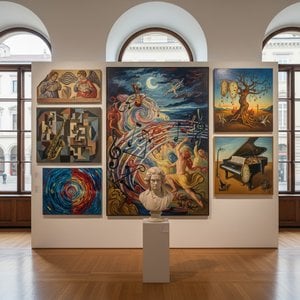
Explore the fascinating history of music's visual representation in art! From ancient symbolism to modern abstraction, discover how artists have captured sound and emotion on canvas. Expert insights & stunning examples.

Explore the captivating world of Mikalojus Konstantinas Čiurlionis, a pioneer of abstract art. Discover his unique blend of music and painting, spiritual themes, and lasting influence on Lithuanian culture. Learn more at WahooArt.
ヴェネツィア・ビエンナーレの至宝25選。印象派から現代アートまで、名画の背景にある物語と芸術家の情熱を紐解きます。WahooArtで、キャンバスアートや油絵複製をお楽しみください。今すぐコレクションをご覧ください。


 プレビュー
プレビュー
 プリントを購入
 シェアする
シェアする シェアする
シェアする
 詳細を見る
詳細を見る

 ダウンロード
 似ている作品
 X線調査
X線調査 スライドショー
 詳細を見る
詳細を見る









 ガラスオプションは、110cm未満のサイズでのみご利用いただけます。


