

 Macchiaioli
 1879
1879 55.0 x 89.0 cm
 Museo d’Arte Moderna Ca’ Pesaro
当社のアーティストが、お客様のご希望のサイズと額縁に合わせて、キャンバスに手描きで制作する油彩画です。 ( Switch to Print Switch to Digital Image)
作品のオリジナル比率に合わせた、当店の規定サイズからお選びください。

特定のフレームやスペースに合わせて、ご希望のサイズをご入力いただけます。選択されたサイズが元の画像の比率と異なる場合、アートワークをトリミングするか、手描きで要素を追加して絵画を拡張いたします。デジタルモックアップ を制作し、制作開始前にご確認(承認)をいただきます。
画面上のプレビューは、実際のトリミングや拡張を正確に反映しているものではありません。最終的な構図は、モックアップによってのみ正確にご確認いただけます。
カスタムサイズもご利用いただけますが、元の比率を維持するためには、あらかじめ用意されたリストからサイズを選択することをお勧めいたします。

Summer
複製画のサイズ

Born in the heart of Venice on September 13, 1842, Guglielmo Ciardi emerged from a world shaped by both Austrian administration and Italian artistic tradition. As the son of an official of the Austrian government, his early life was rooted in the structured elegance of Venice, yet his soul was destined for the untamed beauty of the natural world. His formal education at the Venice Academy of Fine Arts served as the crucible for his talent, where he studied the rigorous discipline of perspective under Federico Moja and the evocative possibilities of landscape and seascape with Domenico Bresolin. This foundational training provided him with a technical mastery that would later allow him to transcend academic rigidity in favor of a more spontaneous, atmospheric realism.
The trajectory of Ciardi’s career was profoundly altered by his movement through Italy's most vibrant artistic centers. In 1868, his journey led him to Florence, a pivotal moment that brought him into the orbit of the Macchiaioli movement. Through friendships with luminaries such as Giovanni Costa, Ciardi began to embrace a new aesthetic language—one that prioritized the "macchia," or the expressive patch of color and light, over the polished, idealized forms of traditional academicism. This encounter instilled in him a lifelong devotion to direct observation and the plein air technique, allowing him to capture the fleeting, ephemeral qualities of light as it dances across the water and settles upon the earth.
Upon returning to Venice in 1869, Ciardi established himself not merely as a painter of scenery, but as a poet of the Venetian atmosphere. His work became an intimate dialogue with the lagoon, capturing the shimmering, translucent waters that reflect the pastel transitions of dawn and dusk. He possessed a rare ability to render the maritime environment with such clarity and vibrancy that the viewer can almost feel the salt spray and the humid warmth of the Italian summer. Beyond the canals of Venice, his gaze wandered into the lush, rolling countryside of Treviso and the rugged landscapes of Lombardy, finding profound beauty in the rustic rhythms of rural life.
Ciardi’s canvases often serve as windows into a vanishing era of pastoral tranquility. In masterpieces such as Summer (1879) and Harvest (1883), he depicts the dignity of labor and the symbiotic relationship between humanity and the land. His brushwork, while precise, carries an emotional weight that celebrates the textures of wheat fields, the heavy baskets of a harvest, and the soft, sun-drenched skin of workers in the field. Through his use of warm palettes and soft, blended strokes, he evokes a sense of serene contemplation, inviting the observer to find stillness within the movement of nature.
The historical significance of Guglielmo Ciardi lies in his ability to bridge the gap between the disciplined traditions of the 19th-century Academy and the burgeoning modernism of the late century. He did not merely replicate what he saw; he interpreted the emotional resonance of the landscape through a lens of luminous realism. His legacy is further intertwined with a rich familial tapestry of art, as his children, Emma and Beppe Ciardi, also rose to prominence as notable painters, carrying forward the Venetian tradition of light and elegance.
Today, Ciardi remains a cornerstone of Italian landscape painting. His works are celebrated for their:
As we look upon his seascapes and sunlit fields, we encounter more than just paint on canvas; we encounter a profound reverence for the natural world that continues to resonate with the modern soul.

1842 - 1917
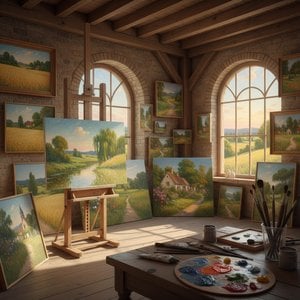
Discover the profound tranquility of rural art through an expert exploration of Impressionist landscapes. From pastoral scenes to textured oil masterpieces, learn how timeless nature-inspired artworks bring enduring elegance and serenity to sophisticated collectors.

Explore the profound beauty of village scene art. From Impressionist light to pastoral realism, discover how timeless landscapes capture nostalgia through expert artistry and historical depth. Perfect for collectors seeking evocative, museum-quality landscape inspirations.

Embark on a visual journey through Italy's most iconic landscapes and Renaissance masterpieces. Discover the profound beauty of classical art, from Venetian altarpieces to serene countryside vistas, curated for the discerning art enthusiast and collector.

Embark on a visual journey through history's most iconic landscapes. Discover the mastery of Impressionism and the sublime power of nature through our expert guide to classical landscape art, curated for the discerning collector and fine art enthusiast.

 プレビュー
プレビュー
 シェアする
シェアする シェアする
シェアする
 詳細を見る
詳細を見る

 ダウンロード
 似ている作品
 X線調査
X線調査 スライドショー
 Stats
Stats 詳細を見る
詳細を見る






































 ガラスオプションは、110cm未満のサイズでのみご利用いただけます。


