作品詳細説明
A Botanical Portrait: Unveiling Giuseppe Arcimboldo's "Spring"
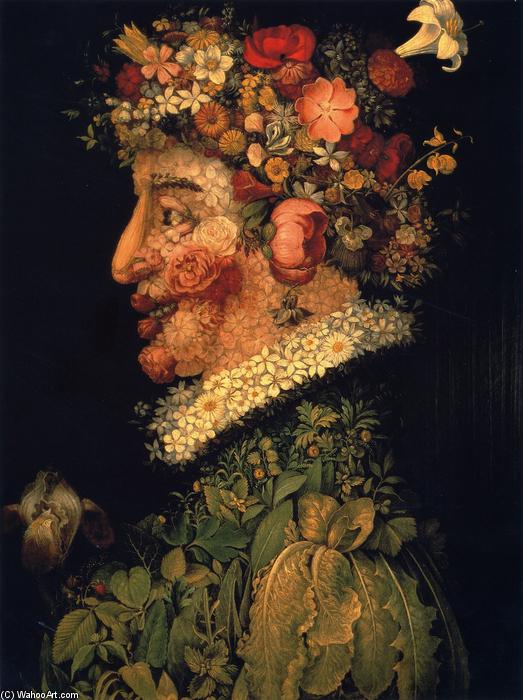
Step into a world where nature intertwines with human form in this captivating artwork, “Spring,” created by the ingenious Italian painter, Giuseppe Arcimboldo in 1563. This piece is far more than just a portrait; it’s a vibrant exploration of transformation and the enduring power of the natural world. The subject, almost entirely obscured by an elaborate arrangement of flowers, foliage, and fruits, presents a fascinating enigma. It's a visual riddle that invites viewers to contemplate the relationship between humanity and nature.
Mannerism and Artistic Technique
Arcimboldo’s “Spring” exemplifies the Mannerist style, a movement that emerged in 16th-century Italy as a reaction against the High Renaissance's emphasis on classical ideals and naturalism. Notice the elongated proportions of the figure, the dramatic lighting that highlights specific elements, and the overall sense of stylized elegance rather than strict realism. The artwork is skillfully rendered using oil painting techniques, evident in the visible brushstrokes and layered application of pigments which create depth and texture. The dark background serves to amplify the brilliance of the floral components, drawing the eye directly to the central figure’s botanical disguise.
Symbolism and Interpretation
Beyond its aesthetic appeal, “Spring” is rich in symbolic meaning. The abundance of flowers and fruits—typical springtime imagery—suggests themes of renewal, growth, and fertility. However, the obscured human form introduces a layer of complexity. It could be interpreted as nature’s dominance over humanity, or perhaps a meditation on the ephemeral quality of human existence compared to the enduring cycle of flora. The composition's asymmetry and unconventional arrangement further contribute to its enigmatic character, prompting viewers to consider multiple interpretations. The careful selection of each botanical element—the type of flower, fruit, or leaf—likely held specific symbolic significance within the context of Renaissance Neo-Platonism, though precise meanings remain open to scholarly debate.
Emotional Impact and Legacy
“Spring” evokes a powerful emotional response – one of intense beauty tempered by a slight sense of unease. The distortion of the human form, while visually striking, can be unsettling, prompting reflection on our place within the natural world. Arcimboldo’s innovative approach to portraiture challenged artistic conventions and captivated audiences during his time, particularly at the courts of Ferdinand I, Maximilian II, and Rudolf II. Today, “Spring” stands as a testament to Arcimboldo's unique genius and continues to inspire awe and intrigue in art lovers worldwide. It is a remarkable example of how art can transcend mere representation to become a profound exploration of life, nature, and the human condition.



 プレビュー
プレビュー
 手描きの絵画を購入
 シェアする
シェアする シェアする
シェアする
 詳細を見る
詳細を見る

 ダウンロード
 似ている作品
 X線調査
X線調査 スライドショー

 詳細を見る
詳細を見る






































 ガラスオプションは、110cm未満のサイズでのみご利用いただけます。








