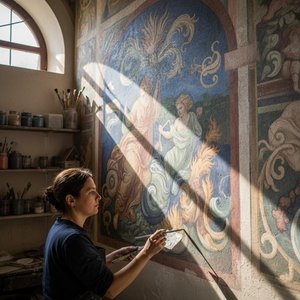
The Dawn of Renaissance Emotion: Giotto’s Last Judgment
Giotto di Bondone, born around 1267 in Florence, stands as an undeniable titan amongst medieval artists—a figure whose groundbreaking vision irrevocably altered the trajectory of European art history. His legacy isn't merely one of technical prowess; it’s a profound reimagining of how emotion and narrative could be conveyed within religious iconography, marking the decisive step away from stylized Byzantine formalism toward the burgeoning humanist ideals of the Renaissance. Legend recounts his humble beginnings as a shepherd boy, diligently sketching remarkably realistic sheep on rocks – an anecdote that speaks volumes about Giotto's innate talent: an unparalleled ability to capture the natural world with unprecedented realism and emotional depth. Recognized by Cimabue, Florence’s leading artist, Giotto’s apprenticeship cemented his mastery of Byzantine techniques while simultaneously nurturing a distinctive artistic voice.
- Style & Technique: Departing from the flattened perspectives and gold backgrounds characteristic of Byzantine art, Giotto pioneered a revolutionary approach—one that prioritized naturalism and spatial depth. He meticulously observed human anatomy and employed innovative fresco painting methods to achieve astonishing realism, particularly evident in his depiction of figures and drapery.
- Historical Context: Giotto’s work emerged during a period of significant intellectual ferment – the burgeoning Renaissance—fueled by rediscovered classical texts and a renewed interest in human experience. Yet, unlike many artists of his time who embraced humanist ideals, Giotto remained firmly rooted in Christian theology, channeling his artistic fervor into conveying profound spiritual truths.
A Dramatic Narrative: The Composition of Judgment Day
The Last Judgment, executed between 1305 and 1310 for the Cappella Scrovegni in Padua—a commission funded by Enrico Scrovegni—is arguably Giotto’s magnum opus. This monumental fresco cycle depicts Christ presiding over the apocalypse, surrounded by angels and demons – a scene brimming with visceral emotion and symbolic significance. The composition is meticulously crafted to guide the viewer's gaze across the vast expanse of heaven and hell, emphasizing the universality of human suffering and redemption. Notice the careful positioning of figures—each conveying distinct expressions of terror, grief, and hope—creating an immersive experience that transcends mere visual representation.
Symbolism & Emotional Resonance: Capturing Divine Horror
Giotto’s masterful use of color and light contributes significantly to the fresco's emotional impact. Pale blues and whites dominate the celestial realm, symbolizing purity and divine grace, while fiery reds and yellows illuminate the inferno below—representing damnation and torment. Giotto skillfully portrays human faces with unflinching honesty, capturing the agony of those awaiting judgment – a testament to his ability to convey psychological realism. The artist’s deliberate attention to detail—from the folds of drapery to the musculature of Christ’s body—underscores his commitment to portraying God's majesty and humanity's vulnerability.
Legacy & Influence: Shaping the Renaissance Aesthetic
Giotto’s Last Judgment irrevocably transformed artistic conventions, establishing a new standard for naturalism and emotional expression. His influence extended far beyond Padua, inspiring generations of artists who followed—including Pietro Lorenzetti and Maso di Banco—who embraced his pioneering techniques and stylistic innovations. Giotto's work stands as an enduring symbol of the Renaissance’s triumph over medieval formalism, cementing his place as one of history’s most transformative figures in art.



 プレビュー
プレビュー
 手描きの絵画を購入
 シェアする
シェアする シェアする
シェアする
 詳細を見る
詳細を見る

 ダウンロード
 似ている作品
 X線調査
X線調査 スライドショー
 詳細を見る
詳細を見る






































 ガラスオプションは、110cm未満のサイズでのみご利用いただけます。


![Scrovegni - Last Judgment (detail) [03] — ジョット, Proto-renaissance](/media/artworks/images/thumbnails/3a/8d/3a8d38fa6f054e659e9d04930988a1b3.jpg)


![聖フランチェス物語 - [07] - 承認の儀式 — ジョット, Gothic Art](/media/artworks/images/thumbnails/f2/6b/f26b6aca49074c0f913b81fe760f8b07.jpg)