作品詳細説明
A Fragmented Landscape of Emotion: Exploring Gerhard Richter’s Untitled (1968)
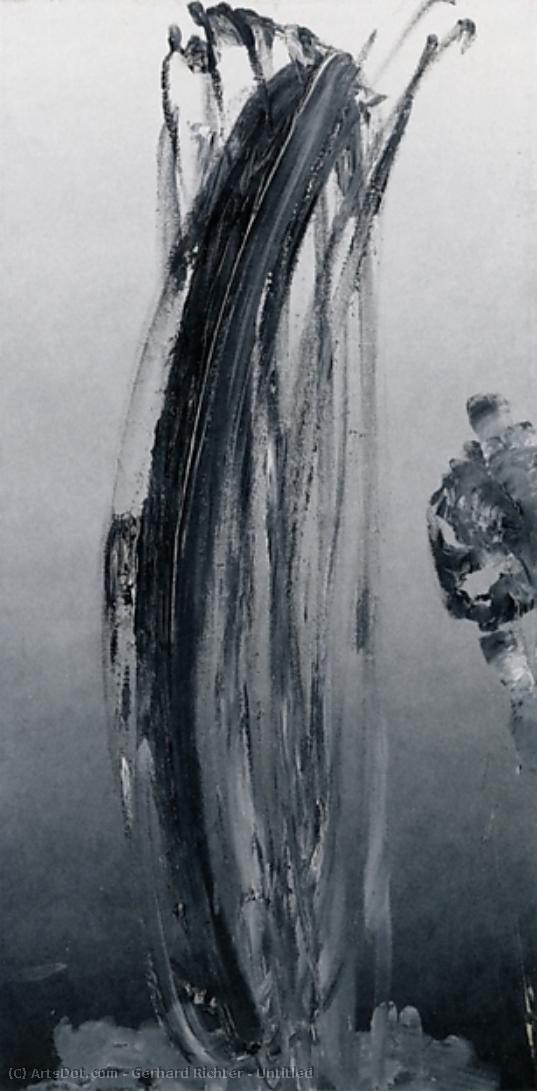
The painting “Untitled” by Gerhard Richter stands as a cornerstone of Abstract Expressionism, embodying the anxieties and uncertainties that characterized postwar Germany. Executed in 1968, it's not merely pigment on canvas; it’s a distillation of experience—a visual echo of Richter’s upbringing amidst political upheaval and displacement. Measuring 80 x 40 cm, this monumental piece immediately commands attention with its dominant palette of grey and black, punctuated by subtle tonal variations that convey an atmosphere of profound contemplation.
Composition and Technique: The Fluid Gesture
At first glance, the artwork presents a deceptively simple visual language. However, beneath the surface lies a complex interplay of formal elements. Richter employs a technique known as wet-on-wet—a method championed by artists like Pollock and Rothko—allowing for an astonishing fluidity within the paint itself. Thick impasto strokes dominate the canvas, creating a palpable textural richness that invites tactile engagement. These gestures aren’t precise or controlled; they are spontaneous expressions of feeling, mirroring the turbulent emotional landscape of Richter's formative years. The vertical form, reminiscent of a waterfall or ribbon, ascends towards a denser central area, subtly guiding the viewer’s gaze upwards—a deliberate choice reflecting perhaps an aspiration for stability amidst chaos.
Historical Context: Echoes of Division
The painting emerged during a period of significant political transformation in Germany. Richter's artistic sensibility was profoundly shaped by the trauma of World War II and the subsequent division of the nation into East and West blocs. This experience instilled within him a preoccupation with fragmentation—a visual representation of the fractured realities faced by individuals navigating turbulent times. The absence of recognizable imagery isn’t accidental; it serves to elevate the painting beyond specific narratives, focusing instead on universal themes of emotion and psychological exploration. Richter deliberately avoids offering easy answers or comforting illusions, mirroring the disillusionment prevalent in intellectual circles during the late 1960s.
Symbolism: Texture as Emotional Resonance
The pervasive grey and black hues contribute to the artwork’s symbolic weight. These colors are often associated with mourning, contemplation, and introspection—reflecting Richter's own internal struggles. More importantly, however, the textured surface embodies a deeper significance. The impasto technique isn’t merely decorative; it represents the artist’s attempt to capture the intangible essence of experience—the feeling of movement, energy, and vulnerability. Like ripples spreading outwards from a stone dropped into water, the brushstrokes convey an impression of dynamism and instability, mirroring the anxieties inherent in navigating a rapidly changing world.
Emotional Impact: A Silent Dialogue
Ultimately, “Untitled” transcends mere visual representation. It invites viewers to engage in a silent dialogue—to contemplate the complexities of emotion and memory without resorting to explicit symbolism. Richter’s masterful manipulation of color and texture achieves an extraordinary feat: conveying profound psychological depth through understated formalism. The painting lingers in the mind long after viewing, prompting reflection on themes of displacement, resilience, and the enduring power of artistic expression. It stands as a testament to Richter's ability to transform personal experience into universal aesthetic contemplation—a legacy that continues to inspire artists and collectors alike.



 プレビュー
プレビュー
 手描きの絵画を購入
 シェアする
シェアする シェアする
シェアする
 詳細を見る
詳細を見る

 ダウンロード
 似ている作品
 X線調査
X線調査 スライドショー


 詳細を見る
詳細を見る






































 ガラスオプションは、110cm未満のサイズでのみご利用いただけます。