
 Acrylic On CanvasWallArtNeo-Impressionism
 31.0 x 23.0 cm
迅速な制作と多彩な仕上げオプションを備えた、ミュージアムクオリティのジークレーまたはキャンバスプリント。 ( 手描きの絵画を購入 デジタル画像販売へ切り替え)





























作品のオリジナル比率に合わせた、当店の規定サイズからお選びください。

特定のフレームやスペースに合わせて、ご自身でサイズを指定することも可能です。選択されたサイズが元の画像の比率と一致しない場合、作品をトリミングするか、鏡面反射または単色での塗りつぶしによって画像を拡張いたします。制作を開始する前に、ご確認用のデジタルモックアップをお送りいたします。
画面上のプレビューには、実際のトリミングや拡張は反映されませんのでご注意ください。最終的な構図を正確に確認できるのは、モックアップのみとなります。
カスタムサイズも承っておりますが、元の比率を維持するためには、あらかじめ用意されたリストからサイズを選択することをお勧めいたします。

The black bow
複製画のサイズ
Georges Pierre Seurat (1859-1891), a name synonymous with innovation in late 19th-century art, stands as a monumental figure in the transition from Impressionism to Modern Art. His tragically brief life yielded an artistic legacy that fundamentally altered painting practice—specifically through his groundbreaking development of Pointillism, a technique rooted in scientific observation and driven by an unwavering desire for optical realism.
Born in Paris on December 2nd, 1859, Seurat’s formative years were marked by a privileged upbringing fostered by his father, Antoine Chrysostome Seurat—a former legal official who skillfully transitioned into property speculation. This familial stability afforded young Georges access to exceptional artistic education, propelling him towards mastering the foundational skills necessary for his future endeavors.
Before Seurat’s arrival on the art scene, Impressionists wrestled with capturing fleeting moments of light and color. However, Seurat approached this challenge with a radically different perspective—one informed by Henri Poincaré’s theories on optics. Recognizing that human perception is influenced by how our eyes combine colors, Seurat meticulously applied scientific principles to his artistic process.
Instead of blending pigments directly onto the canvas, Seurat employed tiny dots – or “points” – of pure color—typically juxtaposed in complementary hues—to create an illusion of luminosity and depth. This method, dubbed Pointillism by Roger Fry in 1906, demanded painstaking precision and unwavering attention to detail. It represented a decisive break from Impressionistic brushstrokes, prioritizing scientific accuracy over subjective interpretation.
"The Black Bow," created around 1882, exemplifies Seurat’s meticulous approach perfectly. The painting depicts a woman's face alongside a black bow—a seemingly simple subject rendered with extraordinary complexity. As documented in Google Arts & Culture (
The rough surface of the paper serves as a crucial element in conveying the painting’s atmosphere—a deliberate choice reflecting Seurat's belief that texture contributes significantly to the perception of color and form. The composition itself is carefully balanced, guiding the viewer’s gaze across the canvas with subtle directional cues.
Beyond its technical brilliance, “The Black Bow” speaks volumes about Seurat's artistic vision. It embodies his fascination with capturing the essence of modern life—a preoccupation evident in numerous other works exploring urban landscapes and social interactions. Like many Impressionist paintings, it seeks to evoke emotion through color and light—though Seurat achieves this goal not through blending hues but by orchestrating a dazzling interplay of complementary dots.
As showcased on WikiArt (


1859 - 1891 , フランス
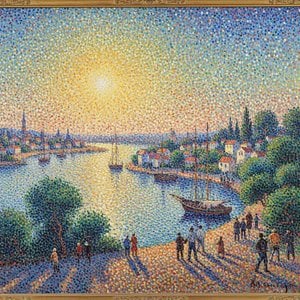
Embark on a sophisticated journey into the luminous world of Neo-Impressionism. Uncover the scientific brilliance of Pointillism, from Georges Seurat’s revolutionary color theory to the mesmerizing magic of the dot. An expert exploration for true art history enthusiasts.
Discover the mesmerizing world of Pointillism. Explore the revolutionary techniques of Georges Seurat, the science of optical color mixing, and the enduring legacy of Neo-Impressionism in this expert guide for classical art enthusiasts.

Explore the vibrant evolution of Post-Impressionism. From Seurat's revolutionary Pointillism to the emotional depth of masters, discover how this movement redefined modern art history through color, structure, and unparalleled creative expression.

Explore the scientific brilliance of Seurat and Signac. Discover how Pointillism revolutionized color through optical mixing and light, offering a profound look into the Neo-Impressionist movement for true art connoisseurs and collectors.


 プレビュー
プレビュー
 シェアする
シェアする シェアする
シェアする
 詳細を見る
詳細を見る

 ダウンロード
 似ている作品
 X線調査
X線調査 スライドショー
 統計情報
統計情報 詳細を見る
詳細を見る









 ガラスオプションは、110cm未満のサイズでのみご利用いただけます。


