ウェブ上のプレビューを遥かに凌駕する、印刷に最適なファイルをご提供します。当サイトで販売しているすべてのデジタル画像は、弊社のデータベース内にある高解像度のマスターデータ(通常、幅5,000〜15,000ピクセル)から作成されています。そのため、大判印刷や大胆なクロップ、細部まで緻密な再現も、安心してお楽しみいただけます。
当スタジオから送り出される画像は、すべて丁寧に加工されています。デジタルエキスパートが原画と照らし合わせて色調を精査し、必要に応じて補正を行った上で、プロ仕様のリタッチツールを用いて鮮明さと細部を向上させます。その際、アーティストの筆致やスタイルに忠実であることを常に追求しています。その結果、単なるスキャン画像にフィルターをかけたようなものではなく、まるで本物の絵画を見ているかのような仕上がりを実現しています。
仕上がりをご確認いただいてから完了となります。専門スタッフが、ご確認用の画像を72時間以内にメールでお送りいたします。もしご満足いただけない場合は、修正や改善のご要望を承るほか、品質が基準に満たない場合には返金も可能です。
出版社、デザインスタジオ、ギャラリー、そして印刷所から信頼される品質です。
個人での鑑賞、印刷、クリエイティブなプロジェクトにご利用いただける高解像度ファイルをダウンロードできます。 ( プリント版に切り替え 手描き複製画を注文する)
WahooArt.com を選ぶことは、単に画像を手に入れることではありません。プロの手によって精密に仕上げられ、満足保証が付いた高品質なデジタルアートワークを受け取ることを意味します。ご注文いただいた際に自動的に付随する内容は、以下の通りです:
ご注文から72時間以内に、高解像度のデジタル画像ファイルをメールでお送りいたします。お手元に届き次第、すぐにご利用いただけます。
お客様の作品は、高度なAI技術と専門家による手作業を組み合わせてプロフェッショナルに最適化されており、細部のディテール、鮮明さ、そして正確な色再現性を最大限に引き出しています。
ファイルを誤って削除したり、紛失してしまったりしましたか?ご安心ください。いつでも無料で再送いたします。
関税や手数料、配送料を気にすることなく、お気に入りのアートワークをすぐにお楽しみいただけます。デジタルダウンロードは常に免税です。
プロ仕様のツールとカラーマネジメント技術を用いることで、デジタル画像が元の色を最大限に忠実に再現することを保証いたします。
ご購入いただいたデジタル画像にご満足いただけない場合は、100日以内であれば、理由を問わず修正または100%の返金対応をさせていただきます。
ご満足いただけない場合は、デジタルファイルを受け取ってから100日以内であれば、理由を問わず全額返金いたします。
3枚購入で10%OFF、5枚購入で15%OFF、10枚以上のご購入で20%OFF。クリエイティブなプロジェクトやギャラリー、エージェンシーに最適です。
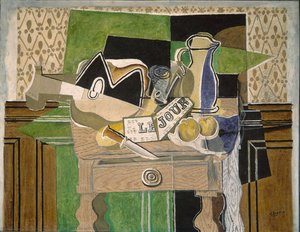
Georges Braque’s “Still Life: The Table,” painted in 1928, isn't merely a depiction of objects; it’s an invitation into a carefully constructed world of fragmented perception and deliberate ambiguity. Born in Argenteuil, France, in 1882, Braque’s artistic journey was deeply rooted in the practicalities of his family’s trade – house painting and decoration – which instilled within him a profound understanding of materials and form. This foundation, combined with rigorous academic training at the École des Beaux-Arts, provided him with an unusual blend of technical skill and a nascent desire to deconstruct traditional artistic conventions. “Still Life: The Table” embodies this spirit perfectly, representing a pivotal moment in Braque’s exploration of Cubism and his fascination with how we perceive reality.
The painting emerged during a period of intense experimentation within the Parisian art scene – a time when artists were actively dismantling established notions of space, perspective, and representation. Influenced by Paul Cézanne's emphasis on geometric forms and multiple viewpoints, Braque began to explore ways to capture the essence of an object not through a single, fixed image, but through a series of intersecting planes and angles. This approach, central to Cubism, sought to convey the totality of an object’s appearance – its various facets and perspectives – simultaneously on a two-dimensional surface.
The painting's visual impact is immediately striking due to its carefully orchestrated palette. Braque employs a restrained range of muted fawn browns, creams, whites, greens, grays, and blacks – colors that evoke a sense of quiet contemplation and understated elegance. These tones are not applied with broad strokes but rather in precisely delineated areas, creating the illusion of flat planes stacked upon one another. This technique, characteristic of Cubism, contributes to the painting’s fragmented appearance, as if the objects themselves have been broken down into their constituent parts and reassembled in a new, unconventional arrangement.
The forms within the still life are equally intriguing. The musical instrument – likely a lute – sits alongside tableware, fruit, and various domestic items, all rendered with simplified geometric shapes. Outlines are sharply defined, creating a sense of artificiality and emphasizing the constructed nature of the composition. Notice how Braque doesn’t attempt to realistically portray these objects; instead, he presents them as abstracted elements within a larger, more conceptual framework. The use of black outlines further reinforces this effect, lending a slightly two-dimensional quality to the scene.
Beyond its formal qualities, “Still Life: The Table” is rich in symbolic potential. The arrangement itself – a collection of seemingly random objects gathered on a tabletop – can be interpreted as a meditation on domesticity, leisure, and the fleeting nature of time. The presence of musical instruments suggests themes of creativity, harmony, and perhaps even melancholy. The scattered fruit hints at abundance and decay, while the rolled-up sheet music evokes memories and forgotten melodies.
Furthermore, the painting’s rough surface – scratched and uneven – adds to its emotional resonance. It feels as though the canvas itself is bearing witness to a process of creation, revealing the artist's hand and the imperfections inherent in any artistic endeavor. This tactile quality invites us to engage with the work on a deeper level, sensing the energy and intention that went into its making. The signed and dated inscription – “G Braque 28” – serves as a quiet testament to this moment in time, anchoring the painting within its historical context.
“Still Life: The Table” stands as a quintessential example of Braque’s pioneering work in Cubism. It exemplifies his ability to transform familiar objects into enigmatic symbols and to challenge traditional notions of representation. The painting's influence extends far beyond the confines of the 1920s, continuing to inspire artists and designers today. Reproductions of this captivating artwork offer a unique opportunity to experience Braque’s innovative vision firsthand, bringing a touch of fragmented reality into any space.
ジョルジュ・ブラクエ作「Still Life: The Table」の関連作品ページでは、関連する作品をご紹介しています。
「Still Life: The Table」はReflectiveに最適で、Living Roomへの飾るのがおすすめです。
「Still Life: The Table」のCubism様式には、Reflectiveな感情が添えられています。


1882 - 1963 , フランス
 設置イメージを表示
 シェアする
シェアする シェアする
シェアする
 詳細を見る
詳細を見る ガイドを表示

 ダウンロード
 似ている作品
 X線調査
X線調査 スライドショーを表示
 Q&A
Q&A
 統計情報
統計情報

 詳細を表示
詳細を表示