

このページに掲載されている作品は著作権法によって保護されており、当社の許可なく同一の複製物を制作または販売することは法律で禁じられています。この保護は、以下のような国際条約に基づき執行されます。 ベルヌ条約 および、以下の条項に定められたものを含む各国の法律により、 米国著作権法 第17編。
この手法は、著作権で保護された作品の複製や複写を伴わないため、著作権法に完全に準拠しています。これは単なる模倣ではなく、創造的な再解釈です。元の作品からインスピレーションを受けつつも、それとは異なる、全く新しい絵画を生み出すものです。
スピーディーな制作と多彩な仕上げオプションが魅力の、ミュージアムクオリティなジークレー・キャンバスプリント。 ( 手描きの複製画を注文する デジタル画像販売へ切り替え)





























作品のオリジナル比率に合わせた、当店の規定サイズからお選びください。

額縁や壁のスペースに合わせて、ご希望の幅と高さを入力してください。プリントはカットすることは可能ですが、元の画像より大きくすることはできないため、異なる比率のサイズを選択された場合は、画像の一部が欠けることになります。印刷を開始する前に、内容を確認していただくためのデジタルモックアップをお送りいたします。このページに表示されている画像は、実際のカット後の状態を示すものではありません。実際の仕上がりはモックアップにてご確認ください。
Glass and Pear
複製画サイズ一覧
Georges Braque's "Glass and Pear," a pivotal work from the early years of Cubism, isn’t merely a depiction of inanimate objects; it’s an invitation to reconsider our very perception of reality. Painted around 1912, this piece embodies the radical shift in artistic thought occurring at the time – a move away from traditional representation towards a fragmented and multi-faceted exploration of form and space. The artwork immediately commands attention with its deliberate disruption of conventional perspective; the piano and chair are not presented as solid, unified entities but rather as a series of interlocking geometric planes, each rendered in muted greens, yellows, browns, and whites. These colors, applied with a smooth yet subtly textured surface – likely achieved through careful layering of oil paint – create an atmosphere of quiet contemplation, contrasting sharply with the dynamism suggested by the fractured forms.
Braque’s approach here is deeply rooted in the principles of Cubism, a movement he co-founded with Pablo Picasso. Rather than striving for a single, fixed viewpoint, Braque sought to capture an object from multiple perspectives simultaneously, as if dissecting it and reassembling it on the canvas. This technique, often referred to as “analytical cubism,” is brilliantly demonstrated in "Glass and Pear." The piano’s keys are broken down into sharp angles, while the chair's back appears to shift and morph, suggesting both stability and instability at once. The absence of strong shadows reinforces this sense of spatial ambiguity; the lighting is diffuse, lending an almost dreamlike quality to the scene. It’s a deliberate rejection of illusionism, prioritizing instead the intellectual engagement with the subject matter.
“Glass and Pear” sits comfortably within the broader context of early 20th-century art. Influenced by Paul Cézanne’s emphasis on geometric forms and his exploration of multiple viewpoints, Braque pushed these ideas to their logical conclusion. The work also reflects a growing interest in industrial materials and the changing urban landscape – the piano, a symbol of domesticity and refinement, is presented with an almost mechanical precision. The chair, representing repose and comfort, offers a counterpoint, suggesting a tension between order and chaos. While overtly symbolic elements are subtle, the arrangement invites interpretation; one might see in the fragmented forms a meditation on the complexities of modern life – a world increasingly defined by rapid change and technological advancement.
Braque’s “Glass and Pear” is more than just a still life; it's a foundational work in the development of Cubism, demonstrating the movement’s core tenets of fragmentation, multiple perspectives, and the deconstruction of traditional artistic conventions. The piece showcases Braque’s mastery of technique – his ability to build up form through layered paint application while maintaining a sense of visual coherence. It's a testament to his pioneering spirit and his willingness to challenge established norms. Today, reproductions of this iconic artwork offer a unique opportunity to experience the intellectual rigor and emotional depth of one of modern art’s most influential figures. Consider adding a high-quality reproduction to your collection – a window into the heart of artistic innovation.
ジョルジュ・ブラクエ作「Glass and Pear」は、彩度Balanced Softで記録されています。
ジョルジュ・ブラクエ作「Glass and Pear」には、Largeのレプリカをおすすめします。比率を維持したまま、サイズを調整することが可能です。
ジョルジュ・ブラクエ作「Glass and Pear」は、Neutralsなカラーパレットを使用しています。この配色が、作品全体の色彩的特徴を象徴しています。

1882 - 1963 , フランス
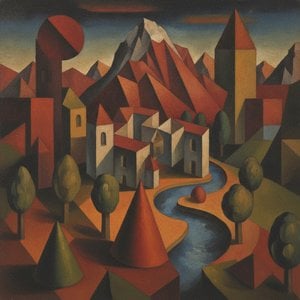
Explore the profound evolution of Cubist landscapes. Discover how masters like Braque and Picasso redefined perspective through geometric mastery, transforming nature into an intellectual mosaic of form and light for the discerning modern art collector.

Explore the profound evolution of Cubist still life, from Cézanne's structural foundations to the fragmented brilliance of Braque and Léger. Discover how geometric abstraction redefined reality through a sophisticated lens of form, color, and modern artistic mastery.

Explore the profound depth of Cubist Expression. From the deconstructed forms of Picasso to Braque’s geometric mastery, discover how shattering reality through abstraction redefined modern art and continues to inspire sophisticated collectors worldwide.

Explore the profound spiritual depth of geometric abstraction. From Malevich's Suprematism to modern masters, our expert guide reveals how pure form and color command presence in fine art collections.
 設置イメージを確認
 送る
送る シェア
シェア
 詳細情報
詳細情報 ガイドを表示

 画像をダウンロード
 似ている作品
 X線調査
X線調査 スライドショー
 Q&A
Q&A 統計情報
統計情報

 続きを読む
続きを読む









 ガラスオプションは、110cm未満のサイズでのみご利用いただけます。


